
When it matters: Claimed at sale. Everything that makes it available was fixed when the shares were issued.
Does this fit you?
- You are a founder, early employee or early investor holding shares issued directly by a C corporation.
- Your company was small when the shares were issued, by a test measured on its assets at that moment.
- Your horizon is long — the holding period runs to years, not months.
What it could be worth
Gain on qualifying shares, held for long enough, can be excluded from federal income tax up to a ceiling measured against the amount invested. Where it applies it is one of the largest provisions an owner will meet.
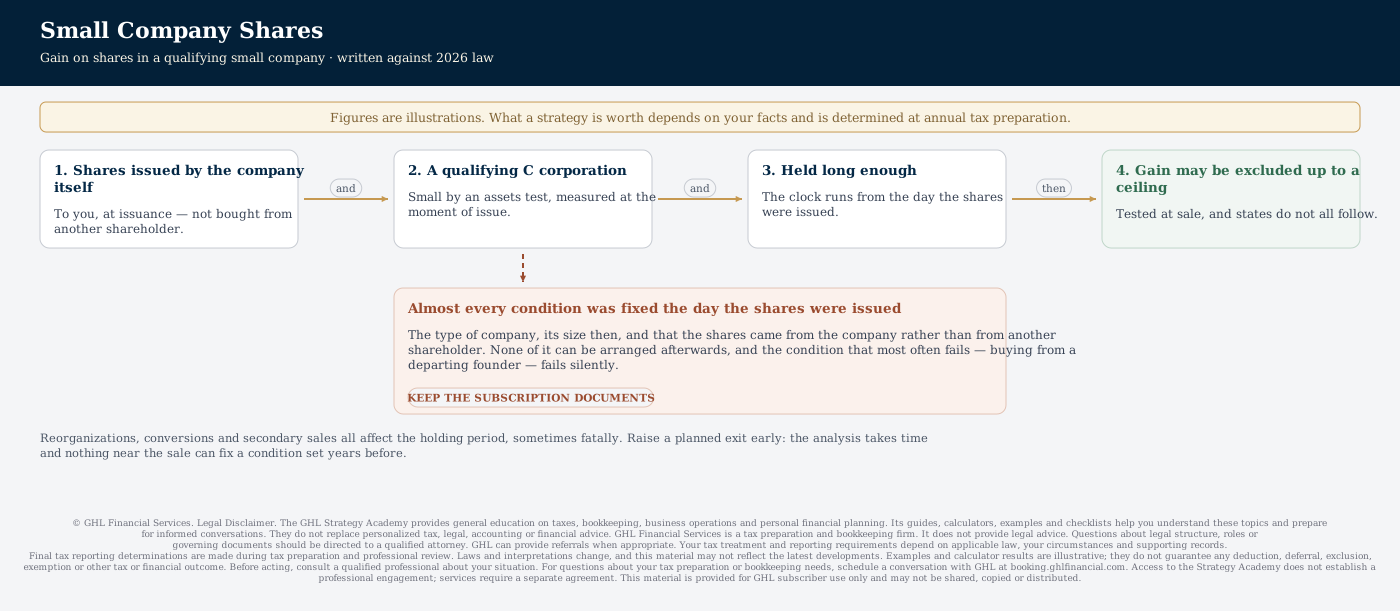
It is also one of the most conditional. Almost every condition is decided by facts at the time the shares were issued — the type of company, its size then, and that the shares came from the company rather than from another shareholder. None of those can be arranged afterwards.
| Ceiling on the exclusion, per company | the greater of ten million dollars (fifteen million for shares acquired after July 4, 2025) or ten times the amount invested |
|---|---|
| Holding period, shares acquired on or before July 4, 2025 | more than five years |
| Holding period, shares acquired after July 4, 2025 | 50% of the gain excluded at three years, 75% at four, 100% at five or more |
| Company's gross assets when the shares were issued | no more than fifty million dollars, or seventy-five million for shares issued after July 4, 2025 |
| Federal effect if fully excluded, at 23.8% | ≈ $2,380,000 |
Figures from 26 U.S.C. §1202 as amended by Public Law 119-21 §70431, enacted July 4, 2025. Shares acquired on or before that date stay under the earlier figures; the newer ceiling and assets limit are adjusted for inflation for tax years beginning after 2026. The full exclusion for older shares applies to shares acquired after September 27, 2010. Every condition is tested at sale, and states do not all follow the federal treatment.
How it works
The shares must have been acquired directly from the company when they were issued, not bought from another shareholder. This is the condition that most often fails, and it fails silently.
The company has to be a C corporation carrying on a qualifying business. Several sectors are excluded, including most professional services.
The size test looks at the company's gross assets at the time the shares were issued, not at what it is worth later.
The holding period runs from issue. Reorganizations, conversions and secondary sales all affect it, sometimes fatally.
States do not all follow this. Some tax the gain in full, so where you live when the shares are sold matters as much as the federal analysis.
The rules have been amended, so shares issued in different years can be governed by different versions.
What you would do
- Keep the original subscription documents from the day the shares were issued — those are the evidence, and they are irreplaceable.
- Ask the company for a statement of its gross assets at the time of issue, while somebody still remembers.
- Tell GHL before any reorganization, conversion, or secondary sale.
- Raise a planned exit early. The analysis takes time and several conditions cannot be fixed near the sale.
- Say where you expect to live when the sale happens; state treatment varies widely.
Allow three to six months. It needs documents, and usually somebody else to draw them.
What GHL needs from you
- Subscription or issuance documents with the date.
- Evidence of the company's status and gross assets at the time of issue.
- The holding history, including any reorganization.
- What the company does, in enough detail to test the qualifying-business question.
- Your state of residence, then and at the expected sale.
What usually goes wrong
- The holding period is absolute. For shares acquired on or before July 4, 2025, a sale a month short of five years gets no exclusion. For shares acquired after that date, a sale short of three years gets none, and a sale at three or four years excludes only part of the gain.
- Whole sectors are excluded, including hotels, restaurants, and most professional services.
- Some states do not follow this at all, so where you live when you sell matters as much as the federal analysis.
Common questions
I bought my shares from a departing founder. Does that count?
Generally not — the shares have to come from the company at issuance. It is worth confirming the facts, but this usually settles it.
My company is an S corporation. Does that work?
No. Converting later does not retroactively qualify shares issued before, and conversion has its own consequences.
Does my state follow the federal treatment?
Not necessarily. It is part of the analysis rather than an afterthought.
Read next
Keeping it alive
A position is not finished when it is set up. This is what it needs each year to still be there when it matters.
- Confirm it still applies — circumstances change more often than the law does.
- Check the documents still say what they said — an agreement that has drifted from practice is the usual failure.
- Ask GHL what changed for 2027. Figures move every year and rules move most years.