
Does this fit you?
- You own one or more short-stay rentals where the average guest stay is seven days or less.
- You personally do the work — bookings, turnovers, guest contact, coordination.
- You are prepared to log hours as they happen. Without that log there is nothing to discuss.
What it could be worth
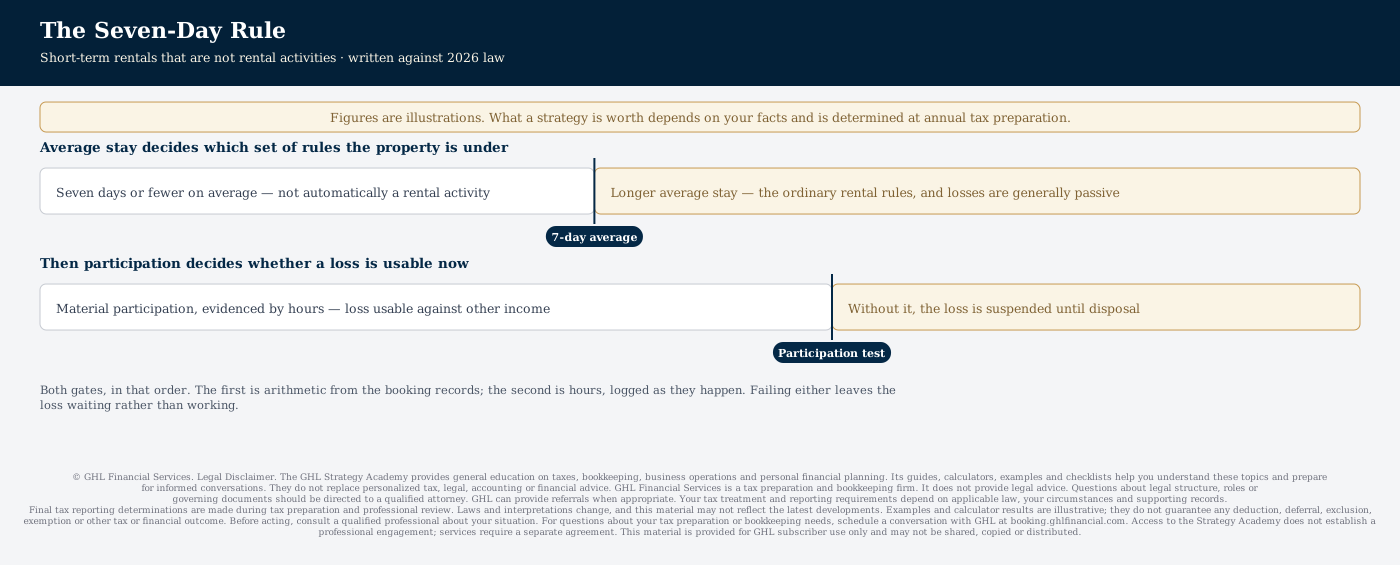
Rental losses are normally passive, which limits what they can be set against. An activity whose average customer stay is seven days or less is not treated as a rental activity for that test, so where the owner materially participates the losses are not passive and can meet other income.
The size of it depends on the property and on whether a cost study has accelerated the depreciation. What it depends on far more is the hours log: this is the strategy where documentation is not paperwork around the edges, it is the substance.
| Reclassified by a cost study to shorter-life components | ≈ 25% ($175,000) |
|---|---|
| Accelerated depreciation available in year one | ≈ $175,000, at the 100% first-year rate |
| Federal effect at a 37% bracket, if the loss is non-passive | ≈ $64,750 |
A cost study supporting the reclassification, the 100% first-year allowance for property acquired after January 19, 2025 (the rate is lower for property acquired earlier), material participation established by a contemporaneous log, and a top-bracket owner. Change any one of those and the figure changes; the last two are where it usually fails.
How it works
The seven-day test is an average across the year, not a rule about each booking. One two-week stay can sit alongside a dozen six-night stays and the average still clears.
Material participation is the second test and the harder one. The usual route is 500 hours in the year, with an alternative at 100 hours where that is more than anyone else spends — including a cleaner, a manager and a co-owner.
Hours that count are the work of running the property: coordinating turnovers, managing the listing, dealing with guests, arranging repairs. Time spent choosing furniture before it was in service generally does not.
This is an area that gets examined, and thin documentation is what loses it. A property handed end to end to a management company is very hard to square with material participation, whatever the hours claimed.
It is a separate path from real estate professional status, and the two do not combine. That status is about hours across all your property activities; this is an exception attaching to a particular property.
What you would do
- Log hours the day you work them — date, what you did, how long. A spreadsheet is enough; a reconstruction is not.
- Keep the booking record that shows stay lengths, so the average can be evidenced rather than asserted.
- Track what anybody else spends on the property, because the 100-hour route depends on out-working them.
- Commission the cost study before year end if one is being used; the timing affects which year the depreciation lands in.
- Tell GHL if you move to full management — it changes the analysis.
Allow one to two months. Some of it depends on other people.
Worksheets to use
- Material participation hours log (XLSX). Date, task, hours, and a running total against both tests — plus a place to record what anyone else spent on the property, which is what the 100-hour route turns on. A line per session of work, the day you do it. Record what anyone else spent on the property too, because one of the two tests compares them.
- Rental property income and expense summary (XLSX). Rent in and running costs out for one property across the year, with days rented and days used personally. One copy per property. Keep improvements off it — they belong on the property improvement register, where they add to basis instead.
What GHL needs from you
- The hours log for the year.
- Booking records showing each stay and its length, so the average can be computed.
- The cost study, where one exists.
- Purchase documents and the date the property was placed in service.
- What was paid to any manager, cleaner or contractor, and what they did.
What usually goes wrong
- The hours log is written in March, from a calendar and some memories. This is an area that gets examined, and a reconstructed log is the thing that loses it.
- The property is handed to a management company and the hours are still claimed. Material participation and full management are very hard to hold at the same time, whatever the total says.
- The average stay is assumed rather than computed. It is an average across the year's bookings, and a handful of long winter lets can carry it past seven without anybody noticing.
Common questions
What if one stay was exactly seven days?
The test is the average across the year, so a single stay does not decide it.
Does my cleaner's time count against me?
Under the 100-hour route, yes — that route requires your hours to exceed everyone else's. Under the 500-hour route it does not, which is why the log records both.
Can I combine this with real estate professional status?
No. Which one is worth pursuing depends on your properties and your time.
Read next
Keeping it alive
A position is not finished when it is set up. This is what it needs each year to still be there when it matters.
- Confirm it still applies — circumstances change more often than the law does.
- Keep the record current. Filled in as the year happens it is evidence; assembled in March it is a reconstruction.
- Put the date in the calendar. This one closes at the year end and cannot be added at tax preparation.
- Ask GHL what changed for 2027. Figures move every year and rules move most years.