
When it matters: Twelve to twenty-four months before the expected sale.
Does this fit you?
- You own a corporation taxed as a pass-through, twelve to twenty-four months from a planned sale.
- Your business holds valuable property or intellectual property you intend to keep.
- You expect a buyer sophisticated enough to want the transaction treated as a purchase of assets.
What it could be worth
It does not produce a deduction. What it does is let the buyer have the treatment they want — a fresh basis in what they are buying — without the seller having to sell the assets directly.
A buyer who gets that treatment is generally willing to pay more for it, because the depreciation they pick up is worth real money to them. That premium is where the value to the seller sits, and it is negotiated rather than automatic — a buyer who does not want the treatment will not pay for it.
It also separates what the owner wants to keep from what is being sold, which is far easier to do before a deal is live than during one.
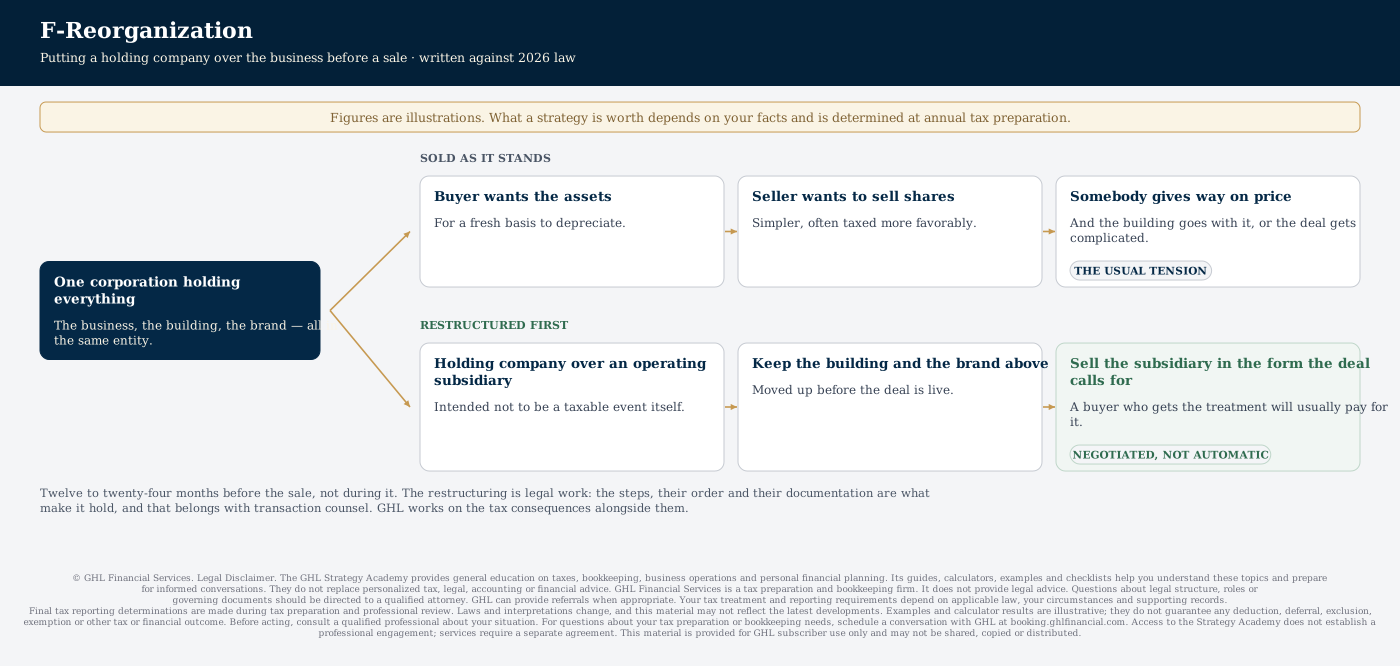
| Before | one corporation holding the business, the building and the brand |
|---|---|
| After the restructuring | a holding company owning an operating subsidiary |
| Kept behind | the building and the brand, moved to the holding company |
| What the buyer acquires | the operating subsidiary, in the form the deal calls for |
A description of the structure. Whether it is available depends on the entity's type and history, and doing it correctly requires transaction counsel — the steps, their order and their documentation are what make it work. It changes the shape of a sale; it does not change what the business is worth.
How it works
A holding company is formed and the existing corporation becomes its subsidiary, in a restructuring that is intended not to be a taxable event in itself.
Assets the owner wants to keep — a building, intellectual property — are moved up to the holding company, which is a separate step with its own consequences.
The operating subsidiary is then what is sold, and can be acquired in a form that gives the buyer a fresh basis while the seller sells an interest rather than the assets themselves.
Timing matters. Done well before a sale it is ordinary planning; done in the middle of a deal it looks like rearrangement for tax purposes and attracts the attention that goes with that.
It requires transaction counsel. The documentation and the order of the steps are what make the treatment hold, and this is legal work, not something a template can do.
Not every buyer wants this and not every business benefits. Where there is nothing to keep behind and the buyer is content with a straightforward purchase, the cost may exceed what it returns.
What you would do
- Raise a possible sale with GHL a year or two out. That is what makes this available at all.
- Say what you would want to keep. That is the question this structure answers.
- Engage a transaction attorney for the restructuring itself — GHL works on the tax consequences; the steps are legal work.
- Keep the entity records clean: formation documents, every election, every change of type, and the ownership history.
- Expect professional fees for the restructuring, and weigh them against what the deal is likely to be worth.
Allow three to six months. It needs documents, and usually somebody else to draw them.
What GHL needs from you
- The entity's formation documents and its full history of elections and changes.
- Ownership records, including when interests were issued.
- A list of assets, with which ones you want to keep.
- Your expected timescale and the kind of buyer you anticipate.
- The transaction attorney's step plan, so the tax position is reviewed against what is actually being done.
What usually goes wrong
- Done close to the sale it invites the argument that it was one step in a single transaction.
- The operating company has to keep genuinely operating afterwards, not sit as a vehicle for the deal.
- States do not all follow the federal treatment of the restructuring.
Common questions
Is this something GHL can do for me?
GHL works on the tax consequences and reviews the plan. The restructuring itself is legal work and belongs with a transaction attorney — we will work alongside one and can make an introduction.
We are three months from closing. Still worth it?
Usually not in this form. Restructuring inside a live deal carries its own problems, and there is generally better work to do on the allocation and the timing instead.
Does the buyer have to agree?
In practice yes — the point is to give the buyer the treatment they want, so it is negotiated with them.
Read next
Keeping it alive
A position is not finished when it is set up. This is what it needs each year to still be there when it matters.
- Confirm it still applies — circumstances change more often than the law does.
- Check the documents still say what they said — an agreement that has drifted from practice is the usual failure.
- Ask GHL what changed for 2027. Figures move every year and rules move most years.