
Does this fit you?
- You expect to sell within the next few years — not next month.
- Your business holds things you may want to keep: property, intellectual property, a brand.
- Your business has changed form over the years, because the history decides which routes are open.
What it could be worth
The after-tax outcome of the same price can differ substantially depending on how the sale is structured: what is sold, by whom, over how long, and in what form the money arrives.
Most of those choices are constrained by things already decided years earlier — entity type, when shares were issued, where assets sit, and how long things have been held. That is why this is a multi-year subject rather than a transaction one.
The saving is not a number that can be quoted in advance. What can be said is that the options narrow steadily as the sale approaches, and by the time there is a signed letter of intent most of them are closed.
| Sale of assets, paid over several years | gain recognized as the payments arrive, with interest on the deferred part |
|---|---|
| Sale of shares in one year | the whole gain in one year, at that year's rates and thresholds |
| Shares in a qualifying small company, held long enough | gain may be excluded up to a ceiling, if conditions set at issuance were met |
| Sale to an employee ownership structure | a route with its own deferral, and its own cost and complexity |
A comparison of shapes, not of amounts. Which are available depends on the entity, the history, what is being sold and what the buyer will accept — a buyer who wants assets and a seller who wants to sell shares is the most common tension in these deals. State treatment and the year the money lands both change the result.
How it works
A buyer generally prefers to buy assets, because it gives them a fresh basis to depreciate. A seller generally prefers to sell shares, because it is simpler and often taxed more favorably. The price usually reflects who gives way.
The entity type sets what is possible. A pass-through and a corporation face different consequences on the same transaction, and changing type shortly before a sale rarely achieves what was hoped.
Where the business has been a corporation and shares were issued long ago, conditions tested at issuance may open a substantial exclusion — but they were decided then, not now.
Assets the owner wants to keep are usually best held outside the operating business, and moving them is easier long before a sale than during one.
Spreading payments over years spreads the gain, at the cost of the buyer's credit risk and interest on the deferred amount.
Charitable planning, employee ownership and deferral routes all exist and all bring their own complexity, cost and professional fees. Each is a conversation with several advisors, not a decision made from a guide.
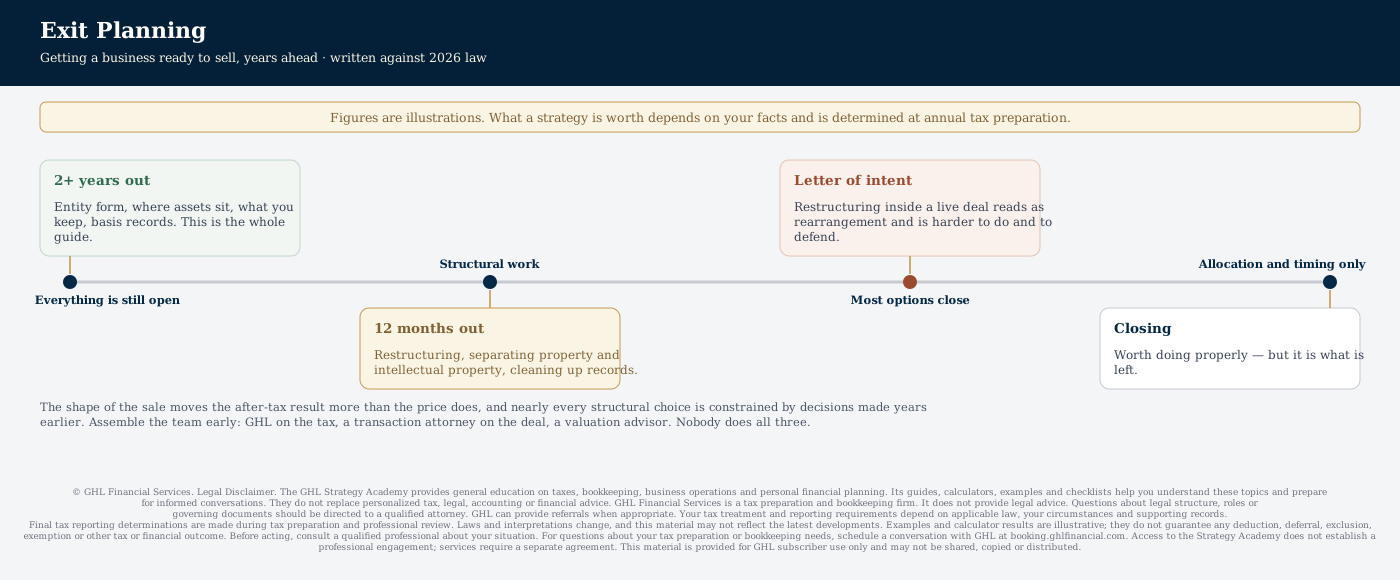
Almost everything here needs to be in place before the deal is live. After a letter of intent, restructuring looks like tax-motivated rearrangement and is both harder to do and harder to defend.
What you would do
- Start the conversation a couple of years out. That sentence is the whole guide — most of what follows depends on time.
- Get your records in order: clean financial statements, a clear picture of what the business owns, and documentation for the things a buyer will ask about.
- Establish your basis in the business and keep the evidence. It is often the number nobody can produce and it directly reduces the gain.
- Say what you want to keep — a building, a trademark, a customer list — early enough that it can be separated properly.
- Assemble the team: GHL on the tax, a transaction attorney on the deal, and a valuation advisor. Nobody does all three.
Allow three to six months. It needs documents, and usually somebody else to draw them.
What GHL needs from you
- The entity's history: how it was formed, every change of type, and when.
- Your basis in the business and the records supporting it.
- A list of what the business owns, including property and intellectual property, and where each sits.
- When shares or interests were issued, and to whom.
- Your timescale, and what you want to keep.
What usually goes wrong
- The conversation starts after the letter of intent. Almost everything worth doing has to be in place before the deal is live; afterwards it reads as rearrangement for tax, and is harder both to do and to defend.
- Nobody can produce the basis. It reduces the gain directly, it is often decades of records, and it is the number most likely to be missing at the moment it is needed.
- The entity type is changed shortly before a sale to improve the treatment. The consequences usually turn on conditions tested long ago, and a late change rarely achieves what was hoped for it.
Common questions
We have a signed letter of intent. Is it too late?
Not for everything, but most of the structural options are closed by then. There is usually still work to do on the allocation and the timing, which is worth doing properly.
Should I convert my entity before selling?
Sometimes, and the timing matters enormously — several of the consequences depend on how long the new form has been in place. It is a question to raise years out, not months.
Can you tell me what I will net?
Not from a guide. It depends on the structure, the allocation, your basis, your state and the year it lands. It can be modeled properly once there is a shape to model, and that is worth doing before agreeing the shape.
Read next
Keeping it alive
A position is not finished when it is set up. This is what it needs each year to still be there when it matters.
- Confirm it still applies — circumstances change more often than the law does.
- Check the documents still say what they said — an agreement that has drifted from practice is the usual failure.
- Ask GHL what changed for 2027. Figures move every year and rules move most years.