
When it matters: Worked out with the return, but the income that triggers them is decided during the year.
Does this fit you?
- Your income is near or above $200,000, or $250,000 on a joint return.
- You have a large one-time gain — a property sale, a business sale, a conversion.
- You and your spouse each earn a modest wage but your joint income is not modest.
What it could be worth
Nothing here is optional, so what this is worth is knowing where the lines are before crossing them.
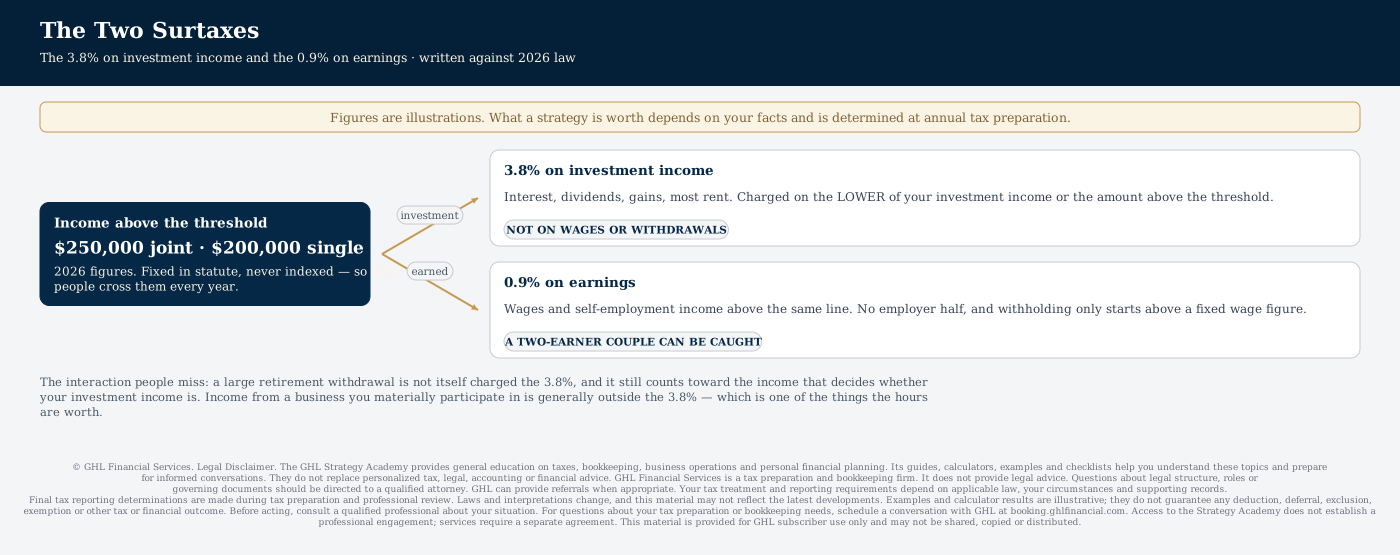
The 3.8% charge falls on investment income — interest, dividends, capital gains, most rental income, and income from a business you do not participate in — but only to the extent income passes the threshold.
The 0.9% charge falls on earnings above the same figures, and unlike ordinary payroll tax there is no employer half.
Because both are measured against a fixed line, the planning is about which year income lands in. The same gain split across two years may cross a threshold once instead of twice.
| 3.8% on investment income, joint / single | above $250,000 / $200,000 |
|---|---|
| 0.9% on earnings, joint / single | above $250,000 / $200,000 |
| Filing separately | $125,000 for both |
| Charged on | the LOWER of investment income, or income above the threshold |
| Indexed for inflation | no — fixed since introduction |
2026 thresholds, from the engine's own constants. They are set in statute and are not adjusted for inflation. Net investment income has its own definition that excludes wages, self-employment income and distributions from retirement accounts — which is why a large withdrawal can push you over the threshold without itself being charged.
How it works
Both charges sit on top of ordinary tax and neither is part of the bracket ladder.
The 3.8% is applied to the lower of two amounts: your net investment income, or the amount by which income exceeds the threshold. Only a little over the line means only a little is charged.
Net investment income does not include wages, self-employment income, or retirement account distributions — but those do count toward the income that decides whether you crossed the threshold.
That is the quiet interaction: a large withdrawal from a retirement account is not itself subject to the 3.8%, and can still drag your investment income into it.
The 0.9% falls on wages and self-employment earnings above the same thresholds, and is not matched by an employer.
An employer is only required to start withholding it above a fixed wage figure, so two earners who are each under it can still owe it on a joint return.
Income from a business you materially participate in is generally outside the 3.8% — which is one of the things participation is worth.
What you would do
- Know roughly where your income will land before December, not in April.
- If a large gain is coming, ask whether it can be split across years or spread over installments. Crossing a threshold once costs less than crossing it twice.
- Tell GHL if you are a two-earner couple — the withholding gap on the 0.9% is a common surprise on a joint return.
- Say which activities you materially participate in, and keep the hours. That decides whether business income is inside the 3.8% or outside it.
- Look at these alongside the Medicare premium lookback; the same income drives both, on different timetables.
What GHL needs from you
- Investment income by type: interest, dividends, gains, rent.
- Wages and self-employment earnings for both spouses.
- Any one-time event, and the year it lands in.
- Hours logs for any business or rental you participate in.
- Last year's return, for the comparison.
What usually goes wrong
- The thresholds are not indexed. They have been the same figures since the charges were introduced, so more people cross them every year.
- The 3.8% applies to the lower of net investment income or the amount by which income exceeds the threshold — so a modest amount of investment income above a large threshold breach is charged in full.
- The 0.9% on earnings is not matched by the employer, and an employer only starts withholding it above a fixed wage figure — a two-earner couple can each be below that and still owe it jointly.
- Filing separately halves the thresholds, which often makes the surtaxes worse rather than better.
Common questions
Is this the same as going into a higher bracket?
No. A bracket applies to the next dollar of ordinary income; these are separate charges with their own thresholds and their own definitions of income. You can cross one and not the other.
My retirement withdrawal is not investment income, so am I safe?
Not necessarily. It is not charged the 3.8% itself, but it counts toward the income that decides whether your investment income is charged. That is the interaction people miss.