
When it matters: The written election goes with the return for the first year it applies.
Does this fit you?
- You have two or more rentals, or other activities, that share management, geography or ownership.
- Your losses are being suspended because no single activity reaches the participation threshold.
- You and your spouse combine rental activities with a business that is operationally tied to them.
What it could be worth
Losses from an activity a person does not materially participate in are suspended, not lost — they wait until the activity is disposed of. Grouping can change when they are usable, not whether they exist.
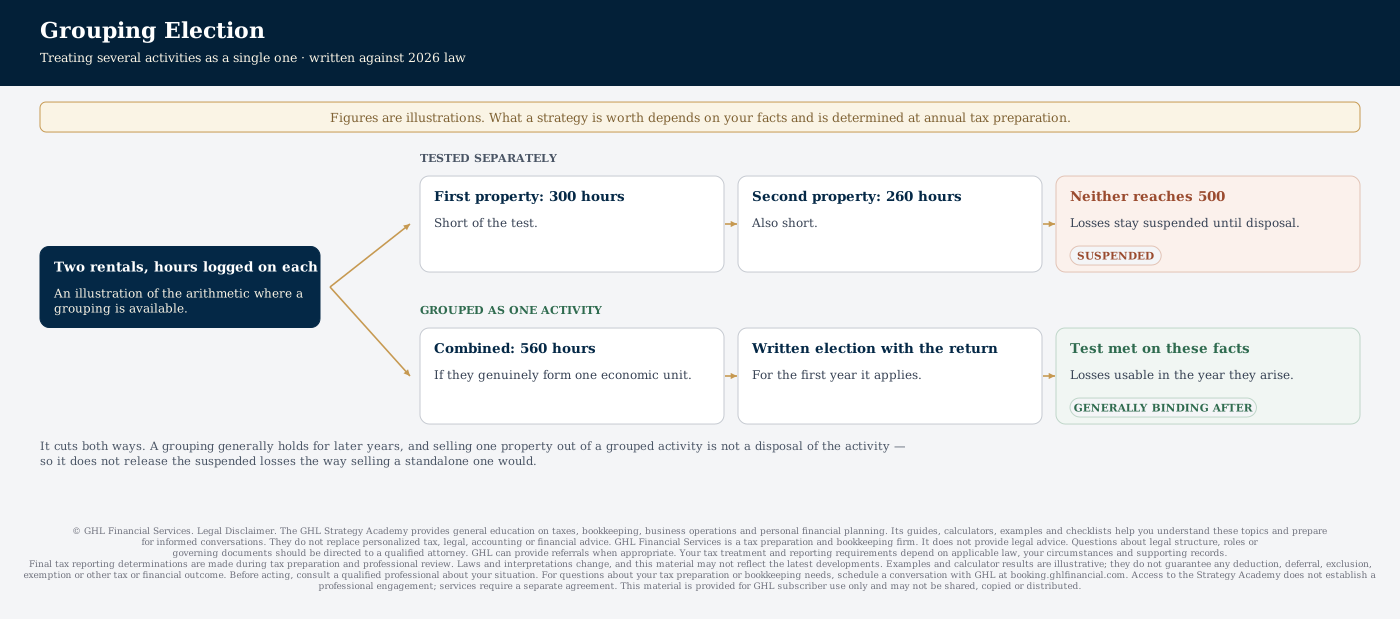
If the hours across the grouped activities reach the threshold where no single one did, the losses stop being suspended and become usable against other income in the year they arise.
It also cuts the other way. Grouping is not a yearly choice made with hindsight: once made it generally holds, and it affects what happens when one of the activities is sold, because a disposal of part of a group does not release suspended losses the way a disposal of a whole activity does.
| Hours on the first property | 300 |
|---|---|
| Hours on the second property | 260 |
| Threshold under the hours test | 500 in the year |
| Tested separately | neither reaches it |
| Tested as one grouped activity | 560 — the test is met on these facts |
An illustration of the arithmetic where a grouping is available. Whether these two activities may be grouped at all is a separate question decided on the facts — shared management, geography, ownership and operational character — and the hours test is one of several ways participation can be shown. Hours have to be evidenced, not estimated.
How it works
Activities may be grouped where they form an appropriate economic unit. The factors are similarity, common control, common ownership, geography and interdependence — no single one decides it.
The grouping is made by a written statement attached to the return for the first year it applies.
Participation is then tested across the combined group, by one of several tests. The hours test is the best known but not the only one.
Once a grouping is made it generally holds for later years. Regrouping is allowed only where the facts have materially changed, not because a different answer would suit better.
Rental and non-rental activities can only be grouped in limited circumstances, and rentals have their own rules on top.
On a sale, suspended losses are released when a whole activity is disposed of. If several properties are one grouped activity, selling one of them may not be a disposal of the activity.
What you would do
- Keep contemporaneous hour records for each activity, by date and task. Everything here rests on hours, and reconstructed hours are the weakest evidence there is.
- Write down what actually connects the activities — the same manager, the same locality, one funding the other. That is the case for grouping, and it has to exist before it is claimed.
- Raise it before the return is filed. The statement goes with the return for the first year, and adding it later is not straightforward.
- Tell GHL if you are planning to sell one of the properties. The grouping changes what that sale releases.
- Tell us if the facts change — a new manager, a property in a different state, an activity sold.
Allow one to two months. Some of it depends on other people.
Worksheets to use
- Participation hours log (XLSX). Hours by date and task, for each activity, with everyone else's hours recorded alongside — several of the tests compare the two. Fill it in as the work happens. A log written up in March describes what somebody remembers, which is the thing these tests are least able to rely on.
What GHL needs from you
- An hours log for each activity, kept as the year went.
- What connects the activities: management, location, ownership, funding.
- Any grouping statement filed in an earlier year.
- The suspended loss carried on each activity.
- Plans to sell or acquire, which can change the grouping.
What usually goes wrong
- The activities have to form a genuine economic unit. A grouping asserted to reach a threshold, with nothing connecting them, is the version that gets unpicked.
- Once made it is sticky. You cannot ungroup to suit a different year.
- It does not turn rental income into self-employment income; it only answers the participation question.
Common questions
Can I ungroup next year if it suits me better?
Generally not. Regrouping is allowed where the facts have materially changed, which is a higher bar than a different answer being more convenient.
Does this make me a real estate professional?
No, that is a separate test with its own requirements. Grouping helps with the participation question; it does not answer that one.
Read next
Keeping it alive
A position is not finished when it is set up. This is what it needs each year to still be there when it matters.
- Confirm it still applies — circumstances change more often than the law does.
- Keep the record current. Filled in as the year happens it is evidence; assembled in March it is a reconstruction.
- Put the date in the calendar. This one closes at the year end and cannot be added at tax preparation.
- Ask GHL what changed for 2027. Figures move every year and rules move most years.