
Does this fit you?
- Your tax bill at filing included a penalty line.
- Your income comes from a business or investments with no withholding.
- Your income jumped this year.
What it could be worth
What it is worth is the penalty itself, avoided by paying enough during the year, or removed by an exception or waiver that fits.
The figures quoted here are the Instructions for Form 2210 for tax year 2025, the latest posted. The Estimated Tax (1040-ES) guide has 2026's tests.
How it works
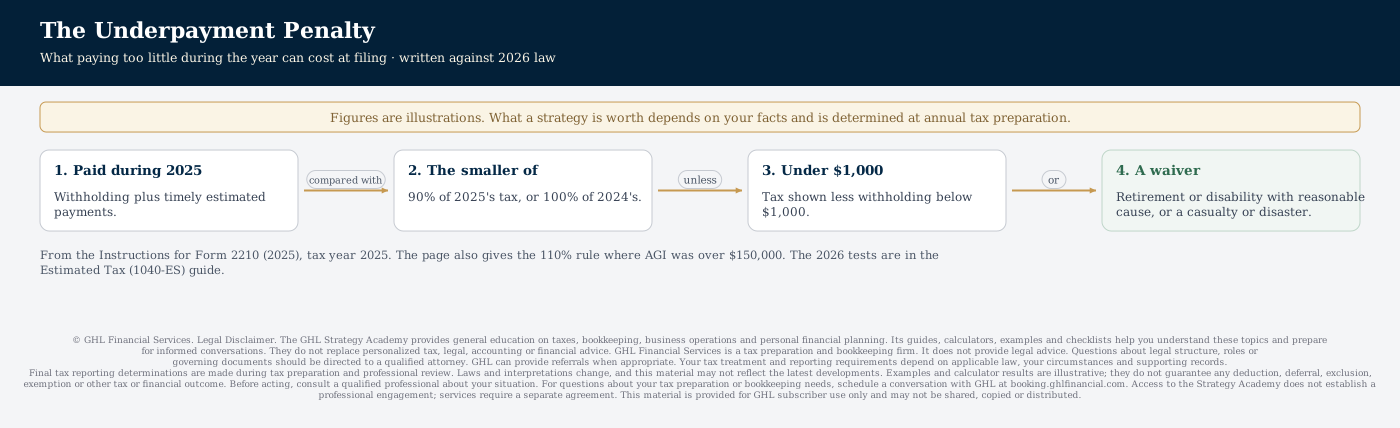
Who may owe it, for 2025. The Instructions for Form 2210: “In general, you may owe the penalty for 2025 if the total of your withholding and timely estimated tax payments didn't equal at least the smaller of: 90% of your 2025 tax, or 100% of your 2024 tax…” The page also gives the 110% rule where AGI was more than $150,000.
One exception. The instructions: “The total tax shown on your 2025 return minus the amount of tax you paid through withholding is less than $1,000.”
Two waivers. The instructions list a waiver where you retired after age 62 or became disabled and the underpayment was due to reasonable cause, and one where the underpayment was due to a casualty, disaster or other unusual circumstance.
Not covered here, because the wording has not been checked against IRS.gov: how the penalty is figured, the annualized income method, and when Form 2210 itself has to be filed.
Sources
What you would do
- Compare what you paid during the year with last year's total tax, early in the year.
- Make each estimated payment by its date, and keep the confirmation.
- If the year had a casualty, disaster, retirement or disability in it, note the dates.
- Bring the penalty line, and anything that might support a waiver, to a qualified tax professional.
Usually a week or two — mostly things you can start yourself.
What GHL needs from you
- Every estimated payment's date and amount.
- The year's withholding, from W-2s and 1099s.
- Last year's return.
- All of it sent through the Secure Client Portal, not by email.
What usually goes wrong
- Paying the year's tax in full in April and assuming that settles it. The test looks at what was paid during the year.
- Counting a late estimated payment as on time. The instructions count timely payments.
- Missing a waiver that fits, such as a casualty or disaster in the year.
Common questions
I paid everything I owed in April. Why is there a penalty?
The test in the Form 2210 instructions is what was paid during the year, through withholding and timely estimated payments, against the smaller of 90% of the year's tax or 100% of the year before's.
Is there a small-balance exception?
For 2025, the instructions list one where the tax shown on the return minus the tax paid through withholding is less than $1,000.
Read next
Keeping it alive
A position is not finished when it is set up. This is what it needs each year to still be there when it matters.
- Confirm it still applies — circumstances change more often than the law does.
- Put the date in the calendar. This one closes at the year end and cannot be added at tax preparation.
- Ask GHL what changed for 2027. Figures move every year and rules move most years.