
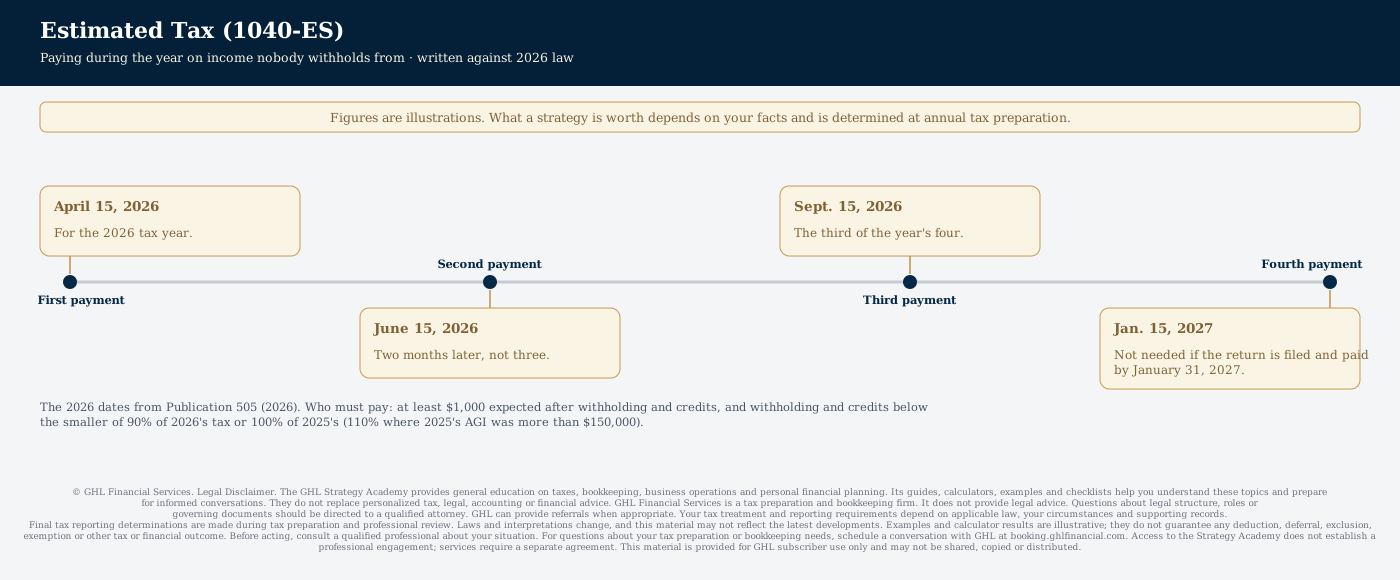
When it matters: For 2026: April 15, June 15 and September 15, 2026, and January 15, 2027.Estimated tax is paid in four parts: April 15, June 15 and September 15, then January 15 of the next year, each moved to the next business day when it falls on a weekend or holiday. A payment that is late or short can owe a penalty for that period even when the year is settled by the filing deadline.
Does this fit you?
- You work for yourself, or have income nobody withholds from.
- Your return last year ended with tax to pay.
- Your income rose sharply this year.
What it could be worth
Nothing here lowers a tax bill. Estimated tax is the same tax, paid earlier, by the person who earns the income rather than by an employer.
What it is worth is avoiding the penalty for paying late during the year, which the Underpayment Penalty guide covers, and an April with no surprise in it.
How it works
What the form is for. IRS.gov: “Use Form 1040-ES to figure and pay your estimated tax. Estimated tax is the method used to pay tax on income that is not subject to withholding…”
Who must pay for 2026. Publication 505 (2026): “In most cases, you must pay estimated tax for 2026 if both of the following apply. You expect to owe at least $1,000 in tax for 2026 after subtracting your withholding and tax credits. You expect your withholding and tax credits to be less than the smaller of: 90% of the tax to be shown on your 2026 tax return, or 100% of the tax shown on your 2025 tax return. Your 2025 tax return must cover all 12 months.”
The higher-income rule. The same publication: “If your AGI for 2025 was more than $150,000 ($75,000 if your filing status for 2026 is Married filing a separate return), substitute 110% for 100% in (2b) under General Rule, earlier.”
The 2026 dates. Publication 505's table gives April 15, 2026; June 15, 2026; September 15, 2026; and January 15, 2027.
The January payment can be skipped in one case. Publication 505: “If you file your 2026 Form 1040 or 1040-SR by January 31, 2027, and pay the rest of the tax you owe, you don't need to make the payment due on January 15, 2027.”
Not covered here, because the wording has not been checked against IRS.gov: how the payments are made, the rules for farmers and fishermen, and the annualized income method for uneven income.
Sources
What you would do
- Find last year's total tax and AGI on last year's return.
- Work out this year's likely tax with the business's profit so far.
- Put the four 2026 dates in your calendar, with the amount planned for each.
- Keep each payment's confirmation with the year's records.
- Re-check the amount after each quarter, and bring the questions to a qualified tax professional.
Usually a week or two — mostly things you can start yourself.
What GHL needs from you
- Every estimated payment's date and amount, with its confirmation.
- Last year's return.
- This year's withholding to date, from pay stubs or the W-2.
- All of it sent through the Secure Client Portal, not by email.
What usually goes wrong
- Spacing the payments three months apart. The second 2026 date is June 15, two months after the first.
- Using 100% of last year's tax when last year's AGI was over $150,000. Publication 505 substitutes 110%.
- Forgetting that withholding from a job counts toward both tests.
Common questions
My AGI last year was $180,000. Which percentage applies?
Publication 505 substitutes 110% for 100% of last year's tax when 2025's AGI was more than $150,000 ($75,000 for married filing separately in 2026).
Do I have to make the January 15, 2027 payment?
Not if you file your 2026 Form 1040 or 1040-SR by January 31, 2027 and pay the rest of the tax you owe, according to Publication 505.
I expect to owe $800. Do I pay estimates?
Publication 505's first test is expecting to owe at least $1,000 for 2026 after withholding and credits. Below that, that test is not met.
Read next
Keeping it alive
A position is not finished when it is set up. This is what it needs each year to still be there when it matters.
- Confirm it still applies — circumstances change more often than the law does.
- Put the date in the calendar. This one closes at the year end and cannot be added at tax preparation.
- Ask GHL what changed for 2027. Figures move every year and rules move most years.