
When it matters: The election for a year is made by the due date of the PRIOR year's return, without extensions — so the election for this year had to be filed by April of this year. A new taxpayer has a short window from starting.
Does this fit you?
- You trade securities frequently enough to wonder whether it is a business.
- You have large trading losses trapped behind the annual capital loss limit.
- You are being caught repeatedly by wash sale disallowance.
- You are thinking about this in the first quarter, which is the only time the decision is live.
What it could be worth
There are three positions, not two, and people conflate them constantly.
An investor holds securities for return. Gains are capital, losses offset gains and then a small amount of ordinary income each year, wash sales apply, and the costs of investing are not deductible.
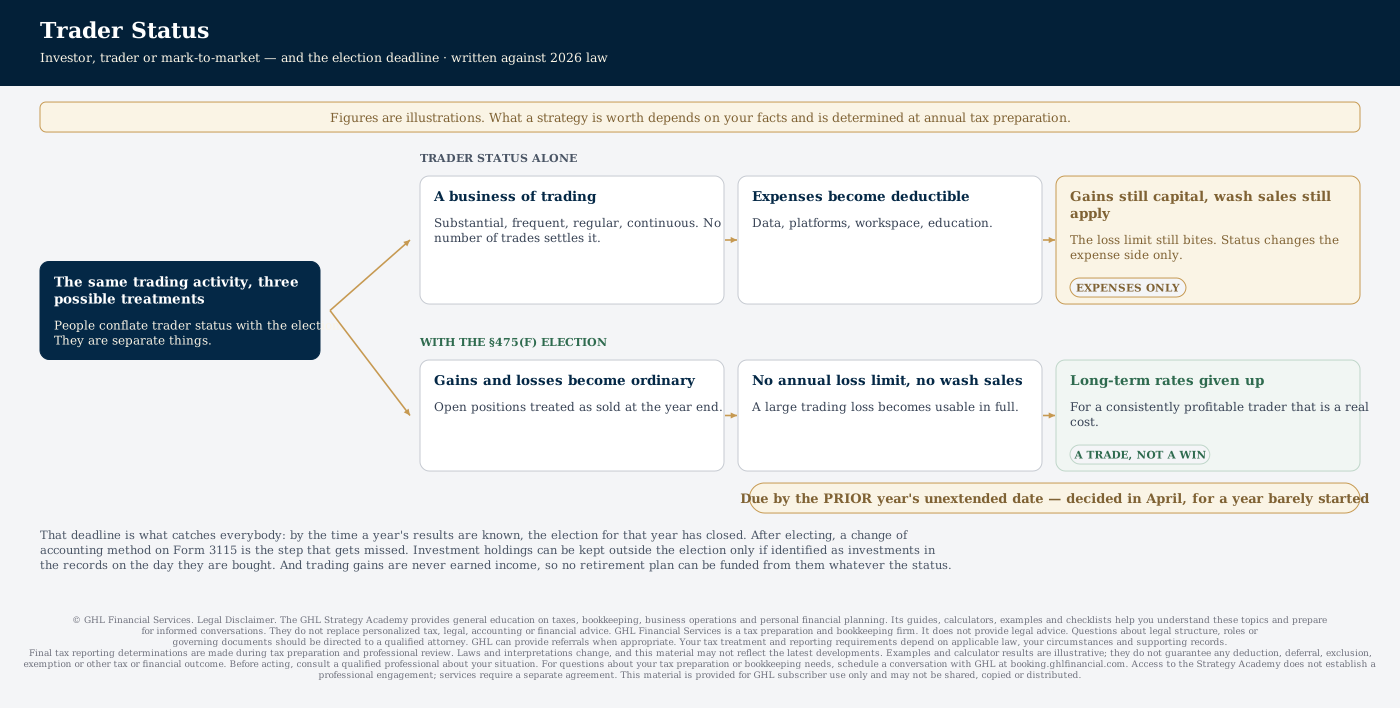
A trader carries on a business of trading. The expenses of it — data, platforms, a home office, education — become business deductions. Gains are still capital, wash sales still apply, and the loss limit still bites. Trader status alone changes the expense side and nothing else.
The mark-to-market election under §475(f) changes the rest. Gains and losses become ordinary, so the annual capital loss limit disappears and wash sales stop applying. The price is that gains are ordinary too, and open positions are treated as sold at the year end.
| Investor | capital gains; losses limited; wash sales; no expense deduction |
|---|---|
| Trader, no election | expenses deductible as a business; gains still capital; wash sales still apply |
| Trader with the §475(f) election | gains and losses ordinary; no loss limit; no wash sales |
| The cost of the election | long-term rates given up; open positions marked at year end |
| When the election is made | by the prior year's unextended due date |
| What it never does | make trading gains self-employment income |
The structure of §475(f) and the case law on trader status. There is no statutory test for being a trader and no number of trades that settles it. GHL works the position on the actual activity, and the election is a decision taken before the year it applies to.
How it works
Trader status is a facts question about carrying on a business. The activity has to be substantial, frequent, regular and continuous, and aimed at profit from short-term movements rather than from dividends or long-term appreciation.
Courts have looked at the number of trades, the number of days traded, average holding periods and the time devoted to it. None of them is decisive on its own and there is no safe number.
A trader without the election reports expenses on a business schedule and gains on the ordinary capital schedule. The two live in different places on the return, which is itself a common source of error.
The §475(f) election treats all securities held in connection with the trading business as sold at market value at the year end. Gains and losses, realized and unrealized, become ordinary.
Ordinary treatment removes the annual capital loss limit — a large trading loss becomes usable in full — and takes the activity outside the wash sale rule entirely.
It also removes the long-term capital gain rates for those positions. For a profitable trader who would otherwise have held anything over a year, that is the cost of the bargain.
The election for a year is made by attaching a statement to the prior year's return, filed by its unextended due date. A taxpayer starting in the year has a short window from the start of the activity.
Having made the election, a change of accounting method is filed on Form 3115 in the first year it applies. Missing that step is a common failure after the election itself was made correctly.
Securities held for investment can be kept out of the election if they are identified as investments in the records on the day they are acquired. Doing it later does not work.
Trading gains are not earned income, whatever the status. They do not support a retirement plan contribution and they carry no self-employment tax.
What you would do
- Raise this in January or February. By the time a year's results are known the decision for that year has closed.
- Keep the trade log, the days traded and a record of time spent. That is the evidence for status.
- Separate investment holdings from trading positions and identify them as investments on the day they are bought.
- If the election is made, calendar the Form 3115 for the first year it applies — the step after the election is the one that gets missed.
- Weigh the loss of long-term rates honestly against the loss limit and the wash sales. For a consistently profitable trader it is not automatically a good trade.
- Do not assume a retirement plan can be funded from the gains. It cannot.
Allow three to six months. It needs documents, and usually somebody else to draw them.
What GHL needs from you
- A full trade history for the year, with dates.
- Days traded, and a record of time devoted to the activity.
- Which holdings are investments and when they were identified as such.
- Any election statement already filed, with the year it was attached to.
- Expenses of the activity: data, platforms, equipment, workspace.
What usually goes wrong
- The deadline is the one that catches everybody. The election for a year is due by the unextended due date of the previous year's return, which means deciding in April for a year that has barely started.
- Trader status and the mark-to-market election are two separate things. Being a trader does not change how gains are taxed; only the election does.
- The election converts gains to ordinary income, so the lower long-term rates are given up permanently for the securities covered. For somebody who is profitable and holds anything, that is a real cost.
- It is not reversible at will. Revoking needs the same kind of election and its own timing.
- Trading gains are not self-employment income, so a solo retirement plan cannot be funded from them even with trader status.
- There is no bright line for trader status — no number of trades that settles it. It is decided on frequency, volume, holding periods and how much of your time it takes.
- Holding investment positions alongside a trading business means segregating them and identifying them as investments, in the records, at the time.
Common questions
How many trades make me a trader?
There is no number. It is decided on frequency, volume, holding periods and the time it takes, and a high count with long holding periods does not get there.
I had a large trading loss last year. Can I elect now?
Not for that year. The election had to be in by the unextended due date of the year before it, which is the rule that catches almost everybody who comes to this after a bad year.
Does trader status stop wash sales?
No. Only the mark-to-market election does that, and it is a separate step with its own deadline.
Can I fund a solo retirement plan from trading profits?
No. Trading gains are not earned income however the activity is classified, so there is nothing for a plan contribution to be based on.
Read next
Keeping it alive
A position is not finished when it is set up. This is what it needs each year to still be there when it matters.
- Confirm it still applies — circumstances change more often than the law does.
- Check the documents still say what they said — an agreement that has drifted from practice is the usual failure.
- Ask GHL what changed for 2027. Figures move every year and rules move most years.