
When it matters: Decided on the facts of the year, from records made during it. There is nothing to elect and nothing to file.
Does this fit you?
- You have a side activity that has lost money for several years.
- You are starting something that runs on enthusiasm and will take years to make money.
- You are deducting losses from an activity a stranger might call a pastime.
What it could be worth
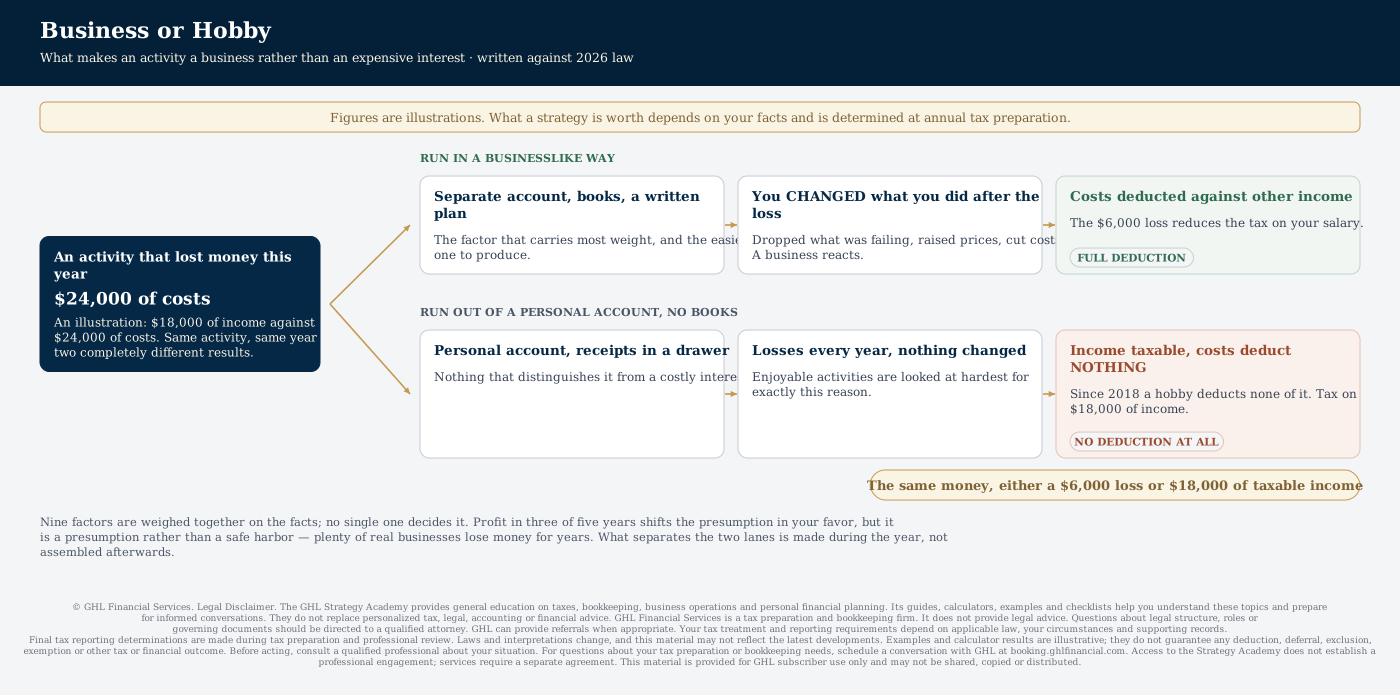
The difference is total. A business deducts its costs against other income; a hobby deducts nothing at all while still reporting its income.
So the value here is not a technique. It is knowing which side of the line an activity sits on, and knowing that the evidence deciding it is made during the year, not assembled afterwards.
A genuine business that keeps businesslike records is on solid ground however long it takes to make money. One run out of a personal account with no books is not, however commercial it feels.
| Run in a businesslike way | separate accounts, books, a plan, changes made after losses |
|---|---|
| Your expertise, or expert advice you relied on | counts toward profit motive |
| Time and effort put in | and whether it looks like work or leisure |
| History of income and losses | including whether losses are falling |
| Personal pleasure or recreation | counts AGAINST |
| Profit in three of five years | shifts the presumption in your favor |
The factors are weighed together on the facts; no single one decides it, and the list is not a scorecard. The three-in-five presumption is a presumption, not a safe harbor. Horse activities have their own longer test. Since 2018 a hobby's expenses are not deductible at all, which is what makes the question worth settling early.
How it works
An activity carried on for profit is a business, and its ordinary and necessary costs are deductible.
An activity not carried on for profit reports its income and, since 2018, deducts none of its costs.
Which it is turns on your intention, tested by nine factors weighed together rather than counted.
Whether it is run in a businesslike way carries the most weight in practice: a separate bank account, proper books, a written plan, and evidence that you changed how you operated in response to losses.
Profit in three of the last five years shifts the presumption toward a business. Without it, you can still be a business — it just has to be shown.
Personal enjoyment weighs against, which is why enjoyable activities get looked at most.
There is nothing to elect. It is settled on the facts of the year, from what exists.
What you would do
- Open a separate bank account for the activity on day one, and run everything through it.
- Keep books, not a shoebox. Bookkeeping is the single most persuasive factor and the easiest to produce.
- Write a short plan, and revise it when things go badly — the revision is the evidence that you responded to losses.
- Keep evidence of expertise sought: courses, advisors, industry bodies.
- Raise it with GHL after a second loss year, not a fifth.
Allow one to two months. Some of it depends on other people.
Worksheets to use
- Profit motive record (XLSX). The evidence that an activity is run for profit: the plan, what changed after a loss year, time spent, expertise sought, and the income and loss history in one place. Start it when the activity starts. Its value is that it is contemporaneous — a plan written after a question is asked carries almost no weight, and the changes-after-losses section is the one that does most of the work.
What GHL needs from you
- Books and bank statements for the activity, separate from personal ones.
- Your written plan and any revisions.
- The income and loss history since it started.
- What you do in the activity and how much time it takes.
- Evidence of expertise, advice taken, or changes made after losses.
What usually goes wrong
- Since 2018 a hobby deducts nothing. It reports its income and deducts none of its costs — so the downside is not a smaller deduction, it is no deduction with the income still taxable.
- Profit in three of five years shifts the presumption in your favor, but it is a presumption, not a rule. Losing money for years without it does not automatically make it a hobby either.
- The factor that carries most weight is whether you run it in a businesslike way — separate accounts, books, a plan, changes made in response to losses. All of which are records.
- Personal pleasure counts against you. Horses, boats, photography, wine and racing are the classic cases precisely because they are enjoyable.
Common questions
I have lost money five years running. Is it automatically a hobby?
No. The three-in-five test shifts a presumption; it does not decide the question. Plenty of real businesses lose money for years. What matters is whether it is run like one, and that is evidenced rather than argued.
Can I at least deduct costs up to the income?
Not since 2018. A hobby reports its income and deducts nothing, which is why the question is worth settling before several years have gone by.
Does enjoying it count against me?
It is one of the nine factors, which is why enjoyable activities attract the most attention. It does not settle anything on its own — plenty of people enjoy their businesses.
Read next
Keeping it alive
A position is not finished when it is set up. This is what it needs each year to still be there when it matters.
- Confirm it still applies — circumstances change more often than the law does.
- Keep the record current. Filled in as the year happens it is evidence; assembled in March it is a reconstruction.
- Put the date in the calendar. This one closes at the year end and cannot be added at tax preparation.
- Ask GHL what changed for 2027. Figures move every year and rules move most years.