
When it matters: Every stage has one, and several are absolute. A deficiency notice gives a fixed window to petition the Tax Court, and that window cannot be extended by agreement or by asking.
Does this fit you?
- You have received a letter and do not know how serious it is.
- You are taking a position that depends on records — which is most of this library.
- You want to know what the process costs before deciding how to respond.
What it could be worth
Nothing directly. What it changes is how much an examination costs when one happens, and that difference is almost entirely made before the letter arrives.
The single biggest variable is whether the records exist. A position supported by a contemporaneous log is usually closed at the first stage; the same position supported by an explanation goes further and costs more.
The second is responding properly and on time. Several routes out of an examination close permanently on a date, and losing one of them narrows every option after it.
| A notice arrives | most often a computer match on one line, not a full examination |
|---|---|
| Information request | produce the records supporting a specific figure |
| Examination | by letter, at an office, or in person for a business |
| Findings | no change, agreed change, or a proposed change you disagree with |
| Appeals | an independent review inside the agency, before court |
| Deficiency notice | a fixed window to petition the Tax Court, and it does not move |
| If tax is owed | installment arrangements and other options exist; ask before defaulting |
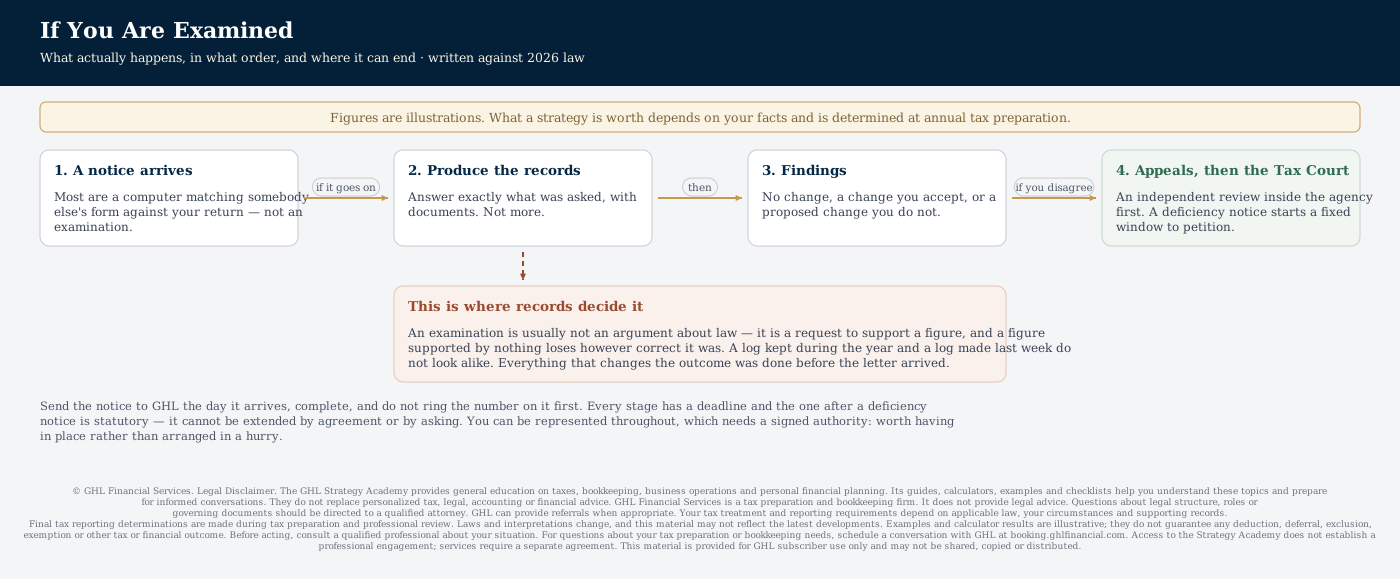
The general shape of an examination. Most never go past the second stage. Timescales and the routes available depend on the kind of notice, and the deadline on a deficiency notice is statutory rather than administrative — it is not extended by agreement.
How it works
It usually starts with a letter. Read which kind it is: a matching notice about one figure is a different thing from an examination of a return.
The letter asks for specific records supporting a specific line. Answering exactly that, with the documents, closes most of them.
An examination proper may happen entirely by correspondence, at an office, or in person where a business is involved.
The outcome is one of three things: no change, a change you accept, or a proposed change you do not.
Where you disagree, an independent appeals function inside the agency reviews it before anything goes to court. That is a real option and it is used often.
If that does not resolve it, a deficiency notice starts a fixed window to petition the Tax Court — the one route that lets a dispute be heard before the tax is paid.
Where tax is ultimately owed, payment arrangements exist. Doing nothing is the one approach with no upside.
At any point you can be represented rather than dealing with it yourself. That needs a signed authority, which is worth having in place rather than arranged in a hurry.
What you would do
- Send the letter to GHL the day it arrives, in full and including the envelope. The deadline and the kind of notice are both printed on it.
- Do not respond before that conversation, and do not phone the number on the letter to 'clear it up'.
- Answer exactly what was asked, with documents. Not more.
- Sign the authority that lets GHL deal with them on your behalf.
- Put every date on the notice in the calendar. The one after a deficiency notice cannot be extended.
- Afterwards, fix whatever made it hard. If the answer was slow because a log did not exist, start the log.
Allow one to two months. Some of it depends on other people.
Worksheets to use
- Year-end checklist (XLSX). What stops being possible at the end of the year, and what can still be done at filing — with a column for what was actually done and who was needed. It is listed here because an examination is won or lost by the records that already exist. Working this before each year end is the cheapest form of audit preparation there is.
What GHL needs from you
- The notice itself, complete, with all pages and the date received.
- The return for the year in question and the records behind the line being queried.
- Any previous correspondence on the same matter.
- A signed authority to represent you.
- Anything you have already sent or said to them.
What usually goes wrong
- The first letter is usually not an audit of the return. Most are a computer matching a form somebody else filed against what you reported, and answering that letter with the document settles it.
- Ignoring a notice does not make it go away; it converts into an assessment on the figures the letter proposed, which are rarely favorable.
- Volunteering more than was asked is the most common self-inflicted wound. A question about mileage is answered with the mileage log, not with the whole ledger.
- The records decide it. An examination is not an argument about the law in most cases — it is a request to support a figure, and a figure supported by nothing loses regardless of how correct it was.
- Reconstructed records are visibly reconstructed. This is the point at which a log kept during the year and a log made last week look completely different.
- There is a fixed window to petition the Tax Court after a deficiency notice, and missing it removes the option of disputing before paying.
- Talking to an examiner directly is rarely a good idea. GHL or another authorized representative can deal with them on your behalf, and a written authority is what makes that possible.
Common questions
I got a letter. Am I being audited?
Probably not in the sense you mean. Most letters are an automatic match between a form somebody else filed and what appeared on your return, and they are closed by sending the document. Send it to GHL before assuming either way — the kind of notice is printed on it.
Should I just ring them and explain?
It rarely helps and often widens the question. A written answer to exactly what was asked, with the records, is the shorter route — and GHL can deal with them directly once an authority is signed.
What if I disagree with the outcome?
There is an independent appeals review inside the agency before anything reaches court, and after a deficiency notice a fixed window to petition the Tax Court — the one route that lets the dispute be heard before paying. That window is statutory and does not move, which is why the dates matter more than the arguments early on.
Read next
Keeping it alive
A position is not finished when it is set up. This is what it needs each year to still be there when it matters.
- Confirm it still applies — circumstances change more often than the law does.
- Keep the record current. Filled in as the year happens it is evidence; assembled in March it is a reconstruction.
- Put the date in the calendar. This one closes at the year end and cannot be added at tax preparation.
- Ask GHL what changed for 2027. Figures move every year and rules move most years.