
When it matters: No fixed date. The first trial run is worth booking within a couple of weeks of writing the steps.
Does this fit you?
- You do a recurring task that nobody else knows how to do.
- You are about to hire, or take time away, and want the work to keep running.
- You find the same task done differently each time, with different results.
- You want fewer questions from the team about how something is done.
What it could be worth
A task written down can be handed over, checked and improved; a task held in one person's head can only be repeated by that person. That is what makes time away, a new hire or a busier month manageable.
Writing it down also tends to show waste: steps nobody needs, information typed twice, a check done in the wrong order. Cutting Repeat Admin picks up from there.
What this produces: one filled-in process checklist, a logged trial run by somebody other than its owner, the revisions it led to, and the date it is next looked at.
How it works
SBA guidance, not a tax rule: “You should document your compliance with internal requirements closely with company records. You might need them when you decide to sell your business or if a legal action is taken against your business.”
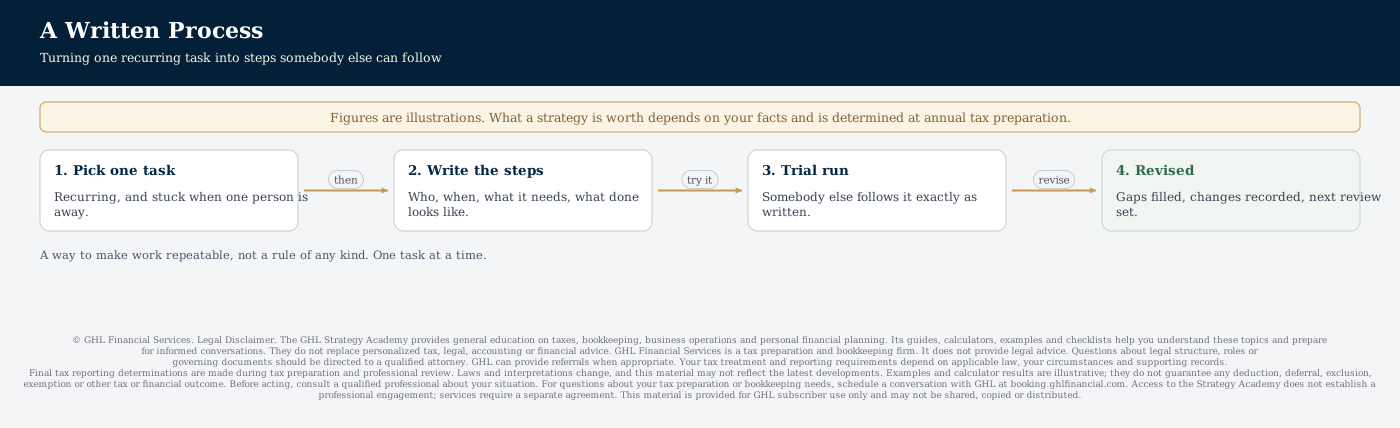
Pick a task that recurs at least monthly and that stops, or goes wrong, when one person is away. Month-end close, sending invoices, onboarding a customer and ordering stock are common first choices.
Write down why it matters, who owns it and how often it runs. Then write what done looks like, so anybody can tell when it is finished.
Write the steps in order, one action per line, for somebody who has never done it. For each step: who does it, when, what it needs (a login, a file, a template) and what done looks like for that step.
Have somebody other than the owner follow it exactly as written, and log the run: where they had to ask or guess, and how long it took.
Every point where they asked or guessed is a step to rewrite. Record what changed and why, so the next person knows the history.
Set the date it is next looked at, and keep it where the task is done, not in a folder of documents.
Sources
What you would do
- Download the process checklist and choose one recurring task.
- Fill in the block at the top, including what done looks like.
- Write the steps, one action per line, with who, when and what each needs.
- Ask somebody else to follow it exactly as written, and log the run.
- Revise the unclear steps and record each change.
- Set the review date, then pick the next task.
Usually a week or two — mostly things you can start yourself.
Worksheets to use
- Process checklist (XLSX). One recurring task with its owner, how often it runs, what done looks like, numbered steps, trial runs and revisions. One copy per process. Write the steps, have somebody else follow them as written, then revise and set the next review date.
What usually goes wrong
- Trying to write down the whole business. One task, finished and tested, is worth more than twenty half-written.
- Writing it for yourself. Steps that make sense to the person who already knows the task leave out exactly what a newcomer needs.
- Skipping the trial run. A process nobody else has followed is still a draft.
- Filing it away. A process that is not opened when the task is done goes out of date quietly.
- Leaving out where the logins, files and templates are. That is the step people most often get stuck on.
Common questions
How detailed do the steps need to be?
Detailed enough that somebody who has never done the task can follow them without asking. The trial run answers this better than any rule of thumb: wherever they asked, add detail; wherever they skipped a line, it may not be needed.
Which task first?
Usually the one that causes the most trouble when its owner is away, or the one that happens most often. A task that recurs monthly gives a trial run quickly.
Read next
Keeping it alive
A position is not finished when it is set up. This is what it needs each year to still be there when it matters.
- Confirm it still applies — circumstances change more often than the law does.
- Keep the record current. Filled in as the year happens it is evidence; assembled in March it is a reconstruction.
- Put the date in the calendar. This one closes at the year end and cannot be added at tax preparation.
- Ask GHL what changed for 2027. Figures move every year and rules move most years.