
When it matters: No fixed date. Worth working through before committing to a hire, a lease or a large customer, and again at the review date you set.
Does this fit you?
- You are thinking about a first or next hire.
- You have been offered a large customer, contract or order.
- You are considering a second location, a new product or a new market.
- You feel the business is at capacity and are unsure what to do next.
What it could be worth
Answering these questions before growing shows what the growth needs in records, cash, people and capacity, while there is still time to prepare them or to decide to wait.
It also makes the decision one the owner can explain. Growth is a choice, and nothing promises it will fit a particular business at a particular time; a written list of what has to be true to go ahead turns a leap into a plan with a review date.
What this produces: the filled-in growth readiness checklist, a list of the Nos and Not sures with who acts and by when, a decision to go ahead, prepare or wait, and the date to look again.
How it works
SBA guidance, not a tax rule: “Once you're ready to expand, update the marketing plan and confirm that your business is financially prepared. Then, make sure to comply with all laws, rules, and regulations in the new business locations.”
For a new location, the SBA puts it this way: “Expanding your business to a new state, county, or city isn't very different from opening a new business there.”
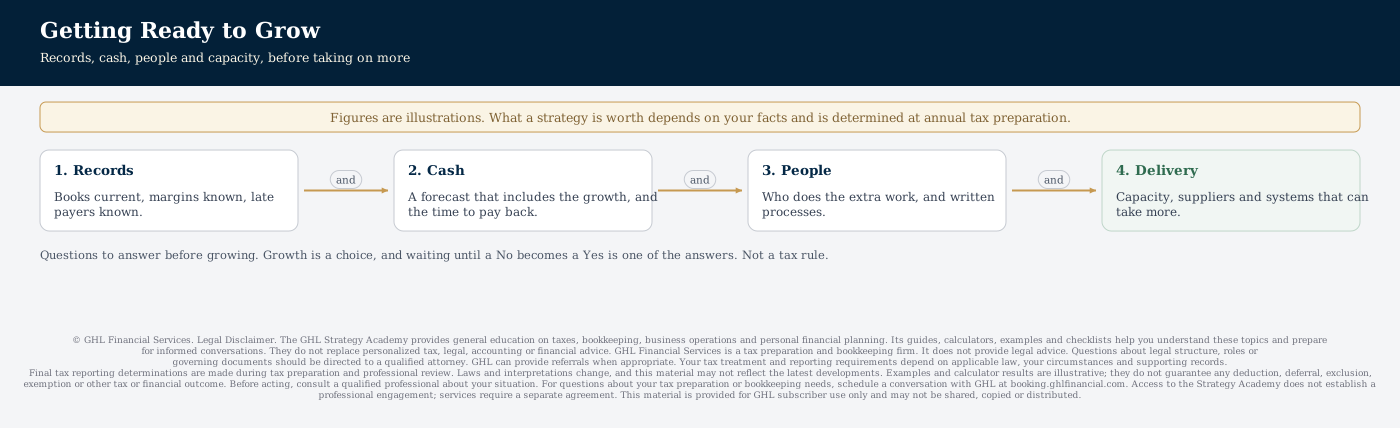
Records come first because every other answer depends on them. Books current to last month, a margin for each main product or service, and a picture of who pays late show what the growth would be built on.
Cash is the usual constraint. Growth tends to mean paying for people, stock or space before the new customers pay, so the thirteen-week forecast with the growth included shows how deep and how long the dip is.
People: who does the extra work, what happens if a key person is away, and whether the recurring tasks are written down so somebody new can follow them.
Delivery: whether the business can do more without the quality slipping, whether suppliers can supply more on the same terms, and whether the systems in use can take more orders or customers. Knowing what would break first is often the most useful answer.
The choice: what has to be true at the review date to go ahead, and what would make the growth stop or be reversed. Not growing yet is one of the options weighed.
Growth can also raise questions about structure, payroll, contracts, leases and the return. Those are separate conversations, with an attorney or a qualified tax professional as each requires; this checklist is about whether the business itself is ready.
Sources
What you would do
- Write down the growth being considered in one sentence.
- Download the growth readiness checklist and answer every row Yes, No or Not sure.
- For each No or Not sure, write what would change it, who acts and by when.
- Build or update the thirteen-week cash flow forecast with the growth included.
- Decide: go ahead, prepare first, or wait.
- Set the date to look again, and work through the list again on that date.
Allow one to two months. Some of it depends on other people.
Worksheets to use
- Growth readiness checklist (XLSX). Questions on records, cash, people, delivery and the choice itself, each answered Yes, No or Not sure, with who acts and a count of what is still open. Work through it before committing to the growth, then again at the review date you set.
What usually goes wrong
- Growing on books that are months behind. Growth multiplies whatever the records already get wrong.
- Planning the growth from the profit and loss alone. Growth usually costs cash before it brings any in.
- Assuming the owner will absorb the extra work. That is often the first thing to break.
- Taking on a large customer who will pay slowly, so that the business is funding them.
- Treating growth as the only good outcome. Some businesses are better served by a higher margin on the same work.
Common questions
How many Yes answers mean the business is ready?
There is no score. One No can matter more than five Yeses — a cash forecast that goes below zero, for example. The checklist is there to make each answer visible, and the decision stays the owner's.
What if the growth opportunity will not wait?
Then the checklist shows which Nos are being accepted, and what would be watched closely as a result. That is still a better position than not knowing they were there.
Is hiring the first employee covered here?
Only as a readiness question. Hiring brings payroll and employer obligations of its own, which other guides in the Learning Center cover.
Read next
Keeping it alive
A position is not finished when it is set up. This is what it needs each year to still be there when it matters.
- Confirm it still applies — circumstances change more often than the law does.
- Keep the record current. Filled in as the year happens it is evidence; assembled in March it is a reconstruction.
- Put the date in the calendar. This one closes at the year end and cannot be added at tax preparation.
- Ask GHL what changed for 2027. Figures move every year and rules move most years.