
When it matters: No fixed date. Log one ordinary week, then review a trial after two to four weeks.
Does this fit you?
- You spend evenings or weekends on admin.
- You type the same information into more than one place: an order form, an invoice, a spreadsheet.
- You pay for software that does more than you use.
- You are weighing a new tool and want to know whether it is worth it.
What it could be worth
Admin time is easy to underestimate because it arrives in small pieces. A week's log turns those pieces into an hours-a-month figure, which is something an owner can weigh against the cost of a change.
Often the first change costs nothing: a setting in software already paid for, a template, or a written checklist that stops a task being done twice.
What this produces: the filled-in admin time log for one week, one change chosen and trialed, the minutes before and after, and a decision at the review: keep, adjust or stop.
How it works
SBA guidance, not a tax rule: “If your budget allows, you may want to consider investing in benefits administration software to make your accounting process easier and more efficient.” And on AI tools: “If you are using free AI tools or software in your small business, have another person review all AI products.”
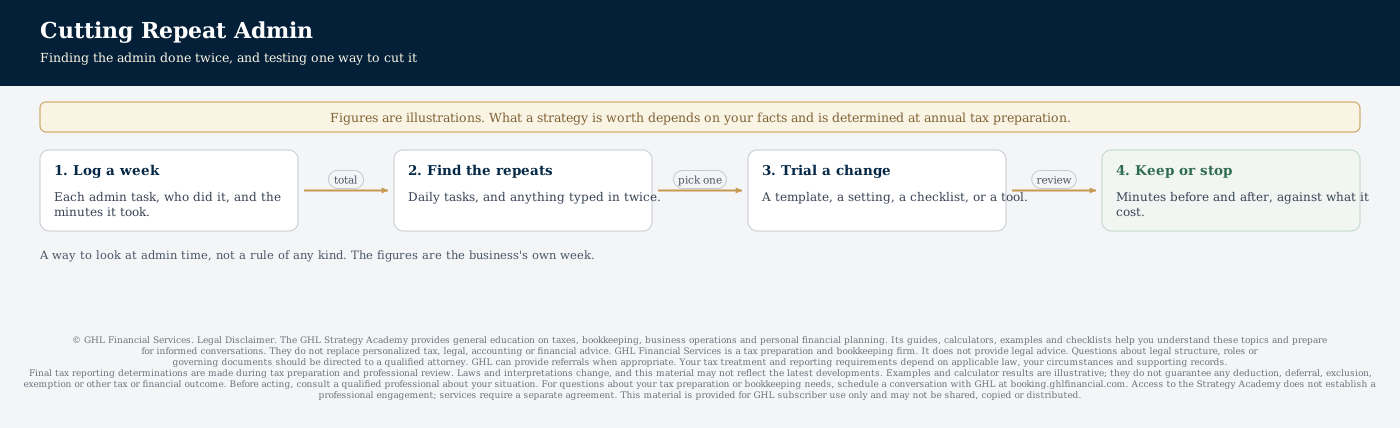
For one ordinary week, every admin task is logged as it is done: the date, the task, who did it, and the minutes it took.
Two marks on each line do most of the work: how often the task repeats, and whether the same information is typed into more than one place.
At the end of the week each task is written once in the summary. The sheet totals its minutes and scales them to a rough hours-a-month figure.
The task to start with is usually one that repeats daily or weekly, or one where information is typed twice. Those are where a template, a software setting, an import or a written checklist tends to help.
Whether a new tool is worth trying is a comparison: the hours a month it might save, against its monthly price and the time it takes to set up and learn.
A trial changes one task. The same task is logged again during the trial, and at the review the minutes before and after are compared.
Sources
What you would do
- Download the admin time log and pick an ordinary week.
- Log each admin task as it is done, with the minutes it took.
- At the end of the week, total by task and read the hours a month.
- Pick ONE task and one change to try. Write down any cost, the start date and the review date.
- Log the same task during the trial.
- At the review, compare the minutes and decide: keep, adjust or stop.
Usually a week or two — mostly things you can start yourself.
Worksheets to use
- Admin time log (XLSX). A week of admin tasks with minutes, how often each repeats and whether it is typed in twice, totaled by task, with one trial and its before and after. Log one ordinary week as it happens, total it, pick one change, then log the same task during the trial and compare at the review.
What usually goes wrong
- Buying a tool before measuring the time. Without the week's log there is nothing to compare the trial against.
- Logging an unusual week. A week with a holiday or a crisis scales up into a misleading monthly figure.
- Counting the tool's monthly price and forgetting the hours it takes to set up and learn.
- Automating a task that should not be done at all. Writing the steps down sometimes shows a task nobody needs.
- Changing several tasks at once, so the review cannot say which change saved the time.
Common questions
Is a week long enough?
For daily and weekly tasks, usually. Monthly tasks may not appear in the week at all, so add them from memory with a note, or log the week that includes the month-end.
How do I decide whether a tool is worth paying for?
Set the hours a month it might save beside its monthly price and the time it takes to learn, and run a trial before committing. The sheet gives the hours; what an hour of your time is worth is your judgment.
Read next
Keeping it alive
A position is not finished when it is set up. This is what it needs each year to still be there when it matters.
- Confirm it still applies — circumstances change more often than the law does.
- Keep the record current. Filled in as the year happens it is evidence; assembled in March it is a reconstruction.
- Put the date in the calendar. This one closes at the year end and cannot be added at tax preparation.
- Ask GHL what changed for 2027. Figures move every year and rules move most years.