
When it matters: Nothing is elected at the loss. Everything that decides it was fixed when the stock was issued, which is why the records matter years before anybody needs them.
Does this fit you?
- You put money into a small company at the outset and lost it.
- You funded the company in cash rather than in effort.
- You invested in a friend's or a family company that did not work out.
- You are about to subscribe for shares in a small company, which is the only moment this can still be got right.
What it could be worth
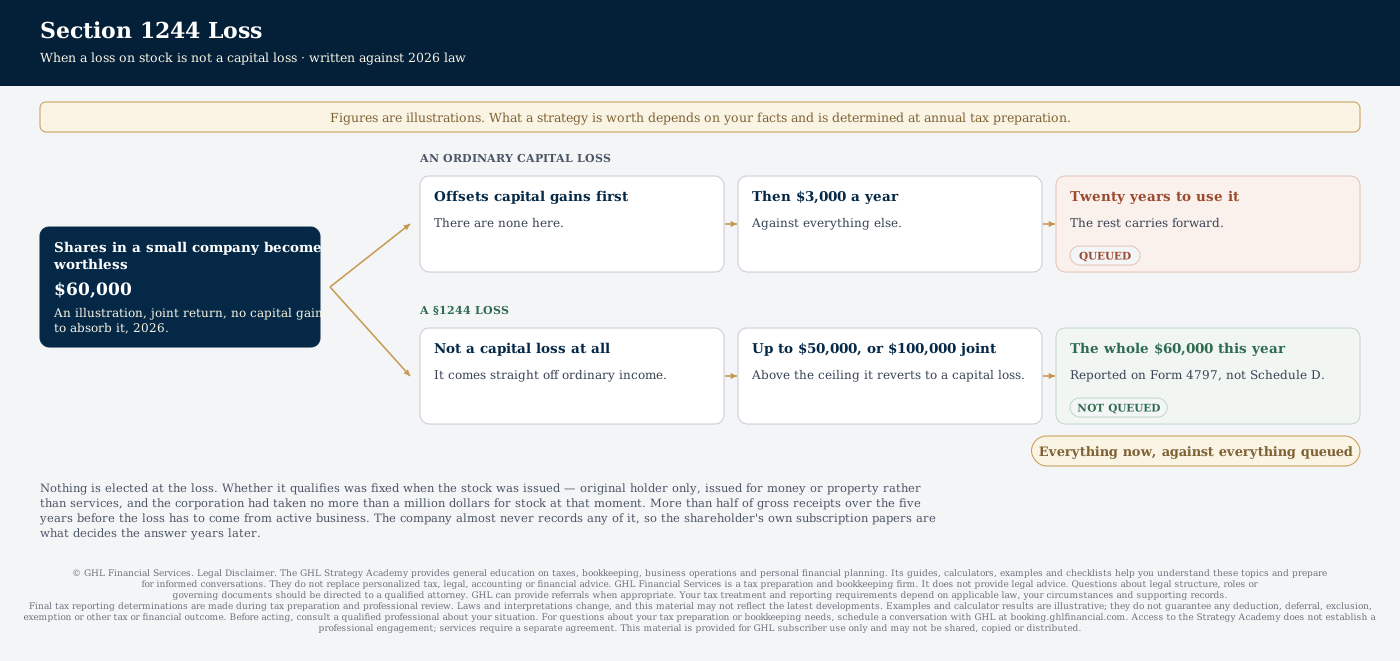
A loss on shares is normally a capital loss. Capital losses offset capital gains, and what is left is worth $3,000 a year against ordinary income, with the rest carried forward. A $60,000 loss with no gains against it takes twenty years to use.
§1244 takes that loss out of the capital queue entirely and allows it against ordinary income in the year it happens, up to $50,000 — $100,000 on a joint return, even where only one spouse held the stock. Anything above the limit stays a capital loss.
Nothing is claimed at the time of the investment and nothing is elected. Whether it qualifies was decided when the stock was issued, and the only thing that can be done later is prove it.
| As a capital loss, usable this year | $3,000 |
|---|---|
| Carried forward | $57,000, at $3,000 a year |
| As a §1244 loss, usable this year | the whole $60,000, against ordinary income |
| Annual ceiling | $50,000 single / $100,000 joint |
| Above the ceiling | remains a capital loss |
The statutory limits in §1244 and the ordinary $3,000 capital loss allowance, on a return with no capital gains to absorb the loss. What it is worth depends on the rate at the top of your income. GHL confirms qualification and the figure at preparation.
How it works
The corporation has to be domestic. It can be taxed as a C corporation or an S corporation — that part does not matter.
The stock has to have been issued for money or other property. Stock issued for services, or in exchange for other stock or securities, is outside it.
At the time the stock was issued, the total the corporation had received for stock and as paid-in surplus must not have exceeded one million dollars. It is a test on the company's history at that moment, and it never changes afterwards.
For the five years before the loss, more than half the corporation's gross receipts must have come from active business rather than from passive sources. Where the company's deductions exceeded its gross income over that period, the test is waived.
Only an individual who acquired the stock directly from the corporation qualifies, or a partnership that held it from issuance. It cannot be transferred with the stock.
The loss can come from a sale, from the stock becoming worthless, or from the company being wound up.
It is reported as an ordinary loss on Form 4797 rather than on Schedule D, which is where the difference actually shows up.
The gain side of small company stock is a separate provision — §1202 — with its own conditions. A company can qualify for one and not the other.
What you would do
- Keep the subscription agreement, the stock certificate and proof of what you paid, from the day you buy in. This is the single thing that decides the answer years later.
- Ask the company, while it still exists, for a statement of the total raised for stock at the time yours was issued.
- Keep the annual accounts or K-1s, which are what show the active-business test over the five years.
- Tell GHL how you acquired the shares — subscribed, bought from someone, gifted or inherited. It is the first question and it ends the matter either way.
- If the company is failing, ask before the year ends. Whether the loss falls this year or next is sometimes a real choice.
- If you are about to invest in a small company, raise it now. Taking the shares for money rather than for services is the whole of it.
Allow one to two months. Some of it depends on other people.
What GHL needs from you
- The subscription agreement or stock certificate, and proof of payment.
- Confirmation you were the original holder.
- Whatever the company can give on the total raised for stock when yours was issued.
- Five years of accounts or K-1s, for the gross receipts test.
- Evidence the stock is worthless, or the sale documents.
What usually goes wrong
- Only the original holder qualifies. Stock bought from another shareholder, received as a gift or inherited never gets this treatment, however well the company itself qualifies.
- Stock issued for services does not qualify. It has to have been issued for money or other property — a founder paid in shares for sweat equity is outside it.
- The million-dollar test is applied to the corporation at the time the stock was issued, not at the time of the loss, and almost no company records it.
- The annual limit is per return, not per company. Losses on two ventures in the same year share it.
- More than half of gross receipts over the five years before the loss has to come from active business rather than from interest, rents, royalties or gains — a company that sold its operations and sat on the cash can fail this.
- The records that prove all of it are the shareholder's problem, and the company is usually gone by the time they are needed.
Common questions
I inherited shares in a company that later failed. Does this apply?
No. The loss is a capital loss.
My company was an LLC. Does that count?
§1244 is about stock, so it needs a corporation. An LLC taxed as a corporation that actually issued stock can be inside it; a membership interest is not stock.
Can I claim it for a year I have already filed?
Possibly, by amending — the ordinary time limit for a refund claim applies. It is worth raising because the difference between $3,000 and the whole loss is large.
Is this the same as the small company exclusion I have heard about?
No. That one is §1202, which is about excluding a GAIN. This is the loss side, and a company can qualify for one without the other.
Read next
Keeping it alive
A position is not finished when it is set up. This is what it needs each year to still be there when it matters.
- Confirm it still applies — circumstances change more often than the law does.
- Check the documents still say what they said — an agreement that has drifted from practice is the usual failure.
- Ask GHL what changed for 2027. Figures move every year and rules move most years.