
When it matters: The accounting procedure for the de minimis safe harbor has to be in place at the START of the tax year. It cannot be adopted afterwards for that year. The election is then made each year by a statement attached to the timely filed return.
Does this fit you?
- You are a landlord spending money on a property.
- Your business has premises, equipment or vehicles.
- You have just replaced a roof, a heating system or a parking lot.
- You have no written capitalization policy, which is most small businesses.
What it could be worth
The same money spent produces a deduction now or a deduction spread over up to thirty-nine years, and the difference is decided by rules most people have never read.
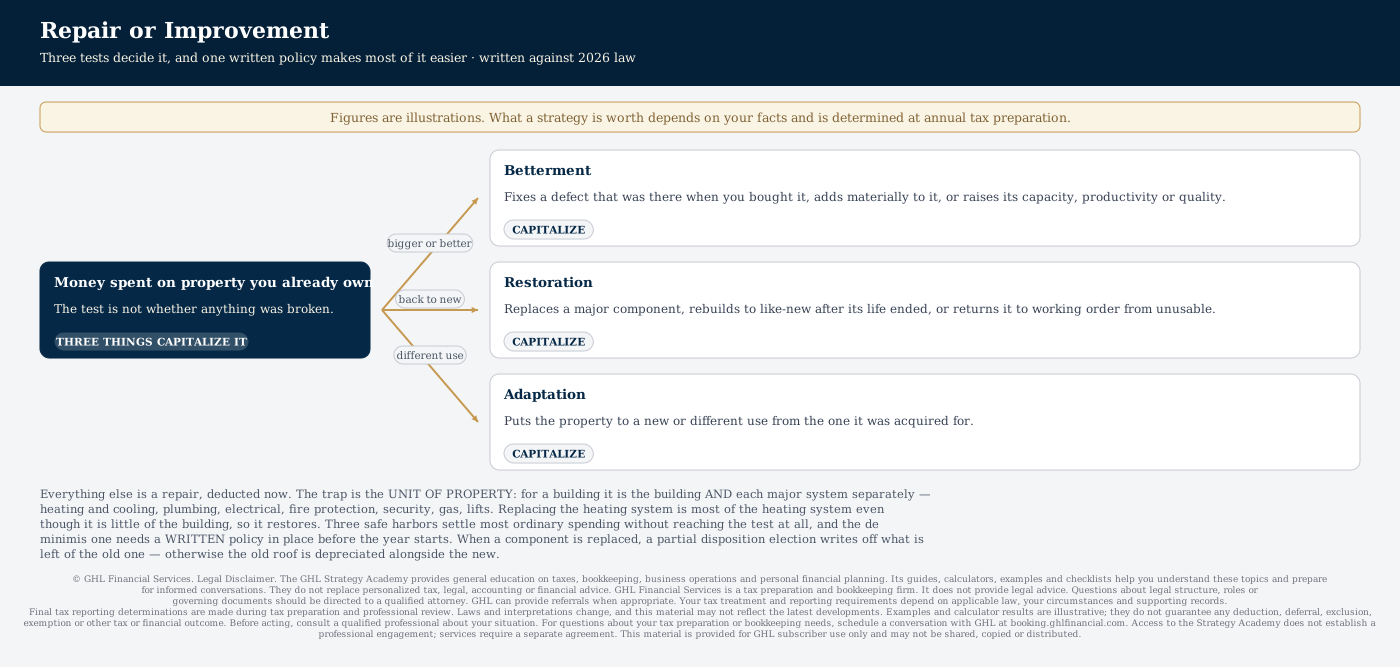
The test is not whether something was broken. An amount has to be capitalized if it is a betterment, a restoration, or an adaptation to a new use. Everything else is a repair, deductible when it is spent.
Three safe harbors settle most ordinary spending without reaching the test at all. The de minimis safe harbor covers items below a per-item threshold ($2,500 for a business without an applicable financial statement, $5,000 with one), provided an accounting procedure was in place before the year started and the election is made on that year's return. A routine maintenance safe harbor covers work expected to recur. A small taxpayer safe harbor covers modest total spending on a modest building.
A dated written policy is the most useful hour in this area. The procedure has to exist before the year begins, and writing it down is what proves it did; it removes the argument for most of what a small business buys.
| Patching a section of roof | generally a repair |
|---|---|
| Replacing the whole roof | a restoration of the roof — capitalized |
| Repainting, resealing, replacing broken parts | generally a repair |
| Enlarging, upgrading capacity, raising quality | a betterment — capitalized |
| Converting a warehouse to retail | an adaptation — capitalized |
| Anything below the de minimis threshold | expensed, with a procedure in place beforehand and the election on the return |
The framework in Treas. Reg. §1.263(a)-3. The de minimis threshold differs depending on whether the business has an applicable financial statement, and the small taxpayer limits are set by the regulations. GHL applies the figures for your year, and the building systems are tested one at a time.
How it works
The unit of property decides the scale of the question. For most equipment it is the item. For a building it is the building AND each of its major systems separately — heating and cooling, plumbing, electrical, fire protection, security, gas distribution, lifts and escalators.
That separation is the part people get wrong. Replacing the heating system is a large proportion of the heating system, even though it is a small proportion of the building, so it is a restoration.
A betterment fixes a defect that existed when the property was acquired, adds to it materially, or increases its capacity, productivity or quality.
A restoration replaces a major component, rebuilds to like-new condition after the end of its life, or returns property to working order after it had deteriorated to unusable.
An adaptation puts the property to a new or different use than the one it was acquired for.
The de minimis safe harbor allows amounts below a per-item threshold to be expensed regardless of the tests. An accounting procedure has to be in place at the beginning of the year (in writing, for a business with an applicable financial statement), the amounts have to be expensed in the books as well as on the return, and the election is a statement attached to each year's timely filed return (Treas. Reg. §1.263(a)-1(f)).
The routine maintenance safe harbor covers activities expected to be performed more than once over a defined period — ten years for a building, the property's class life for other assets. The expectation is judged when the property is placed in service.
The small taxpayer safe harbor lets a business under a gross receipts limit expense total spending on a building under a limit, tested per building and computed on its unadjusted basis.
When a component is replaced and the replacement is capitalized, a partial disposition election writes off the remaining basis of what was removed. Without it, the old roof continues to be depreciated alongside the new one.
Costs of acquiring or producing property, and costs that facilitate an acquisition, are capitalized under their own rules regardless of all of this.
What you would do
- Adopt a written capitalization policy now, so it is in place before the next year starts. It is one page.
- Ask suppliers to itemize invoices. A single line for a large job removes the per-item test entirely.
- Describe work accurately on the invoice. 'Repair' on an invoice for a full replacement helps nobody.
- Keep before-and-after evidence for anything substantial — what was wrong, what was done, what changed.
- Raise a component replacement in the year it happens, so the partial disposition election can be considered.
- Split a project into its parts where they genuinely are separate, and do it at the time rather than afterwards.
Allow one to two months. Some of it depends on other people.
What GHL needs from you
- Invoices, itemized, for anything substantial.
- The written capitalization policy and the date it was adopted.
- What the work was, and what condition the property was in beforehand.
- The property's unadjusted basis, for the small taxpayer test.
- The depreciation schedule, for any component being replaced.
What usually goes wrong
- For a building, each major system is tested separately — heating and cooling, plumbing, electrical, fire protection and several more. That makes capitalization more likely than people expect, because replacing most of one system is a restoration of that system even though it is a small part of the building.
- Without an accounting procedure in place before the year begins there is no de minimis safe harbor for that year at all, and the procedure cannot be backdated. A business without audited or similar financial statements does not strictly need it in writing, but a dated written policy is the easiest way to show it existed.
- The threshold is per item or per invoice line, not per invoice. Twenty items on one invoice are tested individually.
- A repair done as part of a larger improvement project is capitalized with it, however clearly it would have been a repair on its own.
- Replacing a roof and continuing to depreciate the old one is double-counting. A partial disposition election writes off what is left of the old component — and it is generally made in the year of the replacement.
- Making something better than it was, or adapting it to a new use, is an improvement even where nothing was broken.
- Calling a capitalized cost a repair in the accounts does not make it one, and the invoice description is usually the first thing read.
Common questions
Nothing was broken. Surely that makes it a repair?
The other way round, usually. Making something better, bigger or different is an improvement precisely because nothing was wrong with it. Repairs keep property in the condition it was in.
The roof was only a small part of the building's value.
The building is not the unit being tested for the roof. A roof replacement is judged against the building structure, and a heating replacement against the heating system, which is why both usually capitalize.
I do not have a written policy. Does that matter?
Without some accounting procedure in place at the start of the year, the de minimis safe harbor is not available for that year, and a procedure cannot be adopted for a year that has already started. A business without an applicable financial statement does not strictly need it in writing, but writing one down now, dated, is the clearest way to protect next year.
I replaced the roof three years ago and the old one is still on my schedule.
That is common and worth raising. The partial disposition election is normally made in the year of replacement, and what can be done now depends on the facts.
Read next
Keeping it alive
A position is not finished when it is set up. This is what it needs each year to still be there when it matters.
- Confirm it still applies — circumstances change more often than the law does.
- Check the documents still say what they said — an agreement that has drifted from practice is the usual failure.
- Ask GHL what changed for 2027. Figures move every year and rules move most years.