
When it matters: Placed in service by December 31. The date sets the percentage.
Does this fit you?
- Your business is buying tangible property with a recovery period of twenty years or less — equipment, fixtures, off-the-shelf software, certain interior improvements.
- You own property and have had a cost segregation study done, where the reclassified short-life components are what this applies to.
- You bought used as well as new; unlike some allowances, this is not limited to assets that have never been owned before.
What it could be worth
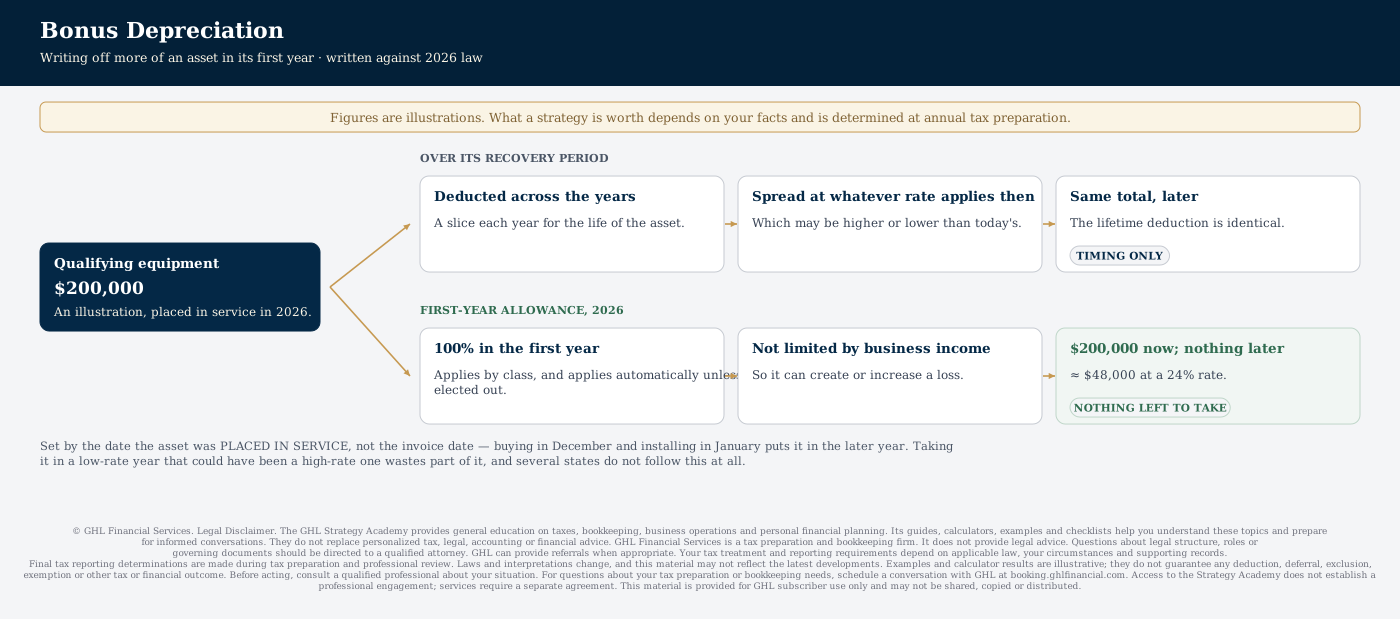
It brings forward a deduction the business would have taken anyway, over years, into the first one. Over the whole life of the asset the total deduction is the same — what changes is when it lands.
That timing is worth something when the rate this year is higher than the rate in later years, and worth less or nothing when it is the other way around. A business expecting a much better year next year may be giving away the deduction at the wrong rate.
Unlike the election most owners know about, this one is not limited by the business's income, so it can create or increase a loss. What happens to that loss then is a separate set of rules.
| First-year allowance, 2026 | 100% of cost |
|---|---|
| Deduction in the first year | $200,000 |
| Federal effect at a 24% marginal rate | ≈ $48,000 |
| Deduction remaining for later years | nothing — it has all been taken |
2026 law. For property acquired after January 19, 2025, the percentage is 100%, made permanent by the 2025 act. Property acquired earlier stays under the older phase-down, which turns on the year it was placed in service — 40% for 2025. The effect shown assumes one marginal rate and no state difference; several states do not follow this at all.
How it works
The asset has to be qualifying property — tangible property with a recovery period of twenty years or less, off-the-shelf software, and certain interior improvements to non-residential buildings.
The percentage is set by when the asset was acquired: 100% for property acquired after January 19, 2025. The year of the deduction is set by when it was placed in service, meaning ready and available for its use, so buying in December and installing in January puts it in the later year.
It applies automatically unless the business elects out. The election out is made by class of asset for the year, not asset by asset, and once made it holds for everything in that class that year.
Where both this and the other first-year election are available, the other one is generally applied first because it is limited by income, and this one takes the remainder.
A property owner who has had a cost segregation study done uses this on the short-life components the study identified. The two work together and neither is much use to a large property without the other.
States diverge here more than almost anywhere else. Several require the deduction to be added back and spread, so the federal answer and the state answer are different numbers.
What you would do
- Record the date each asset was acquired (the contract date, where there is a binding contract) and the date it was placed in service. The first sets the percentage and the second the year, and the placed-in-service date is the one people fail to keep.
- Keep the invoice, the delivery or installation evidence, and a note of what the asset is used for.
- Tell GHL before year end if you are weighing a large purchase — whether it lands this year or next is often the whole decision.
- Say what you expect next year to look like. Taking the deduction at a lower rate than it could have been taken at is the quiet way this goes wrong.
- Tell us which states the business files in, because several do not follow this.
Allow one to two months. Some of it depends on other people.
Worksheets to use
- Equipment placed-in-service log (XLSX). Each asset, what it cost, when it was bought, and — separately — the date it was actually ready and available for use. Fill it in as assets arrive. The placed-in-service date is a different date from the invoice, and it is the one that decides the year and the percentage.
What GHL needs from you
- Invoices, with the date each asset was placed in service.
- What each asset is, and what it is used for in the business.
- Any cost segregation study, with its component schedule.
- Whether an election out has been made in an earlier year, and for which classes.
- The states the business files in.
What usually goes wrong
- Property acquired on or before January 19, 2025 (under a written binding contract, the contract date) follows the older, lower percentages, even if it is placed in service later. Confirm the acquisition date exactly.
- It applies automatically unless you elect out, and the election out is by class for the whole year.
- On a car it is capped by the vehicle rules unless the rated weight is over 6,000 lb.
Common questions
How is this different from the election I already use?
The other one is limited by the business's income and is chosen asset by asset. This one is not limited by income, applies by class, and can produce a loss. In most years both are in play and the order they are applied in matters.
Can I use it on a used machine?
Generally yes, provided it is new to your business and was not acquired from a related party. That is a change from how this provision once worked.
Should I always take it?
No. Taking a deduction in a low-rate year that could have been taken in a high-rate one wastes part of it. The answer depends on what the next few years look like, which is why it is worth raising before the purchase.
Read next
Keeping it alive
A position is not finished when it is set up. This is what it needs each year to still be there when it matters.
- Confirm it still applies — circumstances change more often than the law does.
- Keep the record current. Filled in as the year happens it is evidence; assembled in March it is a reconstruction.
- Put the date in the calendar. This one closes at the year end and cannot be added at tax preparation.
- Ask GHL what changed for 2027. Figures move every year and rules move most years.