
When it matters: A refund claim has to be made within three years of filing the return, or two years of paying the tax, whichever is later. After that the money is gone whatever the merits.
Does this fit you?
- You have found something missed after filing.
- You received a corrected form — a revised K-1, a revised 1099 — after the return went in.
- You have just found an old return with a deduction never claimed.
- You filed early and then received something else.
What it could be worth
Most people's instinct after finding an error is to amend, and it is often not the right first move. A mathematical error is corrected without anybody asking. A missing form usually produces a notice that can simply be answered. Amending in either case starts a second process alongside the first.
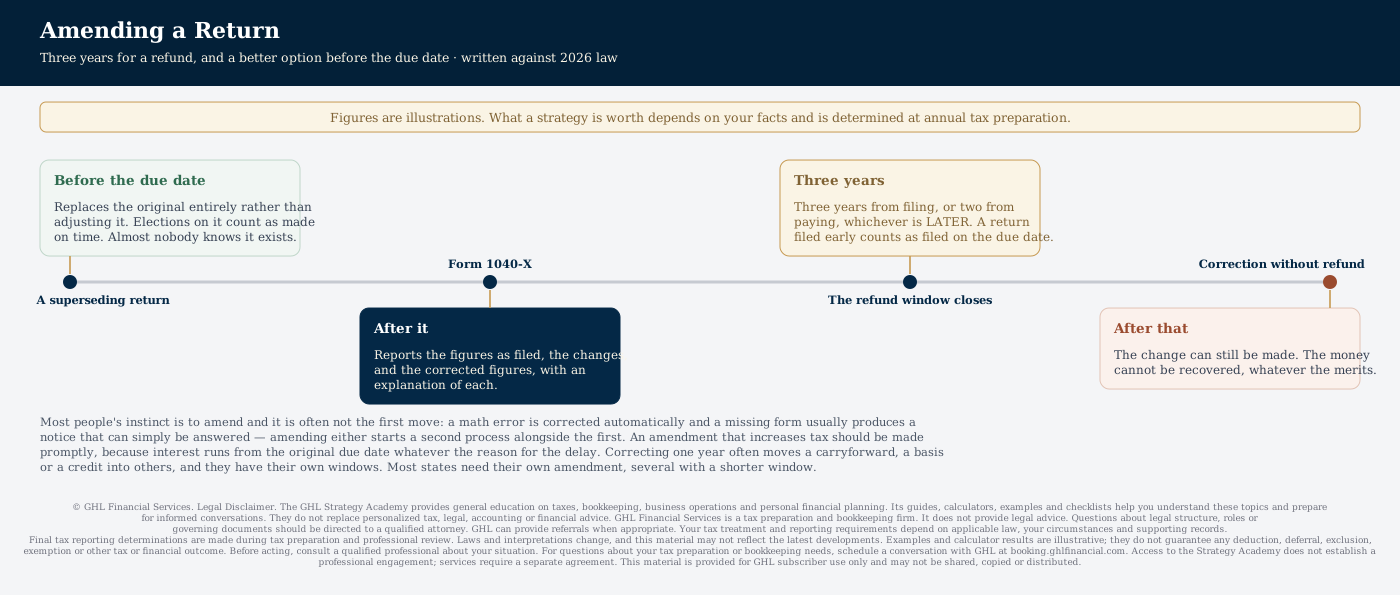
Where the filing deadline has not passed — including an extension — the clean answer is a superseding return. It replaces the original entirely rather than adjusting it, and it is treated as the return for the year. It is quicker, tidier, and almost nobody knows it exists.
Where the deadline has passed, an amendment is the route. The limit that matters is on getting money back: three years from when the return was filed, or two years from when the tax was paid, whichever is later. Past that the correction can still be made and the refund cannot.
| Before the filing deadline, extensions included | a superseding return — replaces the original |
|---|---|
| After it, within three years | an amendment, and a refund is available |
| After three years | the correction can be made; the refund cannot |
| A math error | corrected automatically — nothing to do |
| A missing form | usually a notice; answer it rather than amending |
| An amendment increasing tax | make it promptly — interest runs from the original due date |
The limits in §6511. The two-year measure runs from payment rather than filing, which occasionally makes it the later of the two. State windows differ and are checked separately.
How it works
A superseding return is a complete return filed after an original but before the due date including extensions. It supersedes rather than amends, and the later one is treated as the return for the year.
That makes it the better route whenever it is available — elections made on it are treated as made on time, which an amendment cannot always achieve.
After the due date, Form 1040-X reports the changes: the figures as filed, the changes, and the corrected figures, with an explanation of each.
The refund limit is the later of three years from filing and two years from payment. Filing early does not shorten it — a return filed before the due date is treated as filed on the due date for this purpose.
Some situations have longer windows: a bad debt or a worthless security carries seven years, and a claim relating to a foreign tax credit has its own.
Amending does not, by itself, restart the period in which the tax can be assessed. It can and often does prompt a look at the year, which is a practical consideration rather than a legal one.
Correcting a year that feeds others — a loss carryforward, a basis figure, an unused credit — means the later years move too, and they have their own windows.
State returns are separate. Most require their own amendment, and several have a shorter window than the federal one.
Where an examination is already open, corrections are usually handled within it rather than by filing separately.
What you would do
- Check whether the filing deadline has passed before doing anything. If it has not, a superseding return is the better route.
- For a math error or a missing form, wait for the notice rather than amending — it is usually simpler.
- Work out which is later: three years from filing or two from payment. That is the date, not the earlier of the two.
- Amend the state as well, and check its own window.
- If the change affects later years, list them before starting.
- If tax is going up, do it promptly. Interest is running either way.
What GHL needs from you
- The return as originally filed, in full.
- Whatever prompted the change — a corrected form, a missed document, a recalculation.
- The date the original was filed and the date the tax was paid.
- Which later years the change affects.
- Any notice already received about the year.
What usually goes wrong
- The three-year window is on the REFUND, not on the correction. A return can be amended later; the money cannot be recovered.
- Arithmetic errors are corrected automatically and a missing form usually produces a notice. Amending for either creates two processes running at once.
- Before the filing deadline including extensions there is a better option — a superseding return, which replaces the original rather than adjusting it.
- Amending only the federal return leaves the state one wrong. Most states need their own, with their own window.
- An amendment that increases tax should be made promptly. Interest runs from the original due date whatever the reason for the delay.
- Amending while an examination is open is a different conversation and should not be done without raising it.
- Correcting one year often moves figures into another — a carryforward, a basis, a credit — and the knock-on years have to move with it.
Common questions
I found a deduction I missed four years ago.
The correction can be made and the refund window has almost certainly closed — three years from filing or two from payment, whichever is later. It is worth checking the exact dates rather than assuming.
I filed in February and got a corrected 1099 in March.
The deadline has not passed, so a superseding return is available and is the cleaner route.
Will amending trigger an audit?
It does not restart the assessment period by itself. It does put the year in front of somebody, which is a practical consideration rather than a reason not to correct something.
Do I have to amend the state too?
Almost always, separately, and several states have a shorter window than the federal one.