
When it matters: Disclosure is made with the return, and a position cannot be disclosed retrospectively. The records supporting reasonable cause have to exist at the time the position is taken.
Does this fit you?
- You are taking a position that is arguable rather than settled.
- You are claiming a deduction supported by a valuation.
- Your business is in an area the library marks as closely examined.
- You have received a notice proposing a penalty as well as tax.
What it could be worth
Every guide in this library carries a note on how closely the area tends to be examined. This is what that means in practice: being asked about a position is ordinary, and the question that follows is whether the position was defensible when it was taken.
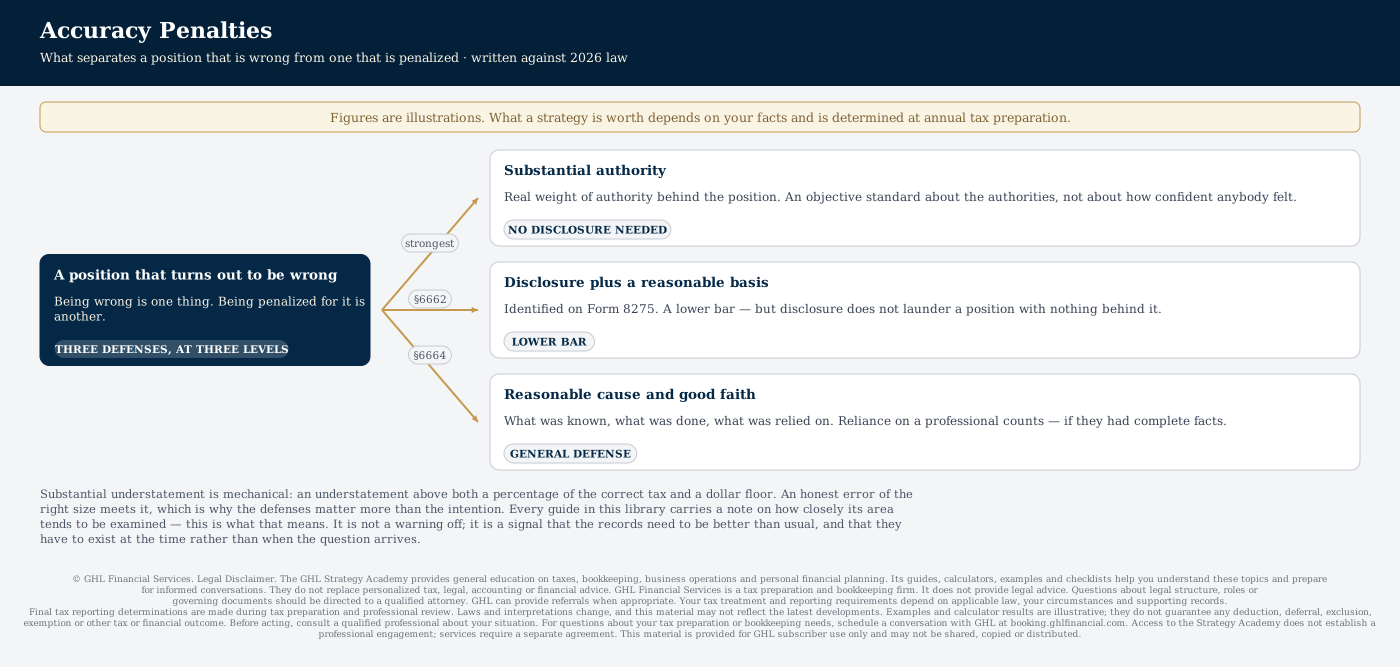
The accuracy-related penalty applies at a percentage of the underpayment, for negligence or for an understatement over a threshold. Three things stand against it, and they work at different levels.
Substantial authority is the strongest: the position is supported by real weight of authority, and no disclosure is needed. Adequate disclosure with a reasonable basis is the next: the position is identified on the return, and the standard it has to meet is lower. Reasonable cause and good faith is the last and covers everything else — including reliance on a professional given complete facts.
| Substantial authority | real weight of authority behind the position; no disclosure needed |
|---|---|
| Disclosure plus a reasonable basis | identified on Form 8275; a lower standard, but not no standard |
| Reasonable cause and good faith | the facts, the advice relied on, and what was done at the time |
| Substantial understatement | a mechanical test on the size of the understatement |
| Negligence | failure to make a reasonable attempt, or to keep records |
| Fraud | a different provision, a much higher rate, and about intent |
The structure of §6662 and §6664. The penalty rate and the understatement thresholds are set by statute and applied by GHL. What the defenses require is unchanged by the year; what changes is whether the evidence for them exists.
How it works
The penalty applies to an underpayment attributable to negligence, to a substantial understatement, or to a substantial valuation misstatement, among others.
Negligence means no reasonable attempt to comply — including a failure to keep the records that would have supported the position.
Substantial understatement is measured: an understatement above both a percentage of the correct tax and a dollar floor. It is arithmetic rather than a judgment about anybody's conduct.
Substantial authority is an objective standard about the weight of authority supporting the position, not about how confident anybody felt. Where it is met, no penalty applies and no disclosure is required.
Where it is not met, adequate disclosure on Form 8275 combined with a reasonable basis for the position can remove the penalty for an understatement. The position still has to be reasonable — disclosure does not launder a position with nothing behind it.
Reasonable cause and good faith under §6664 is the general defense. It turns on what was known, what was done and what was relied on, and it is decided on the facts of the particular return.
Reliance on a professional can be reasonable cause where the professional was given complete and accurate information, had the expertise, and the advice was on the merits rather than a general assurance.
Valuation misstatements carry their own tiers, and the higher tier applies where the valuation is wrong by a large multiple. A qualified appraisal is the usual evidence and its quality is what is examined.
Penalties sit on top of the tax and interest runs on them. Fraud is a separate provision at a much higher rate and is about intent, not amount.
What you would do
- Say when a position is arguable rather than settled, so the decision to take it is made deliberately.
- Keep the records that support it at the time, not when it is questioned.
- Give GHL complete facts, including the ones that are unhelpful. A defense based on advice fails if the advisor was not told.
- For anything resting on a valuation, get a qualified appraisal and keep the appraiser's credentials with it.
- Ask whether disclosure is worth making where a position is reasonable but not settled.
- Bring any notice proposing a penalty promptly — the response window matters.
What GHL needs from you
- The facts behind any position that is not routine.
- Contemporaneous records supporting it.
- Appraisals, with the appraiser's credentials.
- Any written advice relied on, and what facts it was given.
- Any notice proposing a penalty, in full and with its date.
What usually goes wrong
- The penalty is not for being wrong. It is for being wrong without either authority behind the position, disclosure of it, or a reasonable basis for having believed it.
- Relying on a professional is reasonable cause only where you gave complete information and the advice was on the merits. Relying on somebody who was never told the relevant fact is not a defense.
- Disclosure does not protect a position with no reasonable basis. It lowers the bar; it does not remove it.
- Substantial understatement is a mechanical test on the amount, not a judgment about behavior. An honest error of the right size meets it.
- A valuation that is wrong by enough carries its own higher penalty, and appraisals are the usual battleground.
- Penalties are charged on top of the tax and the interest, and interest runs on the penalty too.
- Fraud is a different provision at a much higher rate, and it is about intent rather than about the amount.
Common questions
If my position turns out to be wrong, is a penalty automatic?
No. A well-supported position that loses is not the same as a negligent one.
Does disclosing a position mean I will be looked at?
It identifies the position, which is the point of it. What it buys is a lower standard the position has to meet, and that trade is worth making for some positions and not others.
My preparer told me it was fine.
That can be reasonable cause, where they had complete information and gave advice on the merits.
Why does the library say some strategies are closely examined?
Because they are, and knowing that before acting is the point. It is not a warning off — it is a signal that the records behind it need to be better than usual.