
When it matters: Settled in the purchase agreement, which is where the allocation is written. After signing there is very little left to arrange.
Does this fit you?
- You are thinking about selling in the next few years.
- You have a letter of intent in hand and no tax figure yet.
- Your broker has said the structure 'does not really matter'.
What it could be worth
The difference between structures on the same headline price is routinely a substantial fraction of the proceeds — larger than anything else in this library — and it is decided by the agreement rather than by the return.
Getting the allocation right is where most of it sits. An allocation weighted toward goodwill rather than equipment is taxed at a lower rate, and that is a negotiation rather than an election.
The rest is timing: spreading the price over years can keep it out of the highest band, and a qualifying share sale may take part of the gain out of tax altogether. Both have to be arranged before completion.
| Share sale | one gain on the shares, generally at long-held rates |
|---|---|
| Asset sale | a separate result for each class of asset sold |
| Allocated to equipment | recaptured as ORDINARY income, at full rates |
| Allocated to goodwill | generally at long-held rates |
| Non-compete payment | ordinary income to you, deductible to the buyer |
| What the buyer wants | assets — it gives them a basis to depreciate |
| Both sides report | the SAME allocation, written into the agreement |
The general shape. Which structures are available depends on the entity: a C corporation selling assets can face tax in the company and again on distribution, while an S corporation or partnership generally does not. Installment treatment, and the exclusion available on qualifying small company shares, each have their own conditions.
How it works
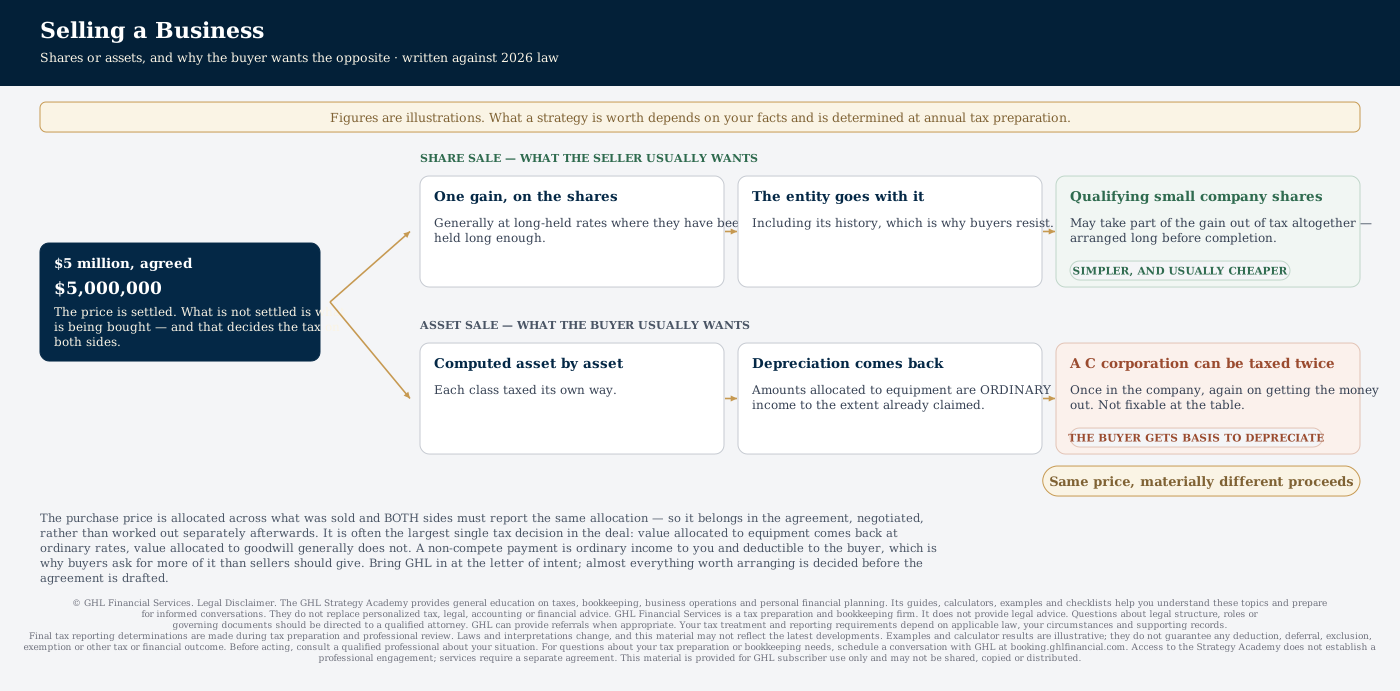
There are two basic shapes. In a share sale the buyer acquires the company with everything in it; in an asset sale they buy the assets and leave the entity behind.
A share sale generally produces one gain for the seller, taxed at long-held rates where the shares have been held long enough.
An asset sale is computed asset by asset, because each class is taxed its own way.
So the purchase price is allocated across the assets, and both parties must report that same allocation — which is why it belongs in the agreement.
Amounts allocated to equipment and fixtures come back as ordinary income to the extent of depreciation already claimed. Amounts allocated to goodwill generally do not.
A payment for a non-compete is ordinary income to the seller and amortized by the buyer, which is why buyers will often ask for more of it than sellers should give.
Taking the price over time can spread the gain across years, at the cost of carrying the buyer's credit risk.
Which entity is selling changes everything. A C corporation selling assets can be taxed in the company and again on distributing the proceeds, and that is not fixable at the negotiating table.
What you would do
- Bring GHL in at the letter of intent, not at the purchase agreement. Almost everything worth arranging is decided before the agreement is drafted.
- Price both structures before negotiating. A higher price on an asset sale can be worth less than a lower one on a share sale.
- Negotiate the allocation as part of the deal, and put it in the agreement. Leaving it to be agreed later gives away the item with the largest rate difference.
- Have the depreciation schedules to hand. The recapture figure comes straight off them and is the number sellers most often have not seen.
- Get an attorney onto the agreement and an appraiser onto anything whose worth is being asserted rather than negotiated.
- If a sale is three to five years away, ask now whether the entity is in the right shape. That is the window in which it can still be changed.
Allow three to six months. It needs documents, and usually somebody else to draw them.
Worksheets to use
- Owner basis schedule (XLSX). Year-by-year opening basis, income, contributions, distributions and losses, with stock and loan basis kept apart. This is the record that decides the gain on a share sale, and it is the first thing asked for when a deal starts. A schedule kept from year one is worth more at this moment than anything else in the file.
What GHL needs from you
- The letter of intent or draft agreement, including any allocation schedule.
- Depreciation schedules for every asset, and what each originally cost.
- The entity type, and how long the shares have been held.
- Your basis in the business — see the basis schedule.
- The payment terms, including any earnout or non-compete.
What usually goes wrong
- A share sale and an asset sale produce very different tax for the same price. The seller usually prefers shares; the buyer usually prefers assets, because assets give them something to depreciate. That tension is the negotiation.
- The purchase price has to be allocated across what was sold, and both sides have to report the SAME allocation. It belongs in the agreement, agreed with advisors, rather than being worked out separately afterwards.
- The allocation decides the rate. Amounts allocated to equipment come back as ordinary income through recapture; amounts allocated to goodwill generally do not. Moving a million between those two lines changes the tax materially.
- Depreciation already claimed is recaptured on an asset sale, which is the item most often missing from a seller's own arithmetic.
- A payment for your agreement not to compete is ordinary income to you and is deductible to the buyer over time. It is frequently traded across the table without either side pricing the tax.
- An earnout is not simply more price. How it is structured decides when it is taxed and sometimes whether it is compensation rather than proceeds.
- A sale of a C corporation's assets can be taxed twice — once in the company and again on getting the money out. Which entity is selling is a question to settle years ahead, not in the negotiation.
Common questions
The buyer wants an asset sale and is offering more. Is that better?
Not necessarily, and the arithmetic is worth doing before answering. An asset sale exposes depreciation recapture at ordinary rates and, for a C corporation, can be taxed twice.
Does the allocation really matter if the price is the same?
It is often the largest single tax decision in the deal. Both sides report the same allocation, so it is negotiated rather than chosen.
We are two years out. What should we do now?
The entity question, the basis records and the depreciation schedules — all three are far easier now than during a negotiation. Two years is enough time to change the shape of the thing being sold, which is the part that cannot be fixed later.
Read next
Keeping it alive
A position is not finished when it is set up. This is what it needs each year to still be there when it matters.
- Confirm it still applies — circumstances change more often than the law does.
- Keep the record current. Filled in as the year happens it is evidence; assembled in March it is a reconstruction.
- Check the documents still say what they said — an agreement that has drifted from practice is the usual failure.
- Ask GHL what changed for 2027. Figures move every year and rules move most years.