
When it matters: Establishing a plan and funding it are two different deadlines, and the establishing one is usually earlier and harder. Several plans have to exist before the year ends even though the money can go in later.
Does this fit you?
- You have no plan yet and are deciding what to put in.
- Your profit has grown past what your current plan can absorb.
- Your business is about to take on its first employees, where the existing plan may no longer fit.
What it could be worth
A retirement contribution is a deduction and a transfer at the same time: the money stays yours. That makes it one of the few places where the tax saved is not offset by money spent.
The gap between plans is large. A plan chosen for simplicity can absorb a fraction of what a defined benefit plan takes, and for a high-profit business with few employees that difference is the largest single planning item there is.
Against that, the more a plan absorbs, the more it costs to run and the more it commits you to. The right answer is the plan that fits the business, not the one with the biggest number.
| Solo 401(k) | owner and spouse only; largest room of the simple options; no employees allowed |
|---|---|
| SEP | simplest to run; employer contributions only; every eligible employee gets the same percentage |
| SIMPLE | small employers; employee deferrals plus a required employer contribution; low overhead |
| Traditional 401(k) | any size; most flexible; testing and administration to match |
| Defined benefit | absorbs by far the most; needs an actuary; commits you to funding in later years |
| Cash balance, alongside a 401(k) | the combination used where profit is high and consistent |
What each plan is designed for, not what it will allow in your case. Contribution limits are set annually, several are indexed, and what a given business can actually put in depends on how it is taxed, how the owner is paid, and who else is on the payroll. A defined benefit or cash balance plan needs an actuary before it can be priced.
How it works
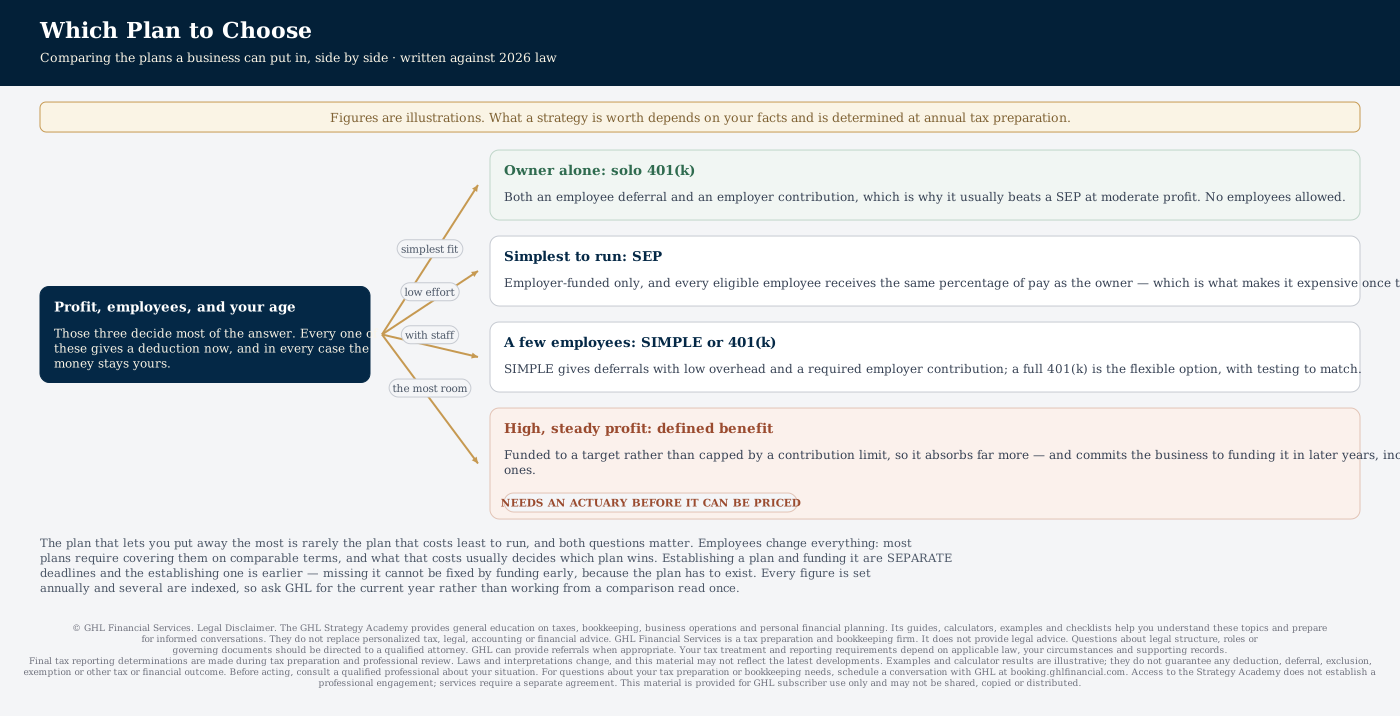
All of these give a deduction now and tax the money when it comes out, and in every case the money remains yours.
They differ on three things: how much can go in, who else has to be covered, and what it costs to administer.
A solo 401(k) suits an owner with no employees and allows both an employee deferral and an employer contribution, which is why it usually beats a SEP at moderate profit.
A SEP is the simplest to run but is employer-funded only, and every eligible employee receives the same percentage of pay as the owner.
A SIMPLE fits a small employer wanting employee deferrals without the administration of a full 401(k), at the cost of a required employer contribution.
A traditional 401(k) works at any size and is the most flexible, with testing and administration to match.
A defined benefit plan is funded to a target rather than by a contribution limit, which is why it absorbs so much more — and it commits the business to funding it in later years.
A cash balance plan alongside a 401(k) is the common combination for a high-profit business with few employees.
What you would do
- Tell GHL the profit, the number of employees, and your age. Those three decide most of the answer.
- Decide before the year end. Several plans have to be established by a date that is earlier than the funding deadline.
- If there are employees, ask what covering them costs before choosing. That figure changes which plan wins.
- If a defined benefit or cash balance plan is in scope, get an actuary involved early — it cannot be priced without one.
- Revisit it when profit changes materially. The plan that fitted at $150,000 of profit is often the wrong one at $600,000.
Allow one to two months. Some of it depends on other people.
What GHL needs from you
- Business profit, and how the business is taxed.
- How the owner is paid — salary, distributions, or self-employment income.
- Everybody on the payroll, with ages, pay and length of service.
- Any plan already in place, and its documents.
- Your age, and roughly when you expect to draw on it.
What usually goes wrong
- The plan that lets you put away the most is rarely the plan that costs least to run. Those two questions have different answers and both matter.
- Employees change everything. A plan that is simple for an owner alone becomes a different proposition the moment there is a second person on payroll, because most plans require covering them on comparable terms.
- Establishing and funding are separate deadlines. Missing the establishing one cannot be fixed by funding early — the plan has to exist.
- A defined benefit plan can absorb far more than any of the others and commits you to funding it in the years afterwards, including bad ones. That commitment is the trade.
- Where a business already has a plan, adding a second is usually not possible, and changing plans mid-year has rules of its own.
- The contribution a plan allows depends on how the business is taxed and how the owner is paid. The same profit produces different limits in a sole proprietor, a partnership and an S corporation.
- Every one of these figures is set annually and several are indexed. Ask GHL for the current year rather than working from a comparison you read once.
Common questions
Which plan lets me put away the most?
A defined benefit or cash balance plan, by a wide margin, because it is funded to a target rather than capped by a contribution limit. It also costs the most to run and commits the business to funding it in later years including bad ones, which is the trade.
I have three employees. Does that rule things out?
It rules out a solo 401(k) and changes the arithmetic on everything else, because most plans require covering employees on comparable terms. What it costs to cover them is the figure that usually decides which plan wins.
Can I set one up after the year end?
Sometimes, and this is where the two deadlines matter: establishing a plan and funding it are separate dates, and the establishing one is usually earlier. Ask before assuming a late decision is still open.
Read next
Keeping it alive
A position is not finished when it is set up. This is what it needs each year to still be there when it matters.
- Confirm it still applies — circumstances change more often than the law does.
- Check the documents still say what they said — an agreement that has drifted from practice is the usual failure.
- Ask GHL what changed for 2027. Figures move every year and rules move most years.