
When it matters: No fixed date. Set two: the day the one change starts, and a review date about 30 days later.
Does this fit you?
- You are waiting on customers for money the business has already earned.
- You have noticed the same customers paying late, or every customer paying a little late.
- You send invoices when there is time rather than when the work is done.
- You are unsure what your payment terms are, or whether customers know them.
What it could be worth
Money that arrives sooner is money the business does not have to borrow, chase or wait for. Profit Is Not Cash explains why a business that is profitable on paper can still be short in the bank, and unpaid invoices are one of the usual reasons.
It also replaces a feeling with a figure. After the review, the business knows its average days outstanding and the delay that turns up most, which is a much better place to start than a sense that customers are slow.
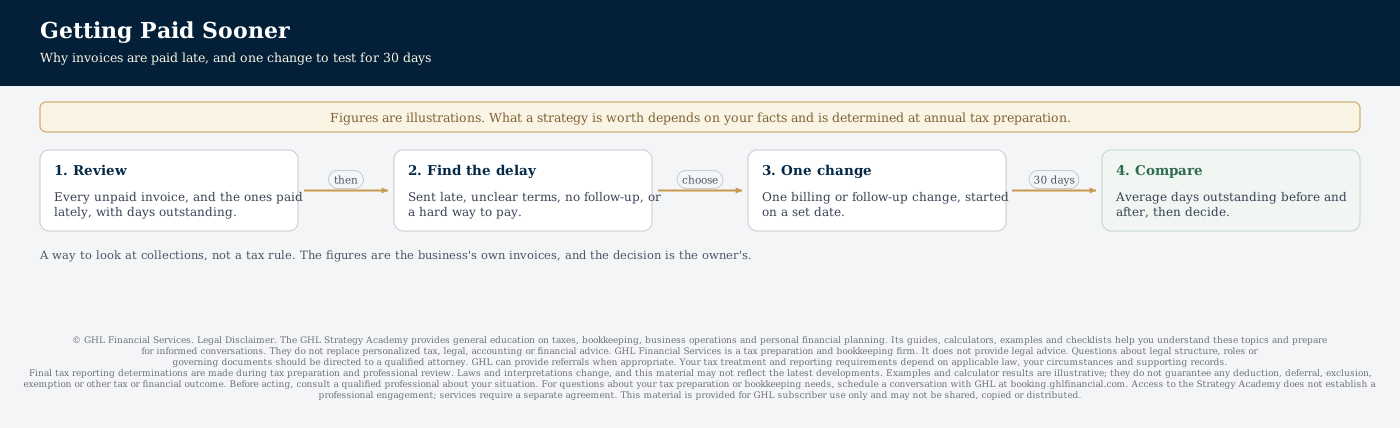
What this produces: the filled-in unpaid invoice review, one change chosen and started on a set date, and a review date about 30 days later when the before and after averages are compared.
| Invoices reviewed | 20, including those paid in the last two months |
|---|---|
| Most common delay found | no follow-up after the due date (8 of the 20) |
| The one change | a reminder on the day after each due date |
| Average days outstanding, before | 45 days |
| Average days outstanding, after 30 days | read from the sheet at the review |
Round illustrative numbers for an imaginary business, not a statistic about businesses in general and not a promise about any one. What the change does is read from the business's own invoices at the review date; it may do little, and that is a result too.
How it works
SBA guidance, not a tax rule: “Ensure that someone can manage the following: Accounts receivable Accounts payable Available cash Bank reconciliation Payroll” And on payments: “Accept forms of payments that are cost effective, secure, and provide a positive experience for your customers.”
Days outstanding is the time from the invoice date to the day the money arrives. The worksheet counts it for each invoice, and keeps counting while an invoice is unpaid.
Late payment usually has a cause that repeats. Four turn up often: the invoice went out late, the terms were unclear or missing, nobody followed up, or paying was harder than it needed to be.
Some causes sit with the customer — a dispute, a cash problem of their own. Those are worth knowing too, because the response to them is different.
A review looks at enough invoices to see a pattern: those unpaid today, plus those paid in the last month or two. One row each, with the reason it was late.
One change at a time is what makes the result readable. Sending invoices on the day the work is done, putting the due date in the first line, a reminder on a set day, a payment link on the invoice: any of these can be tested, but only one per trial.
After about 30 days the business has a second set of invoices to compare. The question is whether the average days outstanding moved, and whether the change was worth what it cost in time or goodwill.
Whether to charge interest or late fees, or how to pursue a customer who will not pay, raises contract and legal questions this guide does not answer. Bad Debts covers what an invoice that is never paid means for the return.
Sources
What you would do
- Download the unpaid invoice review and list every unpaid invoice, plus those paid in the last month or two.
- For each one, pick the reason it was late. Read the count of reasons.
- Choose ONE change aimed at the reason that turns up most, and write down the date it starts.
- Put the review date in the diary, about 30 days later.
- Log the new invoices in the second table as they go out and as they are paid.
- At the review date, compare the averages and decide: keep the change, adjust it, or drop it and try the next.
Usually a week or two — mostly things you can start yourself.
Worksheets to use
- Unpaid invoice review (XLSX). Each invoice with its dates, amount, days outstanding and the reason for the delay, a count of reasons, and before and after averages around one change. Fill in the first table in one sitting, pick one change, then log the next 30 days of invoices in the second table and compare at the review date.
What usually goes wrong
- Changing three things at once. If invoices start arriving sooner, nobody can tell which change did it, and the other two may be costing goodwill for nothing.
- Reviewing only the invoices that are overdue today. The ones paid late last month show the same pattern and are easier to learn from.
- Treating every late payer as the problem. Often the invoice went out a week after the work, or the terms were never written on it.
- Following up with no date in the diary. An invoice nobody asks about tends to be paid last.
- Judging the change after a week. Thirty days is short already; invoices sent near the end of the trial may not be due yet.
Common questions
Is it worth reviewing if only a few customers pay late?
Often, yes. A handful of late payers can still carry most of the money outstanding, and the review shows whether the delay is theirs or something in how the business bills them.
What if the reason is different for every invoice?
Then the first change is usually the one that touches every invoice — sending it the day the work is done, or a reminder on a set day — rather than one aimed at a single customer.
Should the business add late fees?
That is a decision with contract and legal questions in it, and with customer relationships in it too. It is one possible change to weigh, not the first one this guide points at.
Read next
Keeping it alive
A position is not finished when it is set up. This is what it needs each year to still be there when it matters.
- Confirm it still applies — circumstances change more often than the law does.
- Keep the record current. Filled in as the year happens it is evidence; assembled in March it is a reconstruction.
- Put the date in the calendar. This one closes at the year end and cannot be added at tax preparation.
- Ask GHL what changed for 2027. Figures move every year and rules move most years.