
Does this fit you?
- Your business is cutting back on people, space, equipment or products while it keeps operating.
- You are weighing a smaller version of the business against closing or selling it.
- You are past the first cuts and unsure what paperwork follows.
What it could be worth
Nothing here lowers a tax bill by itself. It sets out what to weigh before a business becomes smaller, and the tax paperwork that follows the changes.
Closing a Business and Closing With the IRS cover ending a business. This guide is for a business that becomes smaller and carries on.
How it works
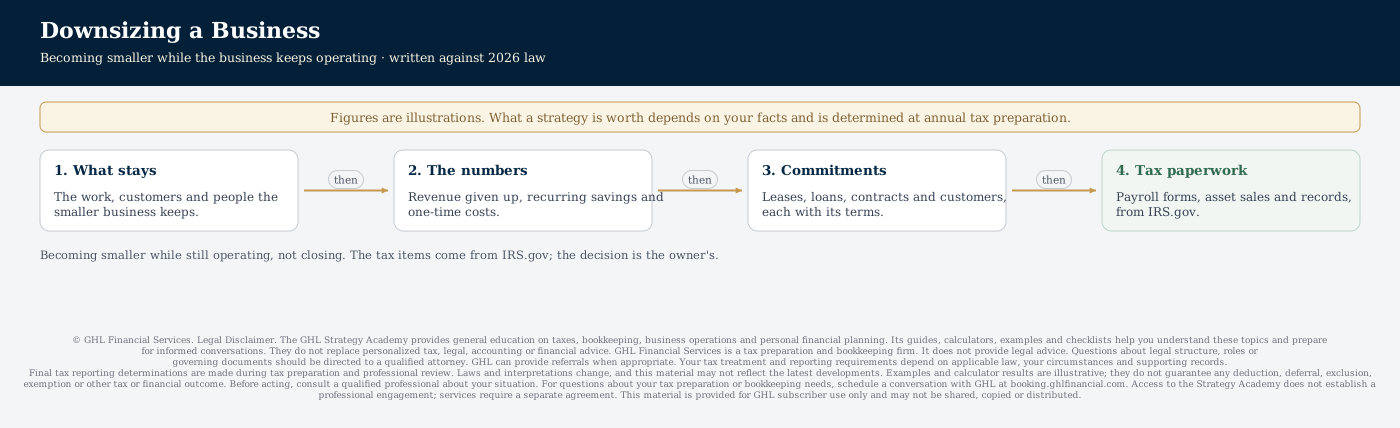
Downsizing means the business keeps operating at a smaller size: fewer people, less space, fewer products or a narrower market. Closing ends the business; its own guides cover that.
Questions to weigh before deciding: which work and customers the smaller business keeps; how much revenue goes with what is cut; the recurring savings each month; the one-time costs of getting there; and what the owner's own time looks like afterward.
When the team gets smaller, the money jobs move to fewer people. SBA guidance, not a tax rule: “Ensure that someone can manage the following: Accounts receivable Accounts payable Available cash Bank reconciliation Payroll”
Commitments come next. Each lease, loan, equipment finance agreement and customer or supplier contract has terms about ending early, changing or assigning it. Reading those terms is legal work; an attorney can explain what a contract allows, and GHL can introduce one.
SBA's advice before ending a lease or selling equipment, SBA guidance and not a tax rule: “Before terminating your lease, selling equipment, and disconnecting utilities, talk to your lawyer and accountant.”
Payroll while the business continues. IRS.gov, Instructions for Form 941: “If none of these exceptions apply and you haven’t filed a final return, you must file Form 941 each quarter even if you didn’t pay wages during the quarter.” And: “If you permanently go out of business or stop paying wages to your employees, you must file a final return.”
Employees who leave. IRS.gov, General Instructions for Forms W-2 and W-3: “If an employee asks for Form W-2, give them the completed copies within 30 days of the request or within 30 days of the final wage payment, whichever is later.”
Staff changes also raise employment-law questions (notice, final pay rules, benefits) that vary by state and by the size of the business. Those are for an attorney or HR professional, not this guide.
SBA guidance, not a tax rule: “You must also comply when terminating an employee, laying off workers, or downsizing the company.” And: “Consult the Department of Labor’s federal and state law resources.”
Selling equipment or other business property. IRS.gov, About Form 4797: “Use Form 4797 to report:” … “The sale or exchange of property.” Publication 544: “When you dispose of depreciable property (section 1245 property or section 1250 property) at a gain, you may have to recognize all or part of the gain as ordinary income under the depreciation recapture rules.”
New terms with a lender. IRS.gov, Publication 4681: “Generally, you must include the canceled debt in your income. However, you may be able to exclude the canceled debt.”
Records. IRS.gov, Employment tax recordkeeping: “Keep all records of employment taxes for at least four years after filing the 4th quarter for the year.”
Not covered here: state payroll and unemployment accounts, sales tax permits and state filings. Those follow each state's own rules, from that state's own website.
Sources
- IRS.gov: Instructions for Form 941
- IRS.gov: General Instructions for Forms W-2 and W-3
- IRS.gov: About Form 4797, Sales of Business Property
- IRS.gov: Publication 544, Sales and Other Dispositions of Assets
- IRS.gov: Publication 4681, Canceled Debts, Foreclosures, Repossessions, and Abandonments
- IRS.gov: Employment tax recordkeeping
- SBA.gov: Manage your business (SBA guidance)
What you would do
- Write down what the smaller business keeps: the work, the customers and the people.
- Put the revenue given up beside the recurring savings and the one-time costs, month by month.
- List every lease, loan and contract, with what its terms say about ending early or changing.
- Decide who tells customers and suppliers, and when.
- Before any staff change, talk with an attorney or HR professional about notice, final pay and benefits.
- Keep the payroll records for anyone who leaves, and the cost and depreciation records for anything sold.
- Set a date to look again at the numbers once the change has run for a few months.
Allow one to two months. Some of it depends on other people.
What GHL needs from you
- The payroll records for the year, including final pay for anyone who left.
- For each asset sold: what it cost, when it was bought, the depreciation taken and what it sold for.
- Any letter or form from a lender about a balance that was reduced or forgiven, including a Form 1099-C.
- All of it sent through the Secure Client Portal, not by email.
What usually goes wrong
- Treating downsizing as closing. A business that keeps operating keeps filing: IRS.gov says Form 941 is still due each quarter unless a final return was filed or an exception applies.
- Counting the savings and not the revenue that leaves with them. A smaller cost base can come with smaller sales.
- Forgetting the one-time costs: final pay, ending a lease early, moving, or selling equipment below what is owed on it.
- Selling equipment without the records of what it cost and what was depreciated. The gain or loss is figured from them.
- Agreeing new terms with a lender without asking what a forgiven balance means for the return.
Common questions
We have no employees left but the business is still open. Do we keep filing Form 941?
The Instructions for Form 941 say a final return is filed when a business permanently goes out of business or stops paying wages to its employees, and that otherwise Form 941 is filed each quarter unless an exception applies. Which one fits is worth confirming with GHL before the next quarter.
Is downsizing the same as closing for tax purposes?
No. A business that keeps operating keeps its returns and accounts. Closing a Business and Closing With the IRS cover what changes when a business ends.
Who can explain what our lease says about leaving early?
That is a question about the contract, which is legal work. An attorney can answer it; GHL can introduce one, and then handle the bookkeeping and tax side of whatever is agreed.
Read next
Keeping it alive
A position is not finished when it is set up. This is what it needs each year to still be there when it matters.
- Confirm it still applies — circumstances change more often than the law does.
- Put the date in the calendar. This one closes at the year end and cannot be added at tax preparation.
- Ask GHL what changed for 2027. Figures move every year and rules move most years.