
When it matters: Final payroll returns and W-2s follow the ordinary dates. State dissolution is what stops the annual fees, and it does not happen by itself.
Does this fit you?
- You are winding down a business, whether it is being sold, given up or simply stopped.
- You stopped trading a while ago and never formally closed the entity.
- You are a shareholder in a company that is about to be liquidated.
- You have employees to let go, where the payroll side has its own deadlines.
What it could be worth
Closing well is mostly a sequencing problem. Several of the filings depend on each other, and two of them create personal exposure that the entity does not stand between you and.
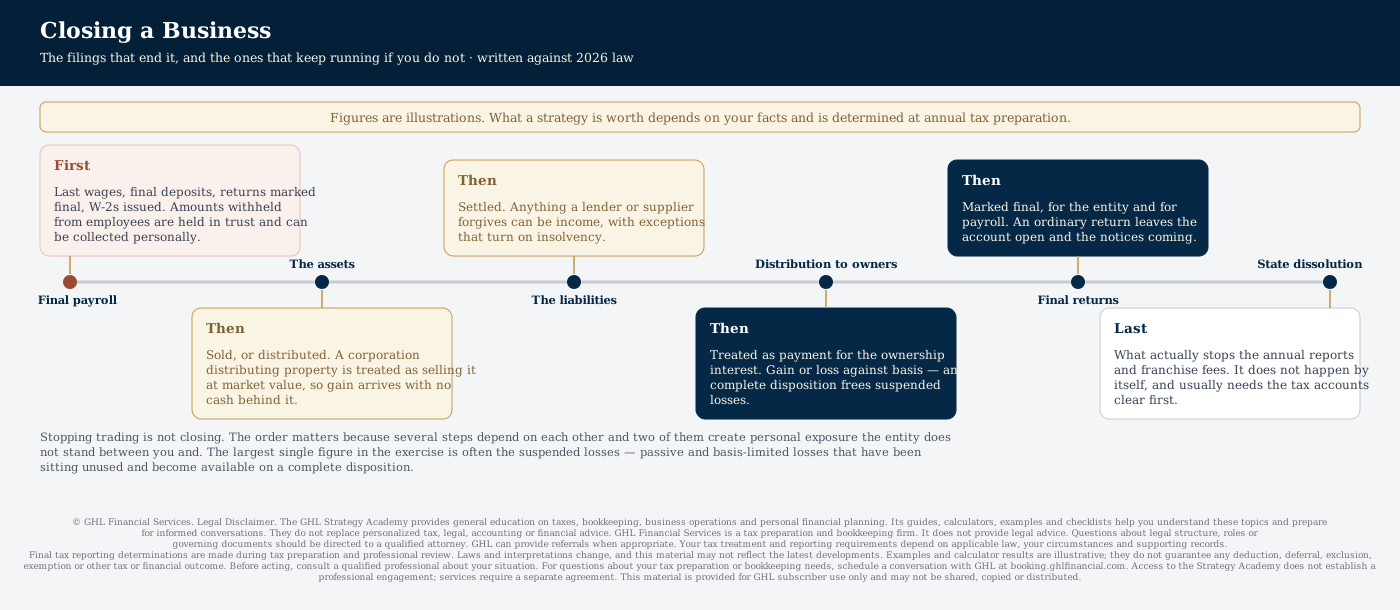
The order that works: settle payroll and its deposits, deal with the assets, make the final distributions, file the final returns marked as final, then dissolve with the state. Dissolving first is the version that leaves obligations with nowhere to report them.
The part worth the most is usually the losses. A complete disposition frees suspended passive losses and basis-limited losses that have been sitting unused, and a shareholder whose stock has become worthless may have an ordinary rather than a capital loss if the stock qualified when it was issued.
| 1. Final payroll | last wages, final deposits, returns marked final, W-2s issued |
|---|---|
| 2. The assets | sold, or distributed — either way a disposal at market value |
| 3. Liabilities | settled; anything forgiven may be income |
| 4. Distribution to owners | treated as payment for the ownership interest |
| 5. Final returns | marked final, for the entity and for payroll |
| 6. State dissolution | what actually stops the annual fees |
The ordinary sequence for a small entity. Which of these apply depends on how the business is taxed and what it owns. GHL works the actual treatment — and what each step costs — from your own figures.
How it works
Payroll comes first because it is the one with personal consequences. Amounts withheld from employees are held in trust, and where they are not paid over they can be collected personally from whoever was responsible, whatever the entity is.
Final payroll returns have a box marking them final. Ticking it is what closes the account; without it the filings are expected to continue and the notices follow.
Assets can be sold or distributed. A corporation distributing property to its owners is treated as having sold it at market value, so gain can arise on the way out with no cash to pay it from.
For a partnership or a single-member entity the mechanics differ, and a distribution of property is usually not a disposal at that level — but basis and the character of any gain still have to be worked through.
Liabilities settled for less than they are owed can produce cancellation of debt income, with exceptions that depend on insolvency and on the kind of debt.
What is distributed to owners is treated as payment for their interest. Gain or loss is the difference against basis, and basis by then is the sum of years of contributions, income and distributions.
A complete disposition frees suspended losses — passive losses held back by the at-risk or passive rules become usable, and that is often the largest single number in the exercise.
Where stock in a small company becomes worthless, the loss may be ordinary rather than capital if the stock qualified when it was issued. It is decided by facts fixed years earlier.
State dissolution is a separate act, filed with the state, and it is what stops annual reports and franchise fees. It usually requires the tax accounts to be clear first, which is why it is last.
What you would do
- Tell GHL before you stop, not after. Several of the steps have an order and some of them cannot be taken back.
- Settle every payroll deposit, including the final one, before anything else is paid out.
- List what the business owns and what it is worth now, not what it cost.
- List what it owes, and say if anything is being written off by a lender or a supplier.
- Ask what suspended losses are sitting there — they may be the largest thing in the closing.
- Dissolve with the state, and keep the confirmation. It is the only proof the fees should have stopped.
- Agree where the records will live for the years they still have to be kept.
Allow one to two months. Some of it depends on other people.
What GHL needs from you
- A list of assets with original cost and current value.
- A list of liabilities, and anything being forgiven.
- Final payroll figures and proof of the last deposits.
- Your basis in the business, or the records to rebuild it.
- Any suspended loss carried forward.
- The state dissolution filing, once it is made.
What usually goes wrong
- Stopping trading is not dissolving. An entity that is not formally dissolved keeps its state filing obligations and its annual fees, sometimes for years.
- Unpaid payroll tax is personal. The trust fund portion — what was withheld from employees — can be collected from whoever was responsible for paying it, and no entity protects against that.
- Distributing assets instead of selling them is still a disposal. A corporation distributing property is treated as having sold it at market value, and the gain appears before anybody has cash.
- Debt forgiven on the way out can be income, which is a cruel place to find one.
- Final returns have to be marked final, and the payroll returns have a box of their own. Filing an ordinary return leaves the account open and the notices coming.
- Suspended losses often become usable on a complete disposition — leaving them behind is giving away a deduction that had been waiting years.
- Records still have to be kept afterwards, and by then nobody owns the filing cabinet.
Common questions
I stopped trading two years ago. Is there anything to do now?
Probably several things — final returns if they were never filed, and dissolution with the state, which is usually what has been quietly generating fees since. It is worth dealing with rather than leaving.
There is no money left. Does that end the payroll problem?
No, and it is the reason to raise it early. The trust fund portion can be collected personally from whoever was responsible, and an empty company does not stand between that and you.
Can I just keep the equipment instead of selling it?
You can, and taking it out is still a disposal at market value. The gain appears without any cash arriving, which is worth knowing before rather than after.
I put $80,000 in and got nothing back. Is that a loss?
Usually yes, once the interest is genuinely worthless or disposed of. Whether it is an ordinary loss or a capital one turns on how the stock was issued, and that is worth checking rather than assuming.
Read next
Keeping it alive
A position is not finished when it is set up. This is what it needs each year to still be there when it matters.
- Confirm it still applies — circumstances change more often than the law does.
- Put the date in the calendar. This one closes at the year end and cannot be added at tax preparation.
- Ask GHL what changed for 2027. Figures move every year and rules move most years.