
When it matters: No fixed date. The forecast is most useful updated once a week, on the same day each week.
Does this fit you?
- You have had a week where the bank balance was lower than you expected.
- You are profitable on paper but often short of cash.
- You have a large payment coming — equipment, a tax payment, an annual bill.
- You are about to take on growth that means paying out before getting paid.
What it could be worth
A low week seen six weeks ahead leaves choices: chasing an invoice, moving a purchase, arranging credit before it is needed. The same week discovered on the day leaves far fewer. That is the whole reason to forecast by week.
It also makes the gap between profit and cash visible. Profit Is Not Cash explains where the gap comes from; the forecast shows when it lands.
What this produces: the filled-in thirteen-week forecast, the lowest week identified, what will be done about it and by when, and a weekly day to roll it forward.
| Opening balance, week 1 | $20,000 |
|---|---|
| Money in, weeks 1 to 5 | about $8,000 a week from customer payments |
| Money out, weeks 1 to 5 | about $7,000 a week, plus payroll every other week |
| Week 6 | an annual insurance payment of $12,000 leaves |
| Closing balance, week 6 | the lowest of the thirteen, and below the cushion |
Round illustrative numbers for an imaginary business that is profitable over the quarter. The low week comes from timing alone: one large payment landing in a week when receipts are ordinary. No tax figure or rule is in it.
How it works
SBA guidance, not a tax rule: “The balance sheet is the foundation of managing your finances.” “It helps you keep track of your capital and provide a cash flow projection for future years.”
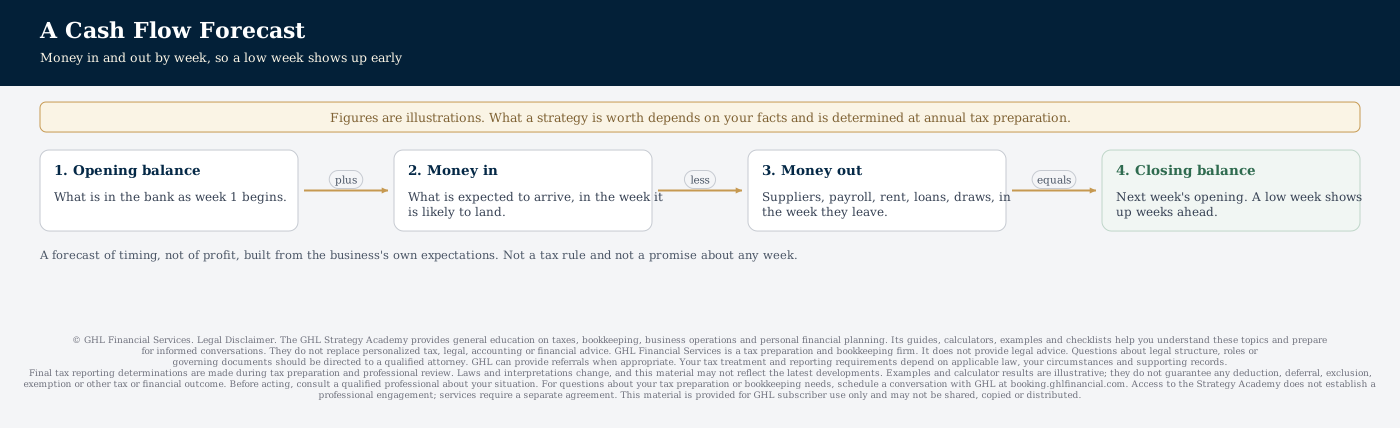
Each week starts with the bank balance carried from the week before. Week 1 starts with the actual balance on the day the forecast begins.
Money in is what is expected to arrive that week: customer payments in the week they are likely to land, cash and card sales, any loan or owner money put in.
Money out is what will leave that week: suppliers, payroll and contractors, rent, loan payments, tax payments, owner draws, and anything else.
The closing balance is the opening balance plus money in less money out, and it becomes the next week's opening balance. Thirteen weeks is about one quarter, long enough to see the large payments that come round a few times a year.
A cushion is the lowest balance the owner wants to hold. The sheet marks any week that closes below it, so the low weeks stand out.
Timing is the point. A quarter can be profitable and still have a week where more leaves than arrives, because customers pay later than suppliers are paid, or because one large bill lands in an ordinary week.
Each week, that week's forecast is replaced with what happened and a week is added at the end, so the view always runs about three months ahead.
Sources
What you would do
- Download the thirteen-week forecast and enter the date week 1 begins, the opening bank balance and a cushion.
- Fill in the money expected in, by the week it is likely to arrive.
- Fill in the money going out, including loan payments, tax payments and owner draws.
- Find the lowest closing balance and any weeks marked Low.
- Write down what will be done about the lowest week, and by when.
- Pick one day a week to replace the past week with actual figures and add a new week at the end.
Usually a week or two — mostly things you can start yourself.
Worksheets to use
- Thirteen-week cash flow forecast (XLSX). Thirteen weekly columns: opening balance, money in, money out, net cash flow and closing balance, with weeks below a chosen cushion marked Low. Fill it in once, then update it weekly: replace the past week with what happened and add a week at the end of your copy.
What usually goes wrong
- Entering income in the week the invoice is sent rather than the week the money is likely to arrive.
- Forgetting the payments a profit and loss does not show as costs: loan principal, equipment bought outright, owner draws.
- Leaving out the large payments that come round a few times a year: insurance, annual software, tax payments.
- Building it once and never updating it. A forecast replaced each week with what actually happened is the one that stays honest.
- Assuming every customer pays on the due date. Getting Paid Sooner shows how to find out how late they really pay.
Common questions
Why weekly rather than monthly?
Because a month can end in a healthy position and still have a week in the middle where payroll and a large bill land before the customer payments arrive. Weekly columns show that week; monthly ones average it away.
What if I do not know when customers will pay?
Use what they have done before: the unpaid invoice review shows how many days they usually take. A forecast that assumes everyone pays on time hides the weeks it exists to show.
What can be done about a low week?
The usual options are moving money in earlier, moving money out later, or arranging to cover the gap — and each has its own costs and conversations. The forecast's job is to show the week early enough for those to be choices.
Read next
Keeping it alive
A position is not finished when it is set up. This is what it needs each year to still be there when it matters.
- Confirm it still applies — circumstances change more often than the law does.
- Keep the record current. Filled in as the year happens it is evidence; assembled in March it is a reconstruction.
- Put the date in the calendar. This one closes at the year end and cannot be added at tax preparation.
- Ask GHL what changed for 2027. Figures move every year and rules move most years.