
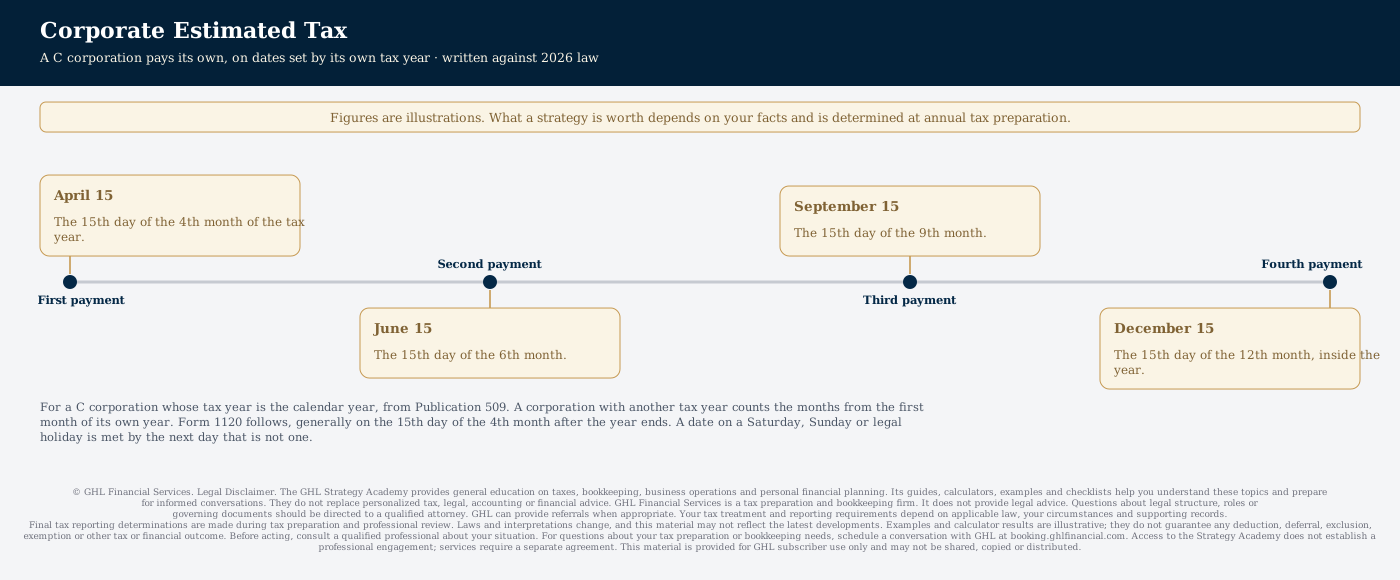
When it matters: The 15th day of the 4th, 6th, 9th and 12th months of the corporation's tax year: April 15, June 15, September 15 and December 15 for a calendar year.
Does this fit you?
- You own a C corporation.
- Your corporation's tax year is not the calendar year.
- You pay estimated tax personally and are not sure what that covers.
What it could be worth
A C corporation is taxed as its own taxpayer, on Form 1120. One that expects to owe $500 or more generally pays its own tax during the year rather than all at once with its return, separately from anything the owner pays personally.
What this is worth is keeping the two apart: the corporation's payments under the corporation's name and number, on the corporation's dates, and the owner's under theirs.
How it works
Which corporations pay. IRS.gov: “Corporations generally have to make estimated tax payments if they expect to owe tax of $500 or more when their return is filed.” The test is the corporation's own expected tax, not the owner's.
When. Publication 509: “Payments are due on the 15th day of the 4th, 6th, 9th, and 12th months of the corporation's tax year.” For a corporation whose tax year is the calendar year, those are April 15, June 15, September 15 and December 15.
A corporation with a different tax year counts the months from the first month of its own year. For a year beginning July 1, the same sentence gives October 15, December 15, March 15 and June 15.
The return the payments are made against. Publication 509 on Form 1120: “This form is due on the 15th day of the 4th month after the end of the corporation's tax year.” That is generally April 15 for a calendar year.
Weekends and holidays. Publication 509 moves a due date that falls on a Saturday, Sunday or legal holiday to the next day that is not one.
The owner's own estimates are a different system, with Form 1040-ES, its own threshold and its own dates, covered in the Estimated Payments guide. The corporation's payments and the owner's are made for two different taxpayers.
Not covered here, because the wording has not been checked against IRS.gov: how each installment is figured, how a corporation makes the payments, what happens when one is short, getting an overpayment back before the return, and whether an S corporation ever makes estimated payments of its own.
Sources
What you would do
- Write down the corporation's tax year, and from it the four installment months.
- Put the four dates on the business calendar, apart from the owner's own.
- Pay from the corporation's account, under the corporation's name and EIN, and keep each confirmation.
- Re-check the expected tax when profit moves, and note the question for a qualified tax professional.
Allow one to two months. Some of it depends on other people.
What GHL needs from you
- Confirmation of each estimated payment the corporation made in the year.
- The prior year's Form 1120.
- The year's profit by quarter, from the books.
- All of it sent through the Secure Client Portal, not by email.
What usually goes wrong
- Paying the corporation's estimate from the owner's personal account, or under the owner's own number.
- Using the owner's Form 1040-ES dates for a corporation whose tax year is not the calendar year.
- Leaving the fourth payment to January. For a calendar-year corporation it falls in December, inside the year.
- Assuming the owner's own estimates cover the corporation. They are payments for a different taxpayer.
Common questions
I pay estimates personally. Does that cover the company?
No. A C corporation is taxed as its own taxpayer, and its estimated payments are made in its own name, on its own dates.
Our year ends in June. Which dates apply?
Publication 509 counts from the corporation's own tax year: the 15th day of its 4th, 6th, 9th and 12th months. For a year that begins July 1, that is October 15, December 15, March 15 and June 15.
We are an S corporation. Does this apply?
This guide is written for a C corporation. Whether an S corporation makes estimated payments of its own is not covered here; it is a question for a qualified tax professional.
Read next
Keeping it alive
A position is not finished when it is set up. This is what it needs each year to still be there when it matters.
- Confirm it still applies — circumstances change more often than the law does.
- Put the date in the calendar. This one closes at the year end and cannot be added at tax preparation.
- Ask GHL what changed for 2027. Figures move every year and rules move most years.