
When it matters: Both charges are assessed on the year, so the documentation of business need has to exist for that year. For the accumulated earnings tax, a dividend paid by the 15th day of the fourth month after the year end counts as paid during that year (IRC 563(a)); after that, it does not reach back.
Does this fit you?
- You run a business taxed as a C corporation with profit staying inside it.
- Your corporation has sold its trading business and is holding the proceeds.
- You are deciding between salary, dividend and leaving it in.
- You have been told a C corporation is better because the rate is lower.
What it could be worth
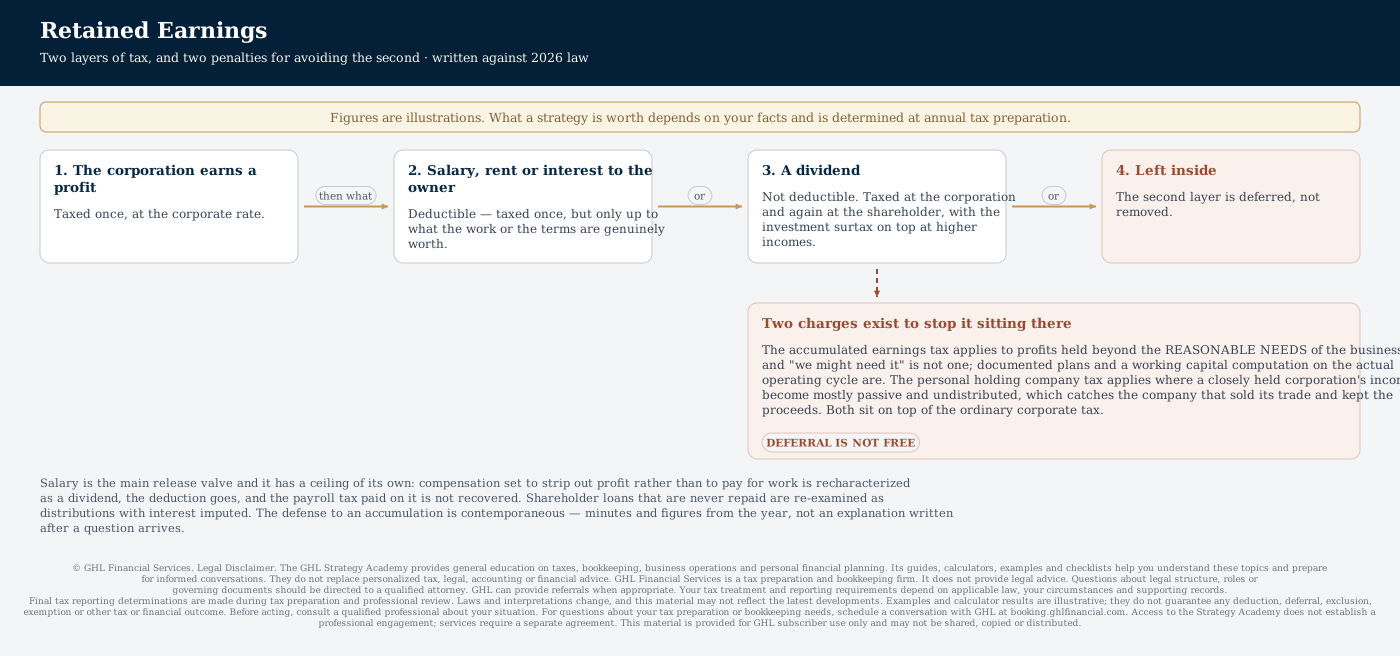
A C corporation pays tax on its profit, and the shareholder pays again when the profit comes out as a dividend. That is the structural cost, and the whole of C-corporation planning is about which route the money takes out.
Salary is the main release valve: it is deductible to the corporation, so it is taxed once rather than twice. It has to be reasonable for the work actually done, which is the same question an S corporation faces from the opposite direction — there the pressure is to pay too little, here it is to pay too much.
Leaving the money in defers the second layer, and there are two charges designed to stop exactly that. The accumulated earnings tax applies where profits are held beyond the reasonable needs of the business. The personal holding company tax applies where a closely held corporation's income has become mostly passive and is not distributed. Both sit on top of the ordinary corporate tax.
| Salary for work done | deductible to the corporation — taxed once, as ordinary income |
|---|---|
| Dividend | not deductible — taxed at the corporation and again at the shareholder |
| Rent or interest to the owner | deductible if genuinely at market terms |
| Fringe benefits for an owner-employee | deductible and not added to pay |
| Left inside beyond the needs of the business | the accumulated earnings charge, on top |
| Left inside where income is mostly passive | the personal holding company charge, on top |
The structure of the two layers and the two charges. Rates and the accumulation credit are set by statute and applied by GHL for your year. Whether an accumulation is reasonable is a facts question decided on the documentation that existed at the time.
How it works
Corporate profit is taxed at the corporate rate. What is then distributed as a dividend is taxed again to the shareholder, at the qualified dividend rates where the conditions are met, with the investment surtax on top for higher incomes.
Salary paid for genuine work is deductible, so it escapes the first layer. It carries payroll tax instead, which is the trade, and it has to be reasonable — a figure set to strip out profit rather than to pay for work is recharacterized.
Rent for property the owner provides, and interest on genuine loans from the owner, are also deductible where the terms are what an unrelated party would agree.
Fringe benefits for an owner-employee of a C corporation are deductible and not added to pay, which is one of the few places this structure is straightforwardly better than the alternatives.
The accumulated earnings charge applies to taxable income retained beyond the reasonable needs of the business, above a credit amount. Reasonable needs means specific and documented: a planned acquisition, a building, working capital computed on the business's own operating cycle, a known liability.
The defense is contemporaneous. Minutes recording the plan, and a working capital calculation based on the actual cycle, carry weight; an explanation written after a question arrives does not.
The personal holding company charge is mechanical rather than judgmental: where a set share of adjusted income is passive and a small group owns a majority, undistributed passive income is charged. The usual cure is to distribute it.
That one catches the corporation that sold its trade and kept the proceeds invested — it can become a personal holding company without anybody deciding anything.
Shareholder loans are examined closely. A genuine loan has a note, a market rate and actual repayments; without them it is a distribution with interest imputed on it.
What you would do
- Document the reason for any significant accumulation in the year it happens, in the minutes, with figures.
- Compute working capital needs from the business's own operating cycle rather than asserting a number.
- Review the owner's salary annually against what the role would cost to fill, and keep the comparison.
- Paper any loan to or from the owner properly, and make the repayments actually happen.
- Watch the mix of income after a sale of the trade — that is when the passive charge becomes a live risk.
- Raise the entity question periodically rather than once. What was right at $200,000 of profit is often not right at $2,000,000.
Allow one to two months. Some of it depends on other people.
What GHL needs from you
- The corporation's income split between operating and passive.
- Retained earnings and what they are earmarked for, with the minutes.
- A working capital computation for the year.
- Owner compensation, and the comparison supporting it.
- Any shareholder loans, with the notes and the repayment history.
What usually goes wrong
- Leaving profit in the company defers the second layer; it does not remove it. The money is still inside a structure that taxes it again on the way out.
- The accumulated earnings charge applies to profits held beyond the reasonable needs of the business, and 'we might need it' is not a reasonable need. Specific, documented plans are.
- The personal holding company charge catches the opposite case: a corporation whose income has become mostly passive and which is closely held. A company that sold its operations and holds the proceeds is the classic one.
- Paying it all out as salary is the obvious release valve and it has its own limit — compensation has to be reasonable for the work, or it is recharacterized as a dividend and the deduction goes.
- Loans to shareholders that are never repaid are not a way out. They are re-examined as distributions, with interest imputed on top.
- Both charges are assessed in addition to the ordinary corporate tax, not instead of it.
Common questions
The corporate rate is lower than mine. Why not leave it all in?
Because the second layer has not gone away, it has been deferred — and two charges exist specifically to stop indefinite deferral. It can still be the right answer; it is not free.
How much can we retain safely?
There is a credit amount below which the accumulation charge does not apply, and above it the test is documented business need rather than a figure. What makes it safe is the documentation, not the amount.
We sold the business and the company holds the cash.
That is the case the personal holding company charge is built for. It is worth addressing deliberately and early, because the usual cure is distribution and that has its own cost.
Can I just pay myself a very large salary?
Only up to what the work is genuinely worth. Beyond that it is recharacterized as a dividend, the deduction is lost, and the payroll tax paid on it is not recovered.
Read next
Keeping it alive
A position is not finished when it is set up. This is what it needs each year to still be there when it matters.
- Confirm it still applies — circumstances change more often than the law does.
- Put the date in the calendar. This one closes at the year end and cannot be added at tax preparation.
- Ask GHL what changed for 2027. Figures move every year and rules move most years.