
When it matters: The deduction belongs to the year the debt becomes worthless, which is a facts question rather than a choice. Taking it in the wrong year is the usual reason it is disallowed.
Does this fit you?
- Your business is carrying receivables it is not going to collect.
- You lent money to your own company and are not getting it back.
- You lent to a friend or a family member and have written it off privately.
- You are deciding between cash and accrual accounting, where this is one of the differences.
What it could be worth
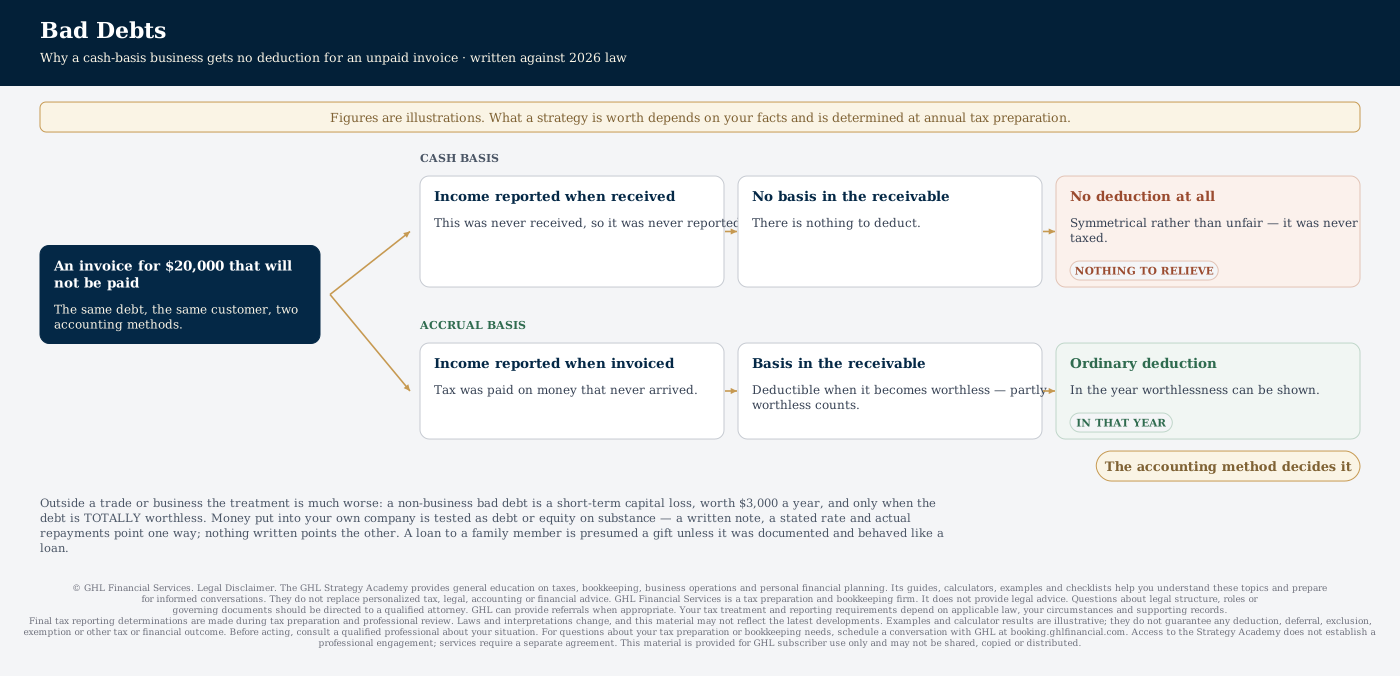
The write-off most people expect is not there. A business on the cash basis reports income when it is received, so an invoice never paid was never income — and a deduction would be relief for something that was never taxed. Nothing is lost; nothing is gained either.
A business on the accrual basis did report the income when the invoice was raised, and so has something to deduct when it proves uncollectible. That is the difference the accounting method makes, and it is the clearest practical consequence of the choice.
Outside a trade or business, a genuine loan that goes bad is a short-term capital loss — $3,000 a year against other income after gains, and only when it is entirely worthless. It is worth far less than a business bad debt, which is ordinary and can be taken as it becomes partly worthless.
| Cash-basis business, unpaid invoice | no deduction — the income was never reported |
|---|---|
| Accrual-basis business, unpaid invoice | ordinary deduction when it becomes worthless |
| Business loan, partly recoverable | deductible as it becomes partly worthless |
| Personal loan gone bad | short-term capital loss, and only when totally worthless |
| Money put into your own company | debt or equity — the documents decide |
The structure of §166 and the effect of the accounting method. Whether a debt is worthless, and in which year, is a facts question decided on the evidence of collection attempts. GHL works the treatment from your own records.
How it works
A deduction for a bad debt requires basis in the debt. On the cash basis there is none in a receivable, because the income was never brought in.
On the accrual basis the income was reported when earned, so the receivable has basis and its loss is deductible.
A business bad debt is an ordinary deduction and can be taken for partial worthlessness, in the year and to the extent it is charged off.
A non-business bad debt is treated as a short-term capital loss, deductible only in the year it becomes wholly worthless. The distinction is whether the debt was created in the course of a trade or business.
Worthlessness is a question of fact. What is expected is evidence that collection was pursued and that there is no reasonable prospect — demands, a debtor's insolvency, a business that has closed, a judgment that cannot be enforced.
Money advanced to a company you own is tested as debt or equity on substance. A written note, a stated interest rate, a repayment schedule, and actual repayments all point to debt. Nothing written, no rate and no expectation of repayment points the other way.
Where it is equity rather than debt, the loss arrives differently — as a capital loss on the interest, or possibly an ordinary one if the stock qualified when it was issued.
A loan between family members is presumed a gift unless it was documented and behaved like a loan. Interest charged, payments made and demands issued are what rebut it.
Recovering a debt already written off brings the recovery back into income to the extent the write-off gave a benefit.
What you would do
- Document the pursuit as you go — the demand letters, the calls, the date you stopped expecting payment.
- Write the debt off in the accounts in the year it actually became worthless, not when the file is tidied.
- If you lend money to your own company, paper it properly at the time: a note, a rate, a date. It costs an hour and decides the answer.
- Same for a loan to a family member, if you intend it to be a loan.
- Know which accounting method your business uses, and ask what it means here.
- Tell GHL about a recovery on something already written off — it comes back into income.
What GHL needs from you
- The invoice or the loan note, and what was originally recorded.
- Which accounting method the business uses.
- Evidence of collection attempts and the date it became worthless.
- For a loan to your own company: the note, the rate, and the repayment history.
- Whether the debt arose in the business or outside it.
What usually goes wrong
- A cash-basis business gets nothing for an unpaid invoice. The income was never reported, so there is nothing to deduct — and this surprises almost everybody.
- The deduction belongs to the year the debt became worthless. Writing it off in the accounts a year later does not move the tax year.
- A non-business bad debt is a short-term capital loss, worth $3,000 a year, and only when it is TOTALLY worthless. A business bad debt can be partly worthless and is an ordinary deduction.
- Money put into your own company is often equity rather than debt, however it was described. Without a note, a rate and a repayment date it is very hard to argue otherwise.
- A loan to a family member is presumed a gift unless it was documented as a loan and behaved like one.
- Worthless means worthless. Slow, disputed and difficult are not the same thing, and some evidence of pursuit is expected.
Common questions
That seems unfair.
It is symmetrical rather than unfair: you were never taxed on money you did not receive. The position is the same as if the invoice had never been raised.
I lent my own company $50,000 and it has failed.
The first question is whether it was debt or equity, and the documents decide it. Paper it properly at the time and the answer is available; leave it undocumented and it usually is not.