
When it matters: The plan is in place for the year before cover is provided under it.
Does this fit you?
- Your closely held business wants a simple benefit that applies to everybody.
- You are an owner-employee of a corporation, subject to the rules on who the plan covers.
- Your business already provides coverage informally and has never checked how it is being reported.
What it could be worth
The premium is a deductible cost to the business, like other employee costs.
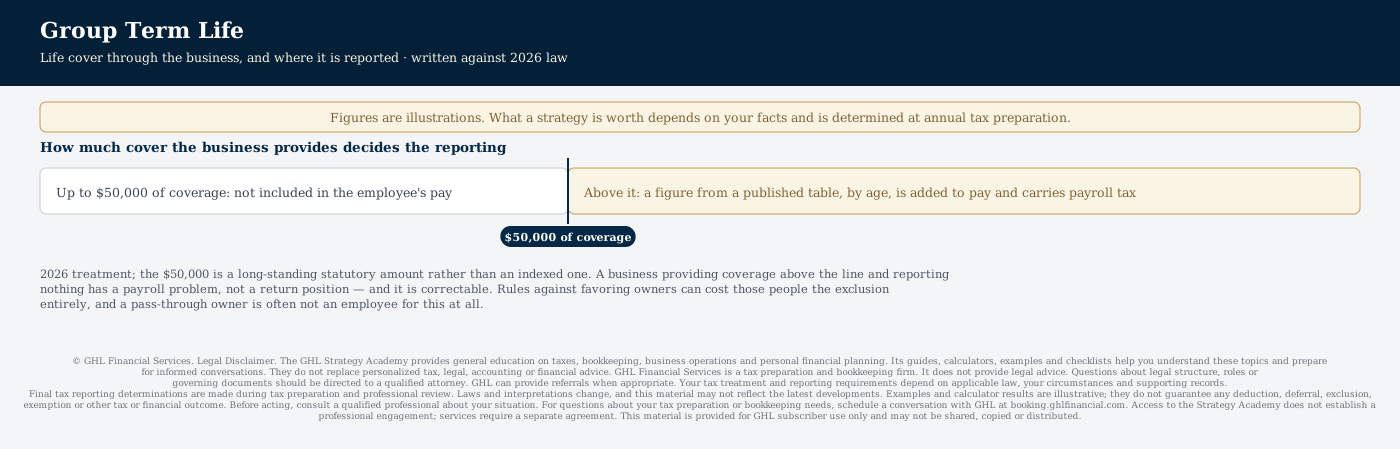
Up to a set amount of coverage, the value is not included in the employee's pay. Above that amount, a figure worked out from a published table by age is added to their pay and taxed.
The amounts are modest — this is a benefit that is cheap to give rather than a large saving. Its value is that it applies to everyone and is simple to run, provided the reporting is right.
| Cover that is not included in the employee's pay | up to $50,000 |
|---|---|
| Cover above that amount | a figure from a published table, by age, is added to pay |
| Typical cost to the business of $50,000 of term coverage | of the order of $200 to $600 a year, depending on age |
| Where the imputed figure is reported | on the employee's wage statement, with the payroll taxes that follow |
2026 treatment. The $50,000 figure is a long-standing statutory amount rather than an indexed one. The cost shown is an insurance cost, not a tax figure, and varies with age and health. The rules on who the plan covers matter: a plan that favors owners and senior people can lose the treatment for them.
How it works
The plan has to be a group plan, providing coverage to employees generally or to a class defined without regard to who the individuals are.
Up to the set amount, the value of the coverage is not included in the employee's pay.
Above it, the value of the excess coverage is worked out from a published table based on age and added to the employee's pay for the year. This is imputed income, and it carries payroll tax.
The imputed amount must appear on the wage statement. A business providing coverage above the threshold and reporting nothing has a payroll problem rather than an income tax one.
There are rules against favoring owners and highly paid employees. Where a plan fails them, those people lose the exclusion — including on the first part of the cover, not just the excess.
An owner of a pass-through business is often not an employee for these purposes, so the benefit does not reach them the way it reaches staff.
What you would do
- Find out how much cover each employee actually has, including anything provided informally.
- Check whether the excess is being imputed and reported. This is the most common failure and it is a payroll correction, not a return position.
- Keep the plan document and the schedule of who is covered for how much.
- Ask GHL how your own cover is treated before assuming it is the same as your employees'.
- Review it when someone's cover changes or when pay bands change, since the class definition can be affected.
Allow one to two months. Some of it depends on other people.
What GHL needs from you
- The plan document and the schedule of coverage by employee.
- Ages, which drive the imputed figure.
- Payroll records showing whether an imputed amount has been reported.
- The business's entity type and each owner's role in it.
- Premiums paid for the year.
What usually goes wrong
- A plan that favors owners and highly paid people costs those people the exclusion entirely, not just on the excess.
- Only genuine group term coverage qualifies. A whole-life or universal policy does not.
- A 2% shareholder of an S corporation generally does not get the exclusion, and the premium becomes reportable pay.
Common questions
We give the owner much more coverage than everyone else. Is that a problem?
It can be. It is worth checking before the next renewal.
Nobody has ever imputed anything. What now?
Raise it. It is a payroll matter and it is correctable, and the correction is much easier than the alternative of it being found later.
I am the owner of an LLC. Does this cover me?
Often not, because you may not be an employee for this purpose. It is worth confirming rather than assuming your coverage is treated the way your staff's is.
Read next
Keeping it alive
A position is not finished when it is set up. This is what it needs each year to still be there when it matters.
- Confirm it still applies — circumstances change more often than the law does.
- Check the documents still say what they said — an agreement that has drifted from practice is the usual failure.
- Ask GHL what changed for 2027. Figures move every year and rules move most years.