
When it matters: December 31 decides everything here. A check posted on the 31st, a card charged on the 31st, and equipment in service on the 31st all count for the year; ordering, promising and intending do not.
Does this fit you?
- Your business is on the cash basis and approaching a year end.
- Your income is much higher or lower this year than next.
- You are deciding whether to buy equipment now or in January.
- You are planning a large deduction and wondering which year to put it in.
What it could be worth
Most planning changes what something is. Timing changes only when, which sounds smaller and is often the only lever left in December — and in a year where the rate genuinely differs between this year and next, it is a real one.
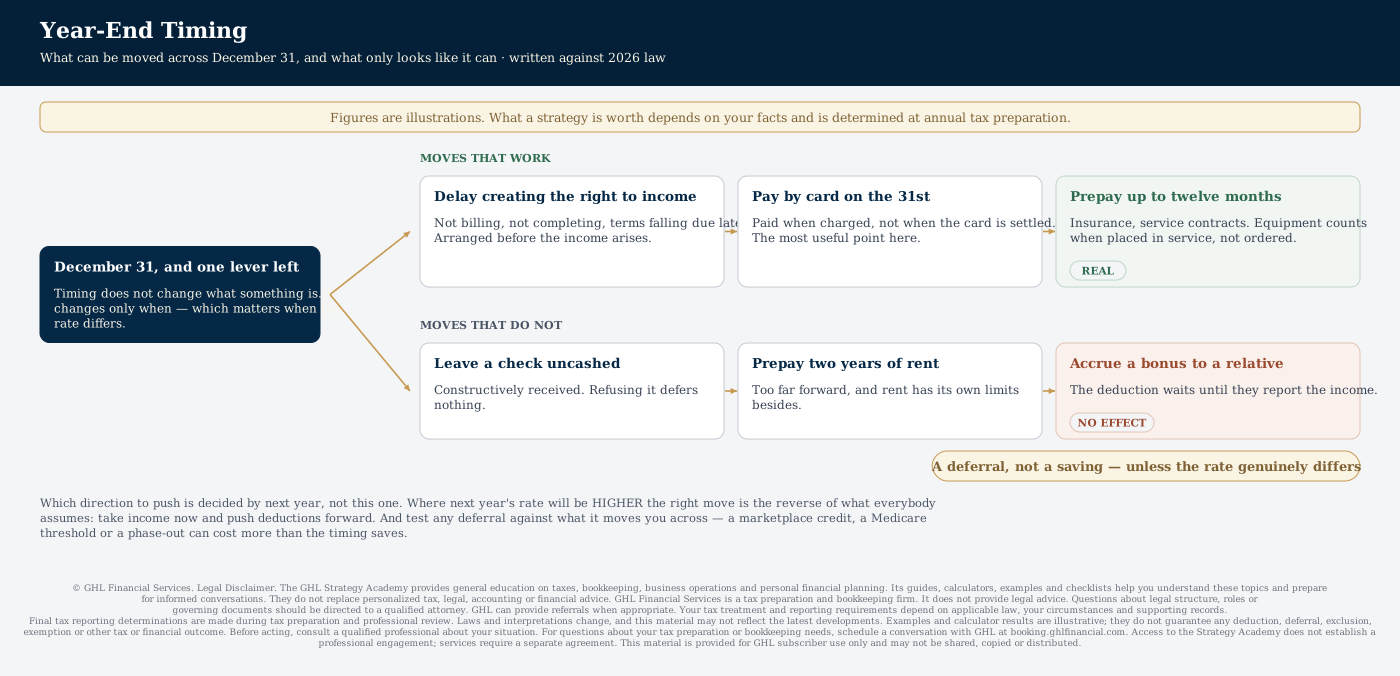
On the cash basis, income is taxed when received and deductions are taken when paid. That gives two moves: delay billing so payment arrives in January, and pay deductible costs before the year turns.
Both have limits that people walk into. Income already available to you is taxed whether or not you collect it, so leaving a check uncashed achieves nothing. And a prepayment only accelerates a deduction where the benefit does not stretch too far into the future.
| Delay sending an invoice | works — the income has not been made available |
|---|---|
| Leave a check uncashed | does not — it was constructively received |
| Pay a supplier by card on December 31 | works — paid when charged |
| Prepay 12 months of insurance | generally works |
| Prepay 24 months | does not — the benefit runs too far forward |
| Order equipment in December, install in January | does not — it was not placed in service |
The cash-basis timing rules and the 12-month rule in Treas. Reg. §1.263(a)-4(f). An accrual-basis business follows different rules and has fewer of these levers. GHL works the actual position on your own method and figures.
How it works
Constructive receipt means income is taxed when it is credited to you, set apart for you, or otherwise made available so that you could draw on it. A refusal to take it does not defer it.
What does defer it is not creating the right to it — not billing, not completing the work, agreeing terms that fall due later. The arrangement has to be real and made before the income arises, not papered afterwards.
On the payment side, a cost paid is deductible when paid, and a charge to a credit card counts as payment at the moment of the charge. The card being settled in February is irrelevant.
The 12-month rule allows a prepayment to be deducted currently where the right or benefit does not extend beyond the earlier of twelve months and the end of the following tax year. Insurance, service contracts and some rent fit; longer commitments do not.
Rent and interest have their own limits and generally cannot be accelerated by prepaying them, whatever the 12-month rule would otherwise allow.
For equipment, the test is placed in service — installed and ready for its intended use. Bought and uninstalled does not qualify, and that is a common December disappointment.
An accrual-basis business deducts when the all-events test is met and economic performance has occurred. For compensation, an amount accrued at the year end and paid within a short window afterwards can be deducted in the earlier year.
That does not apply to a related party. Where the recipient is related and on the cash basis, the deduction waits until they report the income — which usually means the same year after all.
Charitable gifts follow the same logic: a check posted by December 31 counts for the year, and a card charged by then does too.
All of it is a deferral rather than a reduction unless the rate differs. Where next year's income will be higher, accelerating income and deferring deductions is the move — which is the opposite of what most people assume.
What you would do
- Work out in November whether next year looks higher or lower than this one. Everything follows from that and nothing can be decided without it.
- Where deferring income, do it by not creating the right to it — terms, timing of the work, invoice dates — rather than by not collecting.
- Use a card on December 31 for anything you want in this year and cannot fund yet.
- Check that anything bought is actually installed and running before the year turns.
- Do not prepay beyond twelve months expecting a deduction for the lot.
- Test any deferral against the credits and thresholds it moves you across. Some of those cost more than the timing saves.
Usually a week or two — mostly things you can start yourself.
What GHL needs from you
- Expected income for this year and next.
- Which accounting method the business uses.
- Invoice dates and payment dates around the year end.
- For equipment: the date placed in service, not the date ordered.
- Whether any accrued amounts are payable to a related person.
What usually goes wrong
- You cannot defer income by declining to collect it. Money made available to you without real restriction is taxed when it becomes available, not when you pick it up.
- A prepayment only works where the benefit does not run too far forward. Twelve months of insurance paid in December is generally deductible; twenty-four is not.
- Paying by card counts when the charge is made, not when the card is settled. That is the most useful and least known point in the subject.
- Equipment has to be in service by December 31, not merely ordered or delivered. A machine still in its crate is not placed in service.
- An accrual-basis business can accrue a bonus and deduct it in the year if it is paid shortly after — but not to a related party, where the deduction waits until the recipient reports it.
- Moving income out of a year moves it into the next one. It is a deferral rather than a saving unless the rate genuinely differs.
- Deferring into a year with a marketplace credit, a Medicare threshold or a phase-out can cost more than it defers.
Common questions
Can I just not cash the check until January?
No. Once it is available to you it has been constructively received, and holding it changes nothing. Deferring has to happen before the right to the money arises.
Does paying by card at the year end really count?
Yes, at the moment of the charge. It is the most useful point here and the one most people do not know.
I want a deduction now, so I prepaid two years of rent.
That generally does not accelerate it. Rent has its own limits, and the twelve-month rule would not have reached two years in any case.
Should I always defer income?
Only where next year's rate is lower. Where it will be higher, the right move is the reverse — take income now and push deductions forward — and that is the case people rarely consider.
Read next
Keeping it alive
A position is not finished when it is set up. This is what it needs each year to still be there when it matters.
- Confirm it still applies — circumstances change more often than the law does.
- Put the date in the calendar. This one closes at the year end and cannot be added at tax preparation.
- Ask GHL what changed for 2027. Figures move every year and rules move most years.