
When it matters: None of these is elected. They apply to the transaction as it happened, which is why the structure has to be settled before it happens rather than after.
Does this fit you?
- You are selling or buying anything from family, or from a business you control.
- You are lending money to a child, a parent or your own company.
- You rent property to your own entity, or sell equipment into it.
- You are harvesting a loss where a family member might buy the same holding.
What it could be worth
These rules exist because a transaction between people who are not at arm's length can be arranged to produce a tax result without changing anybody's real position. The response is a set of provisions that switch on because of who is on the other side, not because of anything either party intended.
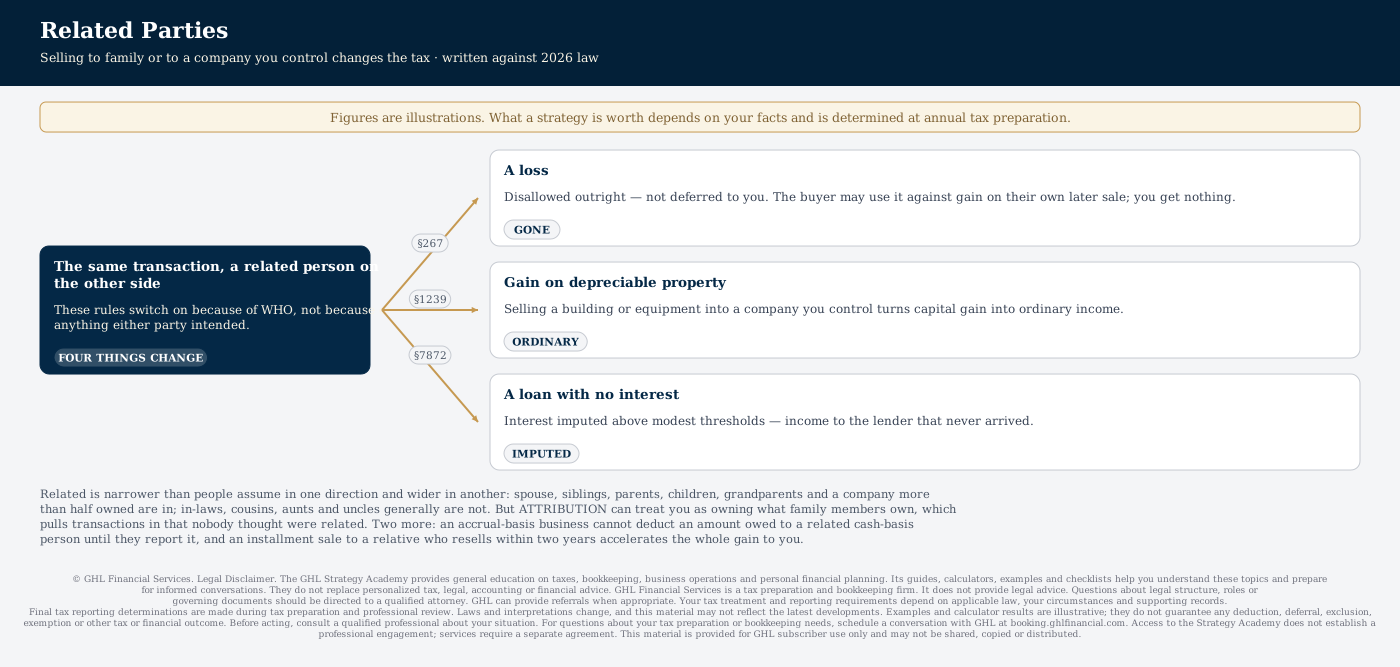
The most common by a distance is the disallowed loss. Selling an asset at a loss to a family member or a controlled company removes the loss entirely from your return. It is not suspended and it does not come back to you — the buyer can use it to reduce gain on their own later sale, which may be worth nothing to you at all.
The others are less known and more expensive when they land. Depreciable property sold to a controlled business produces ordinary income rather than capital gain. An interest-free loan to family produces interest income to the lender that never arrived. And an installment sale to a relative who resells quickly collapses into an immediate gain.
| Loss on a sale to a related party | disallowed entirely; the buyer may use it later |
|---|---|
| Depreciable property sold to a controlled business | gain is ordinary, not capital |
| Loan to family at no interest | interest imputed above modest thresholds |
| Installment sale, relative resells within two years | the whole gain accelerates to you |
| Related: spouse, siblings, parents, children, grandparents | and a company more than half owned |
| Generally not related: in-laws, cousins, aunts and uncles | though attribution can still reach them |
The definitions in §267(b) and (c) and the provisions listed. Attribution rules mean an individual can be treated as owning what family members own, which changes the answer in cases that look unrelated. GHL works the actual position on the specific relationships and ownership.
How it works
§267 disallows a loss on a sale or exchange between related persons. The loss is not deferred to the seller — it is gone from that return permanently.
The buyer gets a limited benefit: on their own later sale, gain can be reduced by the previously disallowed loss. That is useful to them and worth nothing to the seller.
Related for this purpose includes a spouse, brothers and sisters, ancestors and lineal descendants, and an individual and a corporation more than half owned by them. It does not generally include in-laws, cousins, aunts, uncles or nephews.
Constructive ownership applies, so an individual can be treated as owning shares held by family members or by entities they are involved in, and that can make a transaction related when no one thought it was.
§267(a)(2) also handles timing: an accrual-basis payer cannot deduct an amount owed to a related cash-basis payee until the payee includes it in income. Accruing a bonus to a family member at the year end therefore usually achieves nothing.
§1239 converts gain on the sale of depreciable property between related parties into ordinary income. Selling a building or equipment into a company you control is the usual case.
§7872 treats a below-market loan as though market interest had been charged: the lender has interest income and, depending on the relationship, the borrower may be treated as having received a gift or compensation. Exceptions apply below modest amounts and where the borrower's investment income is small.
Installment sales carry two special rules: a resale by the related buyer within two years generally accelerates the seller's remaining gain, and the installment method is not available at all for depreciable property sold to a controlled entity.
The wash sale rule reaches across accounts you control — buying the same security in your own retirement account, or arguably through a spouse, does not avoid it.
Rent, wages and interest between related parties are all tested for reasonableness. The transaction is respected where the terms are what unrelated parties would have agreed, and the documentation is what shows that.
What you would do
- Ask who is on the other side before structuring anything. It is the first question and it changes the answer more than the price does.
- Where a loss is intended, sell to somebody unrelated. Selling to family destroys it rather than moving it.
- Paper any family loan properly: a note, a market rate, a schedule, and payments that actually happen.
- Before selling property into your own company, ask what the gain becomes. Ordinary rather than capital is a large difference.
- Keep evidence that rents, wages and interest between related parties are at market terms.
- On an installment sale to a relative, know that a quick resale by them accelerates your gain.
Allow one to two months. Some of it depends on other people.
What GHL needs from you
- Who the parties are, and the exact relationships.
- Ownership percentages for any entity involved.
- The terms: price, interest rate, repayment schedule.
- What the asset cost and what it is worth.
- Whether the property is depreciable, and by whom it has been depreciated.
What usually goes wrong
- A loss on a sale to a related party is disallowed outright, not deferred to you. The benefit, if any, goes to the buyer on their eventual sale.
- The definition is narrower than people assume in one direction and wider in another: siblings, parents, children, grandparents and grandchildren are related, and in-laws, cousins and aunts generally are not. A company you control is.
- Selling depreciable property to a business you control converts what would be capital gain into ordinary income.
- A loan to a family member at no interest has interest imputed anyway, above modest thresholds — income to the lender they never received.
- Selling to a related party on installments and having them resell within two years accelerates the whole gain to you.
- An accrual-basis business owing a related cash-basis person cannot deduct until that person reports the income, which usually defeats the accrual entirely.
- Attribution means you are often treated as owning what your family owns, which can pull a transaction into these rules when nobody involved thought they were related.
Common questions
I sold shares to my brother at a loss. Can I claim it?
No. He may be able to use it against gain on his own eventual sale.
Is my brother-in-law a related party?
Generally not for this purpose. The list covers spouse, siblings, ancestors and lineal descendants, and controlled entities — in-laws and cousins are usually outside it, though attribution can occasionally reach further.
I lent my daughter money interest-free.
Above modest thresholds, interest is imputed: you have interest income you never received, and she is treated as having received something. Small loans have exceptions and a written note at a market rate avoids the question.
Can I sell my building to my own company?
You can, and the gain is likely to be ordinary income rather than capital. That is a significant difference and it is worth knowing before the price is agreed.
Read next
Keeping it alive
A position is not finished when it is set up. This is what it needs each year to still be there when it matters.
- Confirm it still applies — circumstances change more often than the law does.
- Check the documents still say what they said — an agreement that has drifted from practice is the usual failure.
- Ask GHL what changed for 2027. Figures move every year and rules move most years.