
When it matters: For payments made in 2026: February 1, 2027 (expected; the IRS has not published it yet), to the contractor and to the IRS. The date is January 31, moved to the next business day when it falls on a weekend or legal holiday; January 31, 2027 is a Sunday.
Does this fit you?
- You pay people who are not on your payroll.
- Your business has paid the same contractor several times this year.
- You keep 1099 habits from an earlier year's figure.
What it could be worth
Nothing here lowers a tax bill. The 1099-NEC is a report: it tells the IRS and the contractor what the business paid them in the year.
What it is worth is a January that takes an hour rather than a week. A business that keeps each contractor's running total as it pays them has the figures ready when the year ends.
How it works
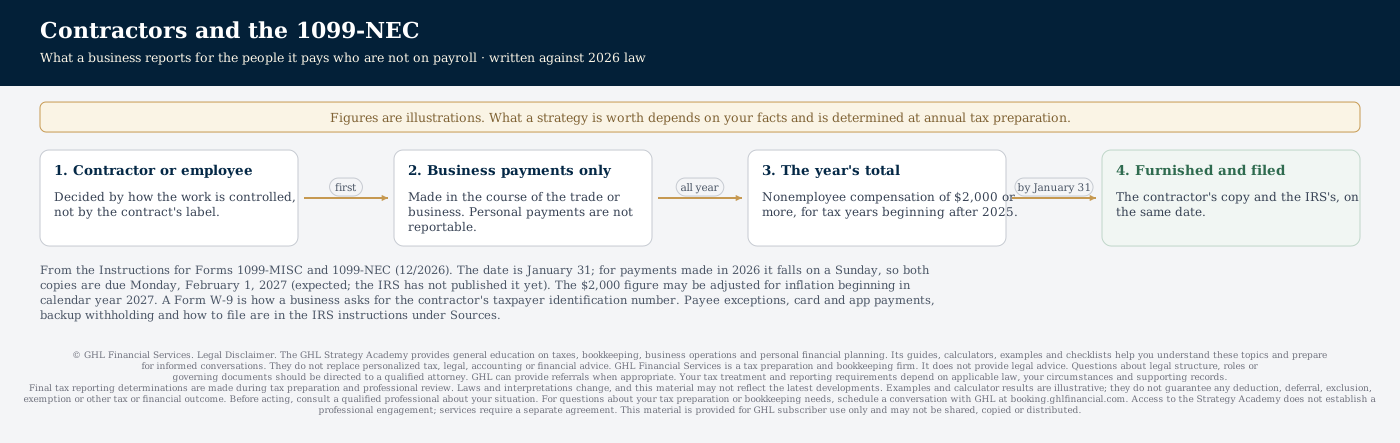
What the form reports. The instructions: “Enter nonemployee compensation (NEC) of $2,000 or more.”
That figure is new. The same instructions: “For tax years beginning after 2025, the minimum threshold amount for reporting certain payments required to be reported on certain information returns and/or perform backup withholding on those payments increased to $2,000 and may be adjusted for inflation beginning in calendar year 2027.” A habit built on an earlier year's figure is out of date for these years.
Business payments only. The instructions: “Report on Form 1099-MISC or Form 1099-NEC only when payments are made in the course of your trade or business. Personal payments are not reportable.” Paying a plumber to work on the business's premises is a business payment; paying the same plumber to work on the owner's own home is not.
The date. The instructions: “You are required to furnish the payee statements and file with the IRS by January 31.” The contractor's copy and the IRS's share that date, and the same instructions move it: “If any date shown falls on a Saturday, Sunday, or legal holiday in the District of Columbia or where the return is to be filed, the due date is the next business day.”
The date, year by year. January 31, 2027 is a Sunday, so for payments made in 2026 both copies are due Monday, February 1, 2027 (expected; the IRS has not published it yet). A year earlier, January 31, 2026 was a Saturday, and the General Instructions for Certain Information Returns gave the date for 2025's payments: “File and furnish a copy of Form 1099-NEC on paper or electronically by February 2, 2026.”
Contractor or employee comes first. Whether somebody is a contractor at all is decided by how the work is controlled, which the Worker Classification guide covers. An employee's pay goes on a W-2, not a 1099-NEC.
The contractor's tax ID comes first. The Instructions for the Requester of Form W-9: “Use Form W-9 to request the taxpayer identification number (TIN) of a U.S. person (including a resident alien) and to request certain certifications and claims for exemption.” About Form W-9 says what the contractor uses it for: “Use Form W-9 to provide your correct Taxpayer Identification Number (TIN) to the person who is required to file an information return with the IRS to report, for example: Income paid to you.” Asking at the first payment means the 1099-NEC has a TIN to report in January.
Payees left out. The instructions: “Some payments do not have to be reported on Form 1099-NEC, although they may be taxable to the recipient.” The first item on their Exceptions list is, generally, payments to a corporation, which has exceptions of its own, such as payments for legal services. That list is the place to check a payee before leaving one off.
Card and app payments. The instructions: “Payments made with a credit card or payment card and certain other types of payments, including third-party network transactions, must be reported on Form 1099-K by the payment settlement entity under section 6050W and are not subject to reporting on Form 1099-MISC or Form 1099-NEC.” How the business paid is part of the record for each payment.
Backup withholding. The instructions, for box 4: “For example, persons who have not furnished their TINs to you are subject to withholding on payments required to be reported in box 1a.” The rate and the rest of the rules are in part N of the General Instructions for Certain Information Returns.
How to file. The General Instructions: “If you are required to file 10 or more information returns during the year, you must e-file.” They also cover paper filing, corrections and extensions; all three pages are under Sources.
Sources
- IRS.gov: Instructions for Forms 1099-MISC and 1099-NEC (due date, exceptions, Form 1099-K, backup withholding)
- IRS.gov: General Instructions for Certain Information Returns (filing, e-file, part N backup withholding)
- IRS.gov: Publication 509, Tax Calendars
- IRS.gov: Instructions for the Requester of Form W-9
- IRS.gov: About Form W-9
What you would do
- Ask each new contractor for a Form W-9 before the first payment, and keep it with the business's records.
- Keep a running total for each contractor as you pay them, by calendar year.
- Mark each payment as business or personal when it is made, not in January.
- In December, list the contractors with each one's total, name and address.
- Put the year's date on the calendar: February 1, 2027 (expected; the IRS has not published it yet), for payments made in 2026.
- Record who prepares and files the forms, and keep the confirmations with the year's records.
- Note the questions the list raises, such as a payee near the amount, for a qualified tax professional.
Allow one to two months. Some of it depends on other people.
What GHL needs from you
- The list of contractors paid in the year, with each one's total.
- Copies of the 1099-NECs issued, and their filing confirmation.
- Anything held for each contractor, such as a Form W-9.
- All of it sent through the Secure Client Portal, not by email.
What usually goes wrong
- Working from an old figure. For tax years beginning after 2025, the instructions give $2,000.
- Adding up a contractor's payments in January from bank statements, and missing the ones paid another way.
- Reporting personal payments. The instructions limit the form to payments made in the course of a trade or business.
- Treating the label in an agreement as the answer to whether somebody is a contractor at all.
Common questions
When do I ask a contractor for a W-9?
The requester instructions say a business uses Form W-9 to request a U.S. person's taxpayer identification number. Asking before the first payment is the habit that leaves nothing to chase in January.
I paid a contractor $1,500 this year. Does the form apply?
For tax years beginning after 2025 the instructions say to enter nonemployee compensation of $2,000 or more. Whether anything else about that payee calls for a form is a question for the instructions or a qualified tax professional.
I paid a painter to work on my house. Is that a 1099?
The instructions say personal payments are not reportable. The form is for payments made in the course of a trade or business.
When is it due?
January 31, both to the contractor and to the IRS, for the year before, moved to the next business day when it falls on a weekend or legal holiday. For payments made in 2026 that is Monday, February 1, 2027 (expected; the IRS has not published it yet).
Read next
Keeping it alive
A position is not finished when it is set up. This is what it needs each year to still be there when it matters.
- Confirm it still applies — circumstances change more often than the law does.
- Put the date in the calendar. This one closes at the year end and cannot be added at tax preparation.
- Ask GHL what changed for 2027. Figures move every year and rules move most years.