
When it matters: Letter 1153 proposes the assessment and carries a short window to appeal. Missing it is the point at which options narrow sharply.
Does this fit you?
- You have employees, whatever the structure.
- You have authority to decide which bills get paid in a business that is short.
- You are a bookkeeper or finance manager who signs checks.
- You have received Letter 1153, where the window is already running.
What it could be worth
Nothing here saves money. It is here because it is the largest personal exposure most business owners will ever have and almost nobody knows it exists until a letter arrives.
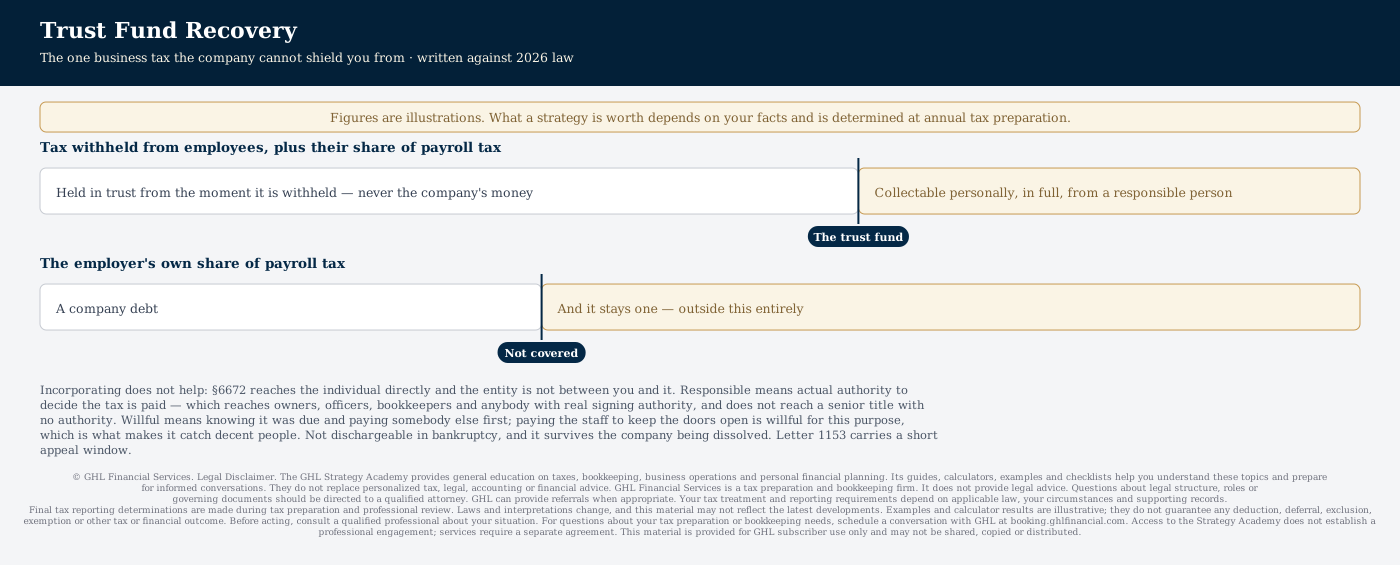
Income tax withheld from employees, and their share of Social Security and Medicare, never belonged to the business. It is the employees' money held in trust and passed on. Where it is not passed on, §6672 allows the full amount to be collected personally from a responsible person who willfully failed to pay it.
Both words are narrower than they sound and broader than people expect. Responsible means having the authority and the duty to decide that the tax is paid — which reaches officers, owners, bookkeepers and anybody with real signing authority. Willful means knowing it was due and using the money for something else. Paying the staff instead, to keep the doors open, is willful for this purpose.
| Income tax withheld from employees | trust fund — personal exposure |
|---|---|
| Employees' share of Social Security and Medicare | trust fund — personal exposure |
| The employer's own share of payroll tax | a company debt, and stays one |
| Who can be assessed | anybody with the authority and duty to pay it over |
| How many people | more than one, each for the whole amount |
| Bankruptcy, or dissolving the company | neither removes it |
The structure of §6672. Whether a particular person is responsible, and whether the failure was willful, are decided on the facts of who did what — which is why the records of who had authority and who knew what matter so much.
How it works
Amounts withheld from wages are held in trust for the government from the moment they are withheld. They are not working capital, even when they are sitting in the same account.
Where they are not paid over, §6672 permits assessment of the whole trust fund amount against a responsible person. It is called a penalty and it operates as a collection of the tax.
Responsibility turns on authority and duty: who could sign checks, who decided which creditors were paid, who could have directed that the deposit be made. Titles are evidence and not the test.
Willfulness means voluntarily and consciously paying other creditors when the tax was known to be due. Bad motive is not required, and an intention to catch up later is not a defense.
It commonly reaches more than one person — an owner and a finance manager, two partners, a director and a bookkeeper. Each can be assessed for the whole; the total is collected once.
Letter 1153 proposes the assessment and sets out the amount and the periods. It carries a short window in which to appeal before it is assessed.
Defenses exist and are factual: no actual authority, no knowledge that the tax was unpaid, or funds that were genuinely encumbered so that they could not lawfully have been used.
It is not dischargeable in bankruptcy and it does not die with the company. Dissolving the entity removes the company's liability and not this one.
Where a business is short, the order in which bills are paid is the whole of the risk. Paying net wages while the withheld tax goes unpaid creates exposure in exactly the way this provision is designed to catch.
What you would do
- Treat withheld amounts as somebody else's money. A separate account for them is old-fashioned and it works.
- If a payroll provider handles deposits, verify they are actually being made rather than assuming. The obligation stays with the business either way.
- If the business is short, raise it before deciding what to pay. This is the one debt where the order of payment creates personal exposure.
- Keep a clear record of who had signing authority and when it changed.
- If you have left a business, document the date your authority ended.
- If Letter 1153 arrives, act immediately — the appeal window is short and the position afterwards is much harder.
Usually a week or two — mostly things you can start yourself.
What GHL needs from you
- Payroll returns and deposit records for the periods in question.
- Who had signing authority, and over what period.
- Bank records showing what was paid and when.
- Any Letter 1153 or Form 2751, with the date received.
- Correspondence with any payroll provider about the deposits.
What usually goes wrong
- Incorporating does not help. This reaches the individual directly and the entity is not between you and it.
- Willful does not mean dishonest. It means knowing the tax was due and paying somebody else first — a supplier, a landlord, a wage run. That is almost always what actually happened.
- It is not dischargeable in bankruptcy and it survives the company being dissolved.
- More than one person can be assessed for the same amount. The authorities collect once in total and can pursue each of them for the whole of it.
- A bookkeeper or an outside advisor with check-signing authority can be a responsible person. It is about actual authority, not about job titles.
- Only the trust fund portion is covered — the tax withheld from employees plus their share of payroll tax. The employer's own share is a company debt and stays one.
- The letter carries a short appeal window, and the position after it has passed is much harder.
Common questions
The company owes it, not me. Does incorporating not protect me?
Not for this. It is the clearest exception to limited liability in tax.
We paid the staff so they could eat. Is that willful?
For this purpose, yes. It does not require any bad motive, which is what makes it catch decent people.
I am only the bookkeeper.
Responsibility is about actual authority rather than title. Somebody who signs checks and decides which creditors are paid can be assessed, and somebody with a senior title and no authority may not be.
Can bankruptcy clear it?
No. It is not dischargeable, and it survives the company being dissolved. That is why the order bills are paid in matters so much while there is still a choice.
Read next
Keeping it alive
A position is not finished when it is set up. This is what it needs each year to still be there when it matters.
- Confirm it still applies — circumstances change more often than the law does.
- Put the date in the calendar. This one closes at the year end and cannot be added at tax preparation.
- Ask GHL what changed for 2027. Figures move every year and rules move most years.