
When it matters: A W-2 goes to the worker by January 31 and the copy to Social Security by the same date. Schedule H goes with the personal return, but the registrations have to exist before the first payment.
Does this fit you?
- You employ a nanny, a housekeeper, a caregiver for a parent, or regular domestic help.
- You are arranging care for an elderly relative, where the money often comes from the relative's own funds.
- You pay more than the annual threshold to one person for work in your home.
- You have been paying cash and want to put it right.
What it could be worth
Nothing here saves money directly. It is here because the cost of getting it wrong is large and arrives late, and because one of the things people give up by avoiding it is a credit they were entitled to.
The test is control. A gardener who brings their own equipment, sets their own hours and works for several households is running a business. A nanny who works the hours you set, in your home, doing what you ask, is an employee — and that is true however the payment is described.
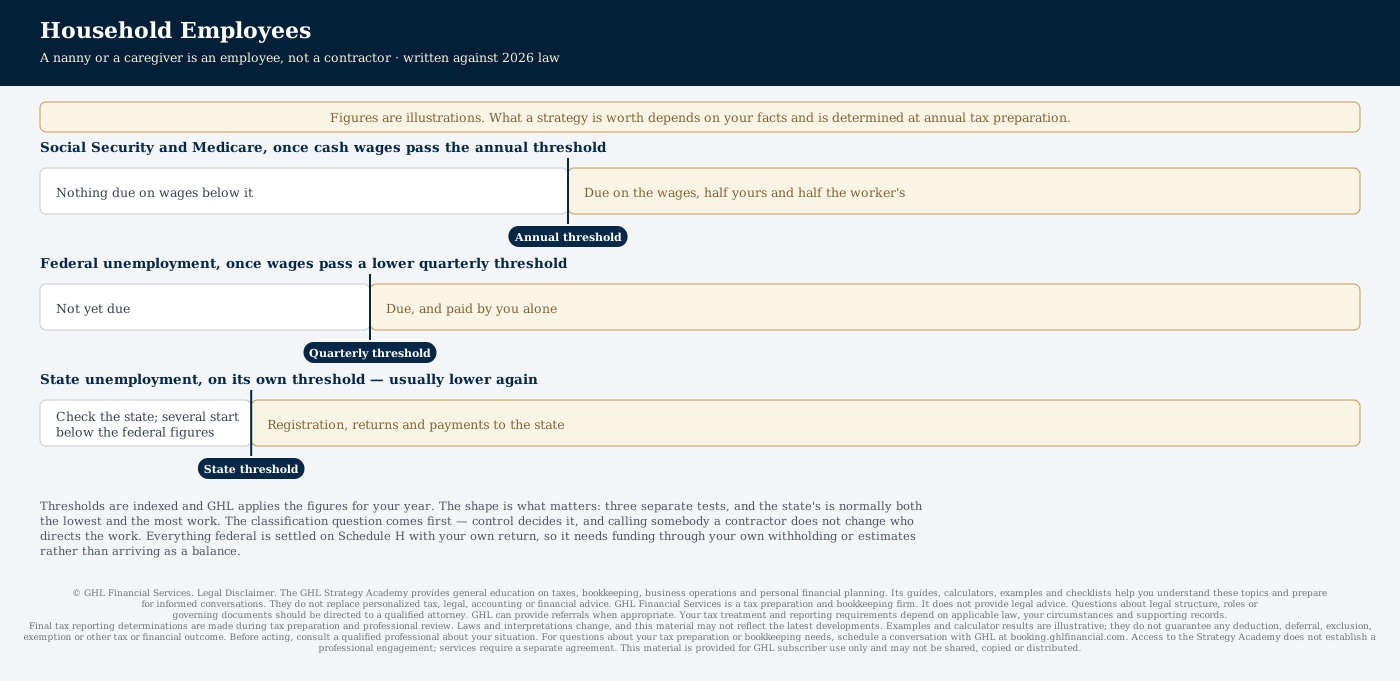
Where wages pass an annual threshold, Social Security and Medicare are due on them, half from the worker and half from you. A separate and lower quarterly threshold brings federal unemployment tax. Both are settled on Schedule H with your own return rather than through business payroll filings.
| Social Security and Medicare | due once cash wages pass an annual threshold, split between you and the worker |
|---|---|
| Federal unemployment | due once wages pass a lower quarterly threshold, paid by you alone |
| Income tax withholding | not required, but commonly agreed so the worker is not left with a bill |
| State unemployment | its own registration and its own threshold, usually lower |
| How it is filed | Schedule H, with your personal return |
| What the worker gets | a W-2 by January 31 |
The structure of household employment tax. The thresholds are indexed and GHL applies the figures for your year. State obligations differ and are checked separately — they are usually where the real work is.
How it works
The classification question is control: who decides what is done, when and how. A household worker under your direction is an employee, whatever the arrangement is called.
Once cash wages to one worker pass the annual threshold, Social Security and Medicare apply. Your half is yours; the worker's half is withheld, or paid by you, in which case it is additional wages.
Federal unemployment applies once wages in any calendar quarter pass a lower threshold. It is yours alone and is not withheld.
Withholding income tax is optional unless you both agree to it. Agreeing is usually kinder — a worker who has had nothing withheld meets the whole bill at once.
An employer identification number is needed, and a W-2 is issued to the worker by January 31 with the copy to Social Security.
Everything federal is settled on Schedule H, which is part of your own return. That means it also has to be funded through your estimated payments or withholding during the year, or it arrives as a balance.
State registration is separate, usually for unemployment insurance, and several states have thresholds well below the federal ones. This is where most of the administration lives.
Where the work is care for a qualifying person that allows you to work, the wages can count toward the dependent care credit or a dependent care account — both of which require the caregiver's identifying number.
Paying a family member has its own rules: wages to a spouse, to a parent in some circumstances, or to a child under twenty-one are treated differently, and those exceptions are worth checking before assuming them.
What you would do
- Settle the classification before the first payment, not after a disagreement.
- Get the employer identification number and register with the state before anybody starts.
- Agree in writing what is being paid, gross or net, and whether income tax is being withheld.
- Keep a record of hours as well as amounts — overtime rules apply and a flat weekly figure does not answer them.
- Fund it through the year, through your own withholding or estimates, so Schedule H does not arrive as a surprise.
- Collect the caregiver's number if you intend to claim the credit or use a dependent care account.
- If you have been paying cash, say so. Putting it right forwards is far simpler than it is made to sound.
Allow one to two months. Some of it depends on other people.
What GHL needs from you
- Total cash wages paid to each household worker for the year.
- Any income tax, Social Security or Medicare withheld.
- The employer identification number.
- State registration details and anything already paid to the state.
- The caregiver's name, address and taxpayer number, for the credit.
What usually goes wrong
- Calling somebody a contractor does not make them one. If you decide what is done and how, they are an employee, and a Form 1099 issued to a nanny is evidence of the wrong treatment rather than a cure for it.
- It usually surfaces later rather than at the time — when the worker files for unemployment, or claims a benefit, and the record is not there.
- State unemployment registration is normally the larger piece of work, and it has its own thresholds, which are often lower than the federal ones.
- The dependent care credit and a dependent care account both need the caregiver's name and taxpayer number. Paying off the books gives up a benefit that was already yours.
- Overtime rules apply to household workers in most situations, and a weekly flat rate that ignores them is a wage claim waiting to happen.
- A worker who lives in has different rules again, in several states.
Common questions
Can I just give her a 1099?
Not if she is an employee, and a household worker under your direction almost always is.
What if I pay below the threshold?
Then Social Security and Medicare are not due on it. The unemployment threshold is separate and lower, and the state's may be lower again, so it is worth checking all three rather than one.
My mother's caregiver is paid from her own savings. Whose employee is that?
It depends who directs the work, and the answer is often the family member arranging it rather than the person paying. It is worth settling deliberately, because the filing follows it.
We have been paying cash for two years. What now?
Say so, and start correctly from a date. Going forward properly is straightforward; what to do about the past depends on the amounts and the state, and it is a conversation to have rather than a form to file blindly.
Read next
Keeping it alive
A position is not finished when it is set up. This is what it needs each year to still be there when it matters.
- Confirm it still applies — circumstances change more often than the law does.
- Check the documents still say what they said — an agreement that has drifted from practice is the usual failure.
- Ask GHL what changed for 2027. Figures move every year and rules move most years.