
Does this fit you?
- Your business files its own return, or reports on Schedule C.
- You received a K-1 and want to know what it is for.
- You want to understand the return before you sign it.
What it could be worth
Nothing here lowers a tax bill by itself. Reading the return beside the books catches a figure that does not match before it is filed.
How it works
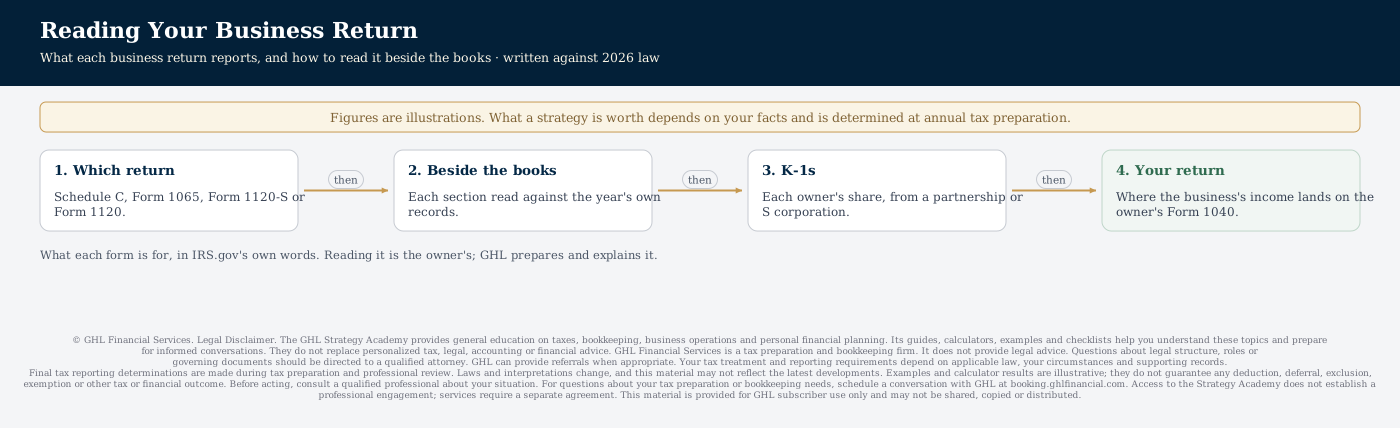
Which return. IRS.gov, Instructions for Schedule C: “Use Schedule C (Form 1040) to report income or (loss) from a business you operated or a profession you practiced as a sole proprietor.”
A partnership. Instructions for Form 1065: “Form 1065 is an information return used to report the income, gains, losses, deductions, credits, and other information from the operation of a partnership.”
An S corporation. Instructions for Form 1120-S: “Use Form 1120-S to report the income, gains, losses, deductions, credits, and other information of a domestic corporation or other entity for any tax year covered by an election to be an S corporation.”
A C corporation. Instructions for Form 1120: “Use Form 1120, U.S. Corporation Income Tax Return, to report the income, gains, losses, deductions, credits, and to figure the income tax liability of a corporation.”
Reading it beside the books: income first, then costs, then what is left. Each total on the return comes from the year's records, so a figure that looks wrong can be traced to the books.
K-1s from a partnership. Partner's Instructions for Schedule K-1 (Form 1065): “The partnership uses Schedule K-1 to report your share of the partnership’s income, deductions, credits, etc.” And: “Keep it for your records.” … “Don’t file it with your tax return unless you're specifically required to do so.”
K-1s from an S corporation. Shareholder's Instructions for Schedule K-1 (Form 1120-S): “The corporation uses Schedule K-1 to report your share of the corporation’s income, deductions, credits, and other items.”
Your own return. The business's income reaches the owner's Form 1040 through Schedule C or through the K-1. GHL can walk through where each figure lands.
Sources
What you would do
- Find which return the business files: Schedule C, Form 1065, Form 1120-S or Form 1120.
- Read it beside the year's books: income, then costs, then what is left.
- Note any figure you do not recognize, with the line it is on.
- If the business sends K-1s, compare each owner's share with the business's records.
- Keep your K-1 with your records.
- Bring your notes to GHL before you sign.
What GHL needs from you
- Your questions about any line, with the line number.
- The year's reconciled books, if GHL did not keep them.
- Every K-1 you received, through the Secure Client Portal.
What usually goes wrong
- Signing without reading. The owner signs the return; the figures on it should be ones the owner recognizes from the books.
- Reading the return without the books beside it. Income and costs make sense line by line only against the year's own records.
- Filing a K-1 with your own return when it is meant to be kept for your records.
Common questions
Do I attach my K-1 to my own return?
The partner's instructions say to keep it for your records and not file it with your return unless you are specifically required to. GHL will tell you if yours is one of those cases.
A figure on the return doesn't match what I expected. What now?
Note the line and ask GHL before signing. Most differences trace to a specific entry in the books.