
Does this fit you?
- You work for yourself, alone or alongside a job.
- You are paid on a 1099-NEC rather than a W-2.
- You are a partner in a business.
What it could be worth
Nothing here lowers a tax bill. It explains a tax people working for themselves meet for the first time, usually the April after they start.
What it is worth is a set-aside that covers both taxes. A business owner who plans for income tax alone finds the second one at filing.
How it works
What it is. IRS.gov: “Self-employment tax is a tax consisting of Social Security and Medicare taxes primarily for individuals who work for themselves.”
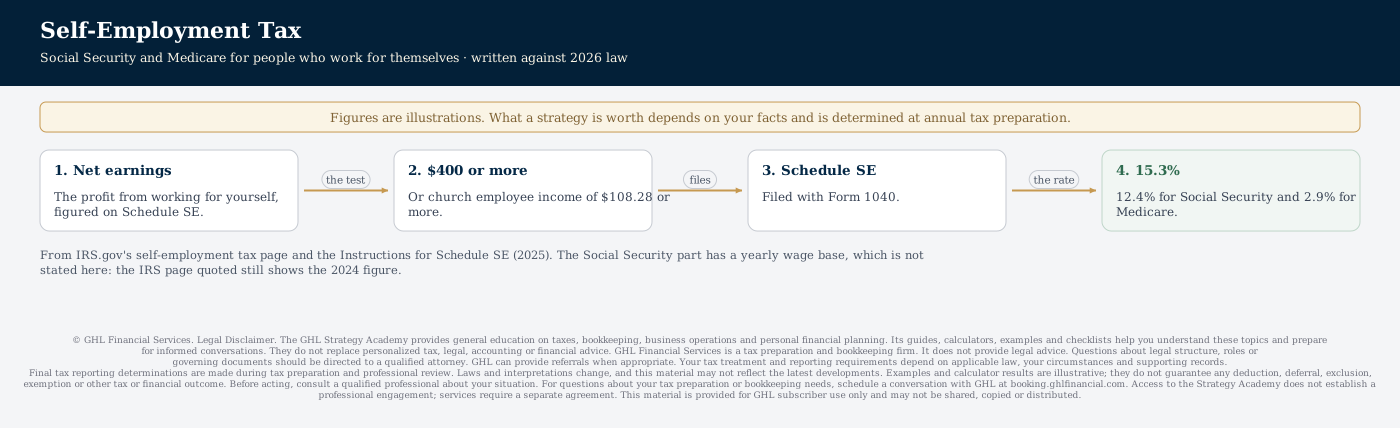
The rate. IRS.gov: “The self-employment tax rate is 15.3%. The rate consists of two parts: 12.4% for social security … and 2.9% for Medicare…”
Who files Schedule SE. IRS.gov: “You must pay self-employment tax and file Schedule SE (Form 1040) if either of the following applies. Your net earnings from self-employment (excluding church employee income) were $400 or more. You had church employee income of $108.28 or more.”
The same line in the Schedule SE instructions (2025): “You must file Schedule SE if: The amount on line 4c of Schedule SE is $400 or more, or You had church employee income of $108.28 or more.”
The Social Security part has a yearly wage base. It is not stated here, because the IRS page quoted above still shows the 2024 figure; the figure for the year being prepared is the one that applies.
Not covered here, because the wording has not been checked against IRS.gov: how net earnings are figured on the schedule, the deduction for part of this tax, and the Additional Medicare Tax.
Sources
What you would do
- Set aside for this tax and income tax together, from each month's profit.
- Keep the business's books current, so the year's net earnings are known before April.
- If you also have a job, keep the year's W-2 with the business records for whoever prepares the return.
- Note the questions the year raises, such as a second business or a K-1, for a qualified tax professional.
Usually a week or two — mostly things you can start yourself.
What GHL needs from you
- The business's profit and loss for the year, or the K-1 that reports it.
- Any W-2 from a job in the same year.
- Last year's return, including Schedule SE.
- All of it sent through the Secure Client Portal, not by email.
What usually goes wrong
- Setting aside for income tax only. Self-employment tax is a separate amount on the same return.
- Using a wage base remembered from an earlier year. It changes every year, and this guide does not state one.
- Assuming a small side business is too small. The Schedule SE line is $400 of net earnings.
Common questions
My side business made $350. Do I file Schedule SE?
The IRS sets the line at net earnings from self-employment of $400 or more (with a separate line for church employee income). Below it, the schedule is not required for that reason.
What is the wage base this year?
This guide does not state one. The IRS page quoted here still shows the 2024 figure, so the figure for the year being prepared comes from whoever prepares the return.
Is this on top of income tax?
Yes. Self-employment tax is Social Security and Medicare; income tax is figured separately on the same return.
Read next
Keeping it alive
A position is not finished when it is set up. This is what it needs each year to still be there when it matters.
- Confirm it still applies — circumstances change more often than the law does.
- Put the date in the calendar. This one closes at the year end and cannot be added at tax preparation.
- Ask GHL what changed for 2027. Figures move every year and rules move most years.