
When it matters: The grouping election is made by attaching a statement to a return, and once made it generally binds later years. Decide it when the arrangement starts.
Does this fit you?
- You hold the premises personally or in a separate entity and lease them to your own operating business.
- You are setting that structure up, before the lease is signed.
- You have other passive losses and expect a self-rental profit to absorb them.
What it could be worth
Holding the property outside the operating company is usually right for reasons that are not about tax: liability, succession, and being able to sell one without the other.
The tax result is more mixed than it looks. The rent is deductible to the business and taxable to you, which is a transfer rather than a saving — its value is in where the income lands and how the property is eventually sold.
What this guide is really worth is preventing an expectation that does not hold: a self-rental profit will not shelter passive losses, and planning that assumed it has to be redone.
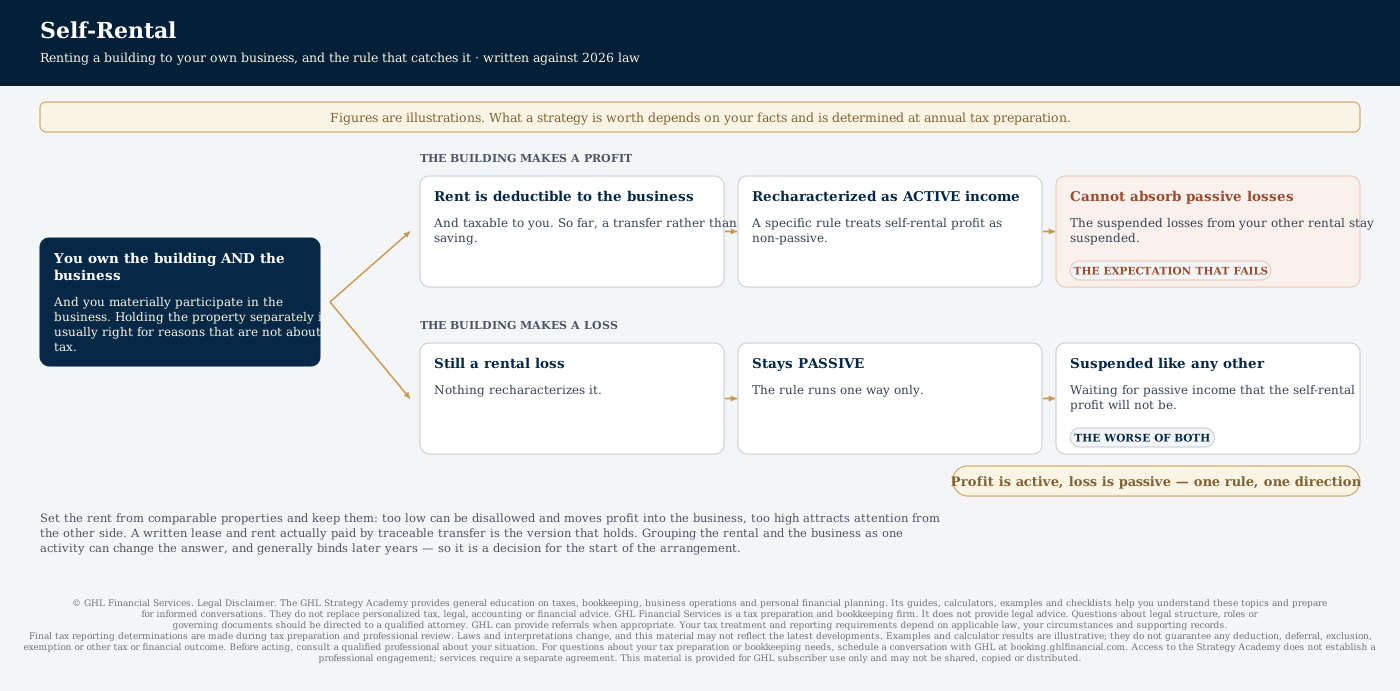
| You own the building and the business | and you materially participate in the business |
|---|---|
| The building makes a profit | recharacterized as ACTIVE — cannot absorb passive losses |
| The building makes a loss | stays PASSIVE — suspended like any other |
| A passive loss elsewhere | still waiting; the self-rental profit will not release it |
| A grouping election | can treat both as one activity — and generally binds later years |
The recharacterization applies to net rental income from property rented to an activity in which the taxpayer materially participates. It does not convert a net loss. Grouping under the passive activity rules is available in some circumstances and is generally binding on subsequent years.
How it works
You own property and lease it to a business you materially participate in.
The business deducts the rent. You report it as rental income.
Where that rental produces net income, a specific rule recharacterizes it as non-passive — so it cannot be offset by passive losses from other activities.
Where it produces a net loss, no such recharacterization happens: the loss stays passive and suspends under the usual rules.
The rent has to be at arm's length. Too low invites disallowance; too high invites attention from the other side.
A written lease is expected. An arrangement between two entities you own with nothing in writing is the version that fails.
Grouping the rental with the business as a single activity can change the treatment, but it is generally binding on later years and interacts with how the property is eventually sold.
What you would do
- Get a written lease, at a rent you can support with comparable properties. Keep the comparables.
- Charge and actually pay the rent, on time, by traceable transfer. Book entries with no money moving are the weakest version.
- Do not plan on a self-rental profit absorbing passive losses. It will not.
- Raise the grouping question with GHL at the start, not after several years of returns.
- Keep the property's own records — improvements, repairs, depreciation — separately from the business's.
Allow three to six months. It needs documents, and usually somebody else to draw them.
Worksheets to use
- Participation hours log (XLSX). Hours by date and task, which is what decides material participation — and material participation is what triggers the self-rental rule in the first place. Log hours as they happen. Here the log is doing something slightly unusual: it evidences the participation that makes the rule apply, so it matters even in a year when the rental makes money.
What GHL needs from you
- The lease, and the comparables the rent was set from.
- Who owns the property and who owns the business, in what shares.
- Whether you materially participate in the business, and the hours.
- Rent actually paid during the year, with dates.
- Any grouping election already made.
What usually goes wrong
- The rule runs one way only. Profit from renting to your own active business is treated as ACTIVE, so it cannot absorb passive losses from elsewhere. A loss on the same property stays PASSIVE. You get the worse of both.
- This surprises people who bought a rental expecting its profit to soak up losses from other property. Against a self-rental it does not.
- Rent set below market is its own problem: it can be disallowed as unreasonable, and it moves profit into the entity that may be paying more tax on it.
- Rent set above market gets attention from the other direction, particularly where the tenant is an S corporation and the landlord is its owner.
- A grouping election can treat the rental and the business as one activity, which changes the answer — but it is generally binding on later years and needs thought before it is made.
- Renting to an entity you do NOT materially participate in is a different question with a different answer.
Common questions
I have suspended losses from another rental. Will my self-rental profit release them?
No. That is exactly what the rule prevents — the profit is treated as active, so it is not passive income for those losses to offset. Plans built on the opposite assumption have to be redone.
Can I just charge a low rent?
It can be challenged as not arm's length, and it moves profit into the business, which may not be where you want it.
Should I make a grouping election?
Sometimes, and it is not reversible on a whim — it generally binds later years and affects what happens when the property is sold. It is a decision for the start of the arrangement, with GHL.
Read next
Keeping it alive
A position is not finished when it is set up. This is what it needs each year to still be there when it matters.
- Confirm it still applies — circumstances change more often than the law does.
- Keep the record current. Filled in as the year happens it is evidence; assembled in March it is a reconstruction.
- Check the documents still say what they said — an agreement that has drifted from practice is the usual failure.
- Ask GHL what changed for 2027. Figures move every year and rules move most years.