
When it matters: No fixed date. Many businesses look at each main price once a year, and again when a main cost moves.
Does this fit you?
- You have left a price unchanged for a long time while your costs moved.
- You are unsure whether a product or service is priced to cover what it costs.
- You are about to quote for larger or different work than usual.
- You price by matching what others charge.
What it could be worth
A price is one of the few figures an owner sets directly, and a small change in it runs through every sale. Reviewing it with the costs and the alternatives in front of you replaces a guess with a decision that has reasons written beside it.
Testing one change on a set date, and reading the weeks before and after, turns a worry about losing customers into something the business can observe. The result may be that the price was right; that is worth knowing too.
What this produces: the filled-in price review worksheet for one product or service, one change chosen (or a decision to leave it), and the review date when the before and after weeks are compared.
How it works
SBA guidance, not a tax rule, on a marketing plan: “Explain your pricing strategy and how you’ll use promotions.”
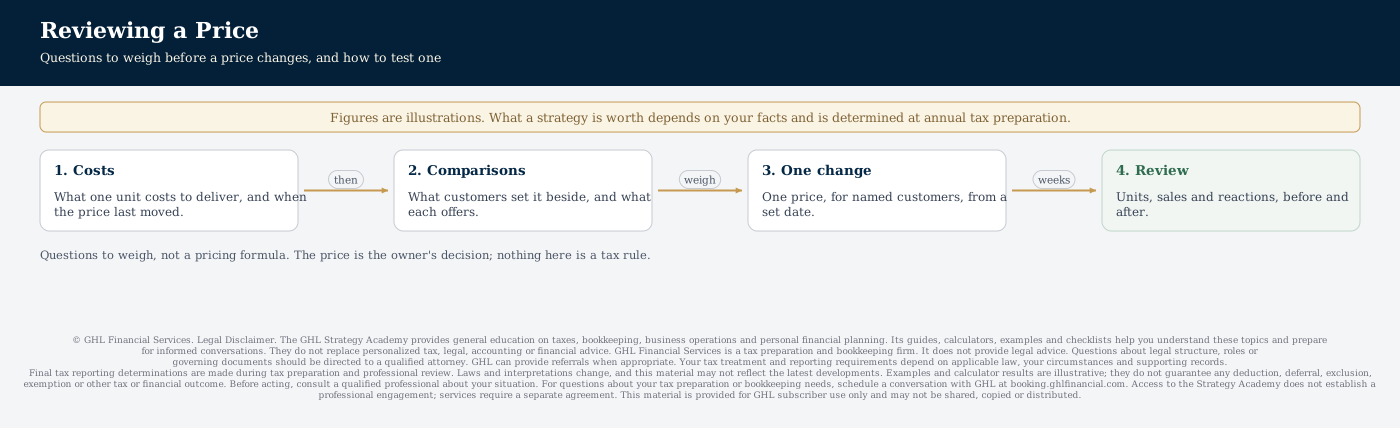
Start with what the price has to cover: the direct cost of one unit, and a share of the overhead. The cost and margin worksheet supplies the first; the second is an estimate.
Then what customers compare it with. That may be a competitor, doing it themselves, or doing without. What each alternative offers that this one does not, and the reverse, is often more telling than the price beside it.
Value is what the customer gets, in their terms: time saved, reliability, a result. Customers who value one of those most tend to notice it more than a small difference in price.
When the price last changed matters because costs rarely stand still. A price unchanged for several years has quietly become a lower price in real terms.
A test changes one price, for named customers or new orders, from a set date. Units, sales and any customer reactions are logged by week, and the weeks before and after are compared at the review.
A price is a commercial decision. Contracts, published price lists and any rules for a particular trade may limit when and how it can change, and those questions sit outside this guide.
Sources
What you would do
- Pick one product or service — usually the one with the lowest margin, or the one whose price has stood longest.
- Download the price review worksheet and fill in what the price has to cover.
- List what customers compare it with, and answer the questions to weigh in your own words.
- Decide whether a change is worth testing. If it is, write down exactly one, who it applies to, the start date and the review date.
- Log the weeks before and after, and note anything unusual beside the week it happened.
- At the review, compare and decide: keep the change, adjust it, or go back.
Usually a week or two — mostly things you can start yourself.
Worksheets to use
- Price review worksheet (XLSX). One price against its direct cost and an overhead share, what customers compare it with, the questions to weigh, one change, and its results week by week. Use one copy per price reviewed. Fill in the top half in one sitting, then log results by week until the review date.
What usually goes wrong
- Reviewing every price at once. The review rarely finishes, and if everything changes, nothing can be learned from the result.
- Matching a competitor's price without knowing what it costs this business to deliver.
- Leaving a price untouched for years while costs rose, so that each year's sale leaves a little less.
- Reading two quiet weeks after a change as the customers' verdict, when the season or one missing order explains it.
- Discounting to win work without writing down when the discount ends.
Common questions
Will customers leave if the price goes up?
Some may, and nobody can say in advance how many. That is why the change is tested on a set date and read from the business's own weeks, rather than decided from a guess either way.
How often should a price be looked at?
There is no rule. Many owners look at each main price once a year, and again when a main cost changes, so that no price drifts for years without a decision.
Is it better to raise prices or cut costs?
They answer different questions, and the cost and margin worksheet shows which lever is larger for each product or service. Both are worth weighing; this guide is about the price.
Read next
Keeping it alive
A position is not finished when it is set up. This is what it needs each year to still be there when it matters.
- Confirm it still applies — circumstances change more often than the law does.
- Keep the record current. Filled in as the year happens it is evidence; assembled in March it is a reconstruction.
- Put the date in the calendar. This one closes at the year end and cannot be added at tax preparation.
- Ask GHL what changed for 2027. Figures move every year and rules move most years.