
When it matters: Guaranteed payments are set by the agreement and belong to the partnership's year. An expense rule has to be in the agreement before the expense, not agreed afterwards.
Does this fit you?
- You are a partner or a member of a multi-member LLC.
- You are moving from employee to partner, where the payroll has to stop.
- Your partnership is deciding how to pay working partners against passive ones.
- You pay business costs personally and wonder where they go.
What it could be worth
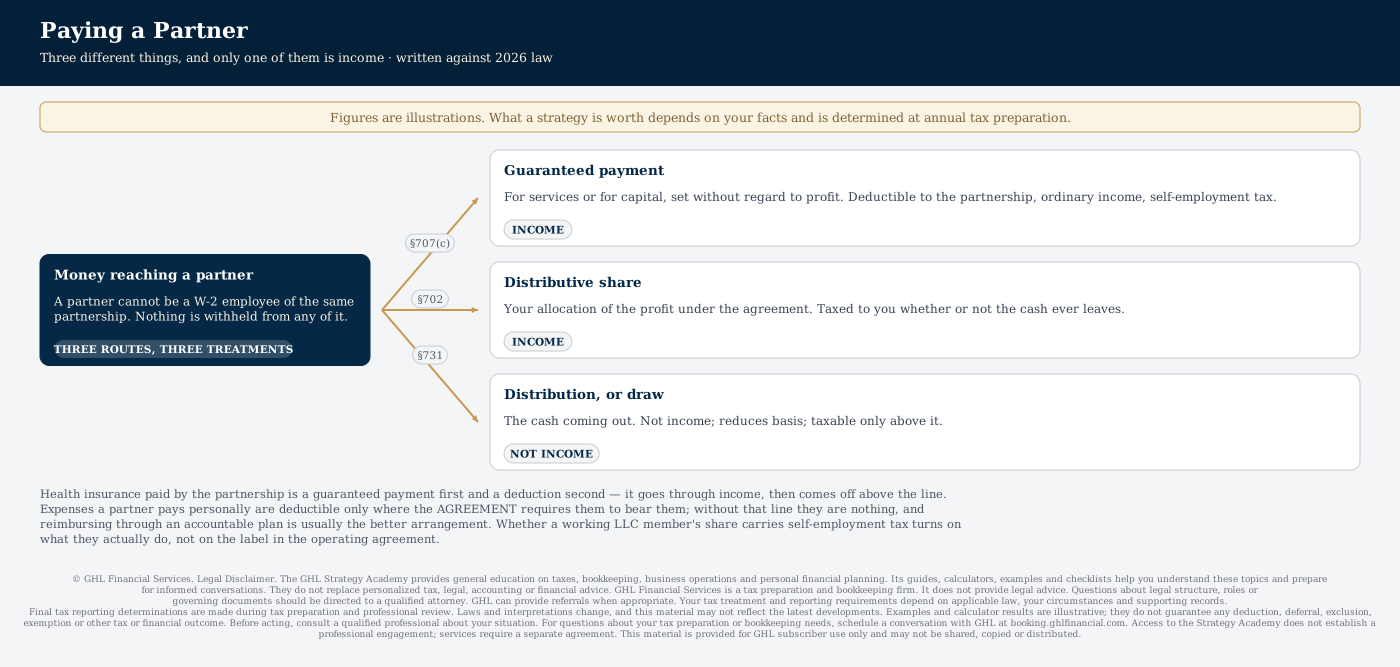
Money reaches a partner in three different ways and they are taxed in three different ways, so the labels on the accounts matter more here than in any other structure.
A guaranteed payment is for services or for the use of capital and is set without regard to whether there is any profit. It is deductible by the partnership, ordinary income to the partner, and carries self-employment tax. It is the closest thing to a salary that a partnership has.
A distributive share is your allocation of the profit under the agreement. It is taxed to you whether or not the cash ever leaves the business.
A distribution — a draw — is neither. It is the cash coming out, it is not income, and it reduces your basis. It only becomes taxable if it exceeds basis, which is where the trouble starts.
| Guaranteed payment | deductible to the partnership; ordinary income; self-employment tax |
|---|---|
| Distributive share of profit | taxed to you whether distributed or not |
| Distribution or draw | not income; reduces basis; taxable only above basis |
| Health insurance paid by the partnership | a guaranteed payment, then deducted above the line |
| Expenses you pay personally | deductible only if the agreement requires you to bear them |
| A W-2 from your own partnership | not available |
The structure of §707(c), §702 and §731. How much self-employment tax applies depends on what the partner does and on the kind of interest, and that question is genuinely unsettled for working LLC members. GHL applies it to your own agreement and facts.
How it works
A partnership does not pay tax. It allocates income to the partners under the agreement, and each partner pays on their share.
A guaranteed payment is fixed without reference to profit — a set amount for running the business, or a return on capital contributed. The partnership deducts it in arriving at profit, and the partner reports it as ordinary income.
Because a partner is not an employee, nothing is withheld from any of it. The partner pays through estimated payments instead, and the first year of partnership is the year people are most often caught short.
Self-employment tax applies to a guaranteed payment for services in all cases. Whether it also applies to the distributive share depends on the kind of partner: a general partner's share carries it, and a genuine limited partner's does not.
For an LLC member the answer is not settled by the operating agreement. What decides it is what the member actually does in the business, and the position has been litigated repeatedly.
Basis is the running record: contributions, plus income allocated, plus a share of partnership liabilities, less distributions and losses. A distribution above basis is a taxable gain, and it can arrive without anybody intending it.
Health insurance paid for a partner is treated as a guaranteed payment, which puts it into income first. The partner then takes the self-employed health deduction above the line, which normally makes it neutral.
Expenses a partner pays out of their own pocket are deductible on their own return only where the partnership agreement or an established practice requires the partner to bear them. That one line is the whole difference, and it is usually easier to reimburse through an accountable plan instead.
Retirement plan contributions are computed on self-employment income after the deduction for half the self-employment tax, not on the gross allocation.
What you would do
- Stop the payroll the day somebody becomes a partner, and switch them to estimated payments.
- Have the agreement say what each partner is paid, and whether it is a guaranteed payment or an allocation.
- Put the expense rule in the agreement if partners genuinely bear their own costs. Otherwise reimburse through an accountable plan.
- Keep a basis schedule per partner from day one. Rebuilding it years later is the single most expensive piece of catch-up work here.
- Set estimated payments in the first partnership year deliberately — nothing is being withheld any more.
- Say what each working member actually does, for the self-employment question.
Allow one to two months. Some of it depends on other people.
What GHL needs from you
- The partnership agreement, including anything on guaranteed payments and expenses.
- Each partner's capital account and basis history.
- Guaranteed payments and distributions for the year, separately.
- What each working partner does in the business.
- Health insurance paid by the partnership, per partner.
What usually goes wrong
- A partner cannot be a W-2 employee of the same partnership. Running one through payroll creates a problem in both directions, and it happens most often when an employee is promoted to partner mid-year.
- A draw is not pay. It is a distribution, it is not income, and taking one does not reduce what you are taxed on.
- You are taxed on your share of the profit whether or not any of it is distributed. A profitable year with everything reinvested still produces a tax bill.
- Unreimbursed expenses a partner pays personally are deductible only where the partnership agreement requires the partner to bear them. Without that line, they are nothing.
- The limited partner exclusion from self-employment tax is not settled for an LLC member who works in the business. The position turns on what the member actually does, not on the label in the operating agreement.
- Health insurance paid by the partnership is a guaranteed payment before it is a deduction — it goes through income first and comes off above the line after.
Common questions
Can I just put myself on payroll?
Not as a partner of the same partnership. It creates a problem on both returns, and the fix is a guaranteed payment with estimated payments behind it.
I only took $40,000 out but my K-1 says $120,000.
The other $80,000 stayed in the business and increased your basis.
I pay for my own car and phone. Can I deduct them?
Only if the partnership agreement requires you to bear them. Where it does not, the deduction is not available — and reimbursing through an accountable plan is usually the better arrangement anyway.
I am a member of an LLC, so no self-employment tax on my share?
Not safe to assume. The exclusion is for genuine limited partners and the position for a working LLC member turns on what they actually do. It is worth settling deliberately rather than by the label.
Read next
Keeping it alive
A position is not finished when it is set up. This is what it needs each year to still be there when it matters.
- Confirm it still applies — circumstances change more often than the law does.
- Check the documents still say what they said — an agreement that has drifted from practice is the usual failure.
- Ask GHL what changed for 2027. Figures move every year and rules move most years.