
When it matters: Everything here is decided during the year. By the time the return is filed, the records either exist or they do not.
Does this fit you?
- You are claiming something substantial and wondering how exposed it is.
- Your business takes cash, or is running losses.
- You have had a matching notice and do not want another.
What it could be worth
Nothing directly. The point is the opposite of avoidance: claim what is yours, and be ready to support it.
What it does save is the cost of an examination going badly — which is almost entirely a function of whether the records existed when the return was filed.
The cheapest item on the list is the simplest: make sure every form issued to you reaches the return. Matching notices are the most common contact there is and the most completely preventable.
| A form issued to you that is not on the return | automatic match — the most common notice there is |
|---|---|
| Round numbers throughout | reads as estimated rather than recorded |
| A large deduction against a small income | the ratio, not the amount |
| Losses year after year from one activity | raises whether it is a business at all |
| A cash-heavy business | a category question, not an accusation |
| Large non-cash charitable gifts | their own substantiation rules, met at the time or not at all |
| What answers every one of these | a record made when it happened |
Described from how examinations are generally initiated rather than from any published list of criteria. Document matching is automated and accounts for most contact. Nothing here is a reason to omit something you are entitled to claim; it is a reason to be able to support it.
How it works
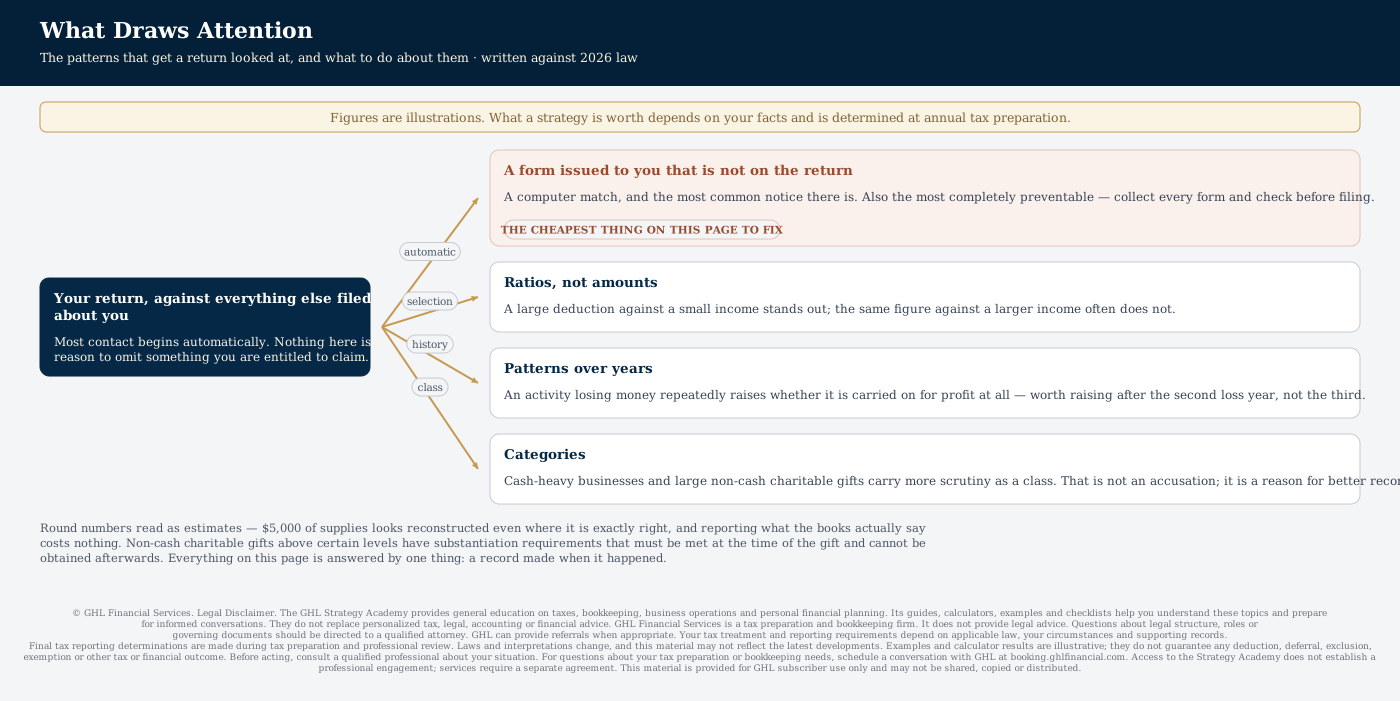
Most contact begins automatically, by matching forms filed about you against your return. A missing form produces a notice without anybody reading anything.
Beyond that, returns are selected partly by how far they sit from what is typical for a comparable taxpayer.
Ratios matter more than amounts. A deduction that is large relative to income stands out; the same figure against a larger income often does not.
Patterns over years matter too — an activity losing money repeatedly raises whether it is carried on for profit at all.
Certain categories carry more scrutiny as a class, including cash businesses and some credits.
Some deductions have specific substantiation requirements that have to be met at the time, particularly larger non-cash charitable gifts.
None of this changes what you may claim. It changes what you should have in the file before you claim it.
What you would do
- Collect every form issued to you and check them against the return before filing. This alone prevents most notices.
- Report what the records say, to the dollar. Tidy figures invite the question that exact ones do not.
- Where a deduction is large relative to income, make sure the supporting file is complete before filing rather than after.
- If an activity has lost money two years running, raise it with GHL now — not on the third.
- For non-cash charitable gifts, get the substantiation at the time of the gift. It cannot be obtained later.
- Run a card or bank feed rather than a shoebox. Contemporaneous records are the whole answer to every item on this page.
Usually a week or two — mostly things you can start yourself.
What GHL needs from you
- Every form issued to you for the year, including ones you think are wrong.
- Records behind any large or unusual deduction.
- The loss history of any activity that has not yet made money.
- Substantiation for charitable gifts, particularly non-cash ones.
- Any prior notices, and how they were resolved.
What usually goes wrong
- Most notices are not judgments about a position. They are a computer comparing a form somebody else filed against what appeared on your return — a missing form is the single most common cause, and it is entirely avoidable.
- Round numbers read as estimates. $5,000 of supplies and $12,000 of contract labor look reconstructed even when they are exact, and the fix is to report what the records say rather than tidy figures.
- A large deduction against a small income attracts attention because of the ratio, not the amount. The same deduction against a larger income often does not.
- Repeated losses from the same activity raise the question of whether it is a business at all — a different guide, and one worth reading before the third loss year rather than after.
- Cash-heavy businesses get more attention as a category. That is not an accusation; it is a reason for better records than a card-only business needs.
- A large charitable deduction, particularly of something other than cash, needs its substantiation in place at the time. Non-cash gifts above certain levels have their own requirements, and they cannot be met retrospectively.
- Being examined is not an accusation either. The question asked is almost always 'show me', and the answer is a record or it is nothing.
Common questions
Should I avoid claiming something because it attracts attention?
No. Claim what you are entitled to — that is the whole point of the rest of this library. What this page is for is making sure the file behind the claim exists before you make it, because the question asked is almost always 'show me'.
Why do round numbers matter?
They read as estimates rather than records. $5,000 of supplies looks reconstructed even where it is exactly right, and reporting what the books actually say costs nothing and removes the impression.
Read next
Keeping it alive
A position is not finished when it is set up. This is what it needs each year to still be there when it matters.
- Confirm it still applies — circumstances change more often than the law does.
- Put the date in the calendar. This one closes at the year end and cannot be added at tax preparation.
- Ask GHL what changed for 2027. Figures move every year and rules move most years.