
When it matters: The form arrives by January 31. The records that reconcile it have to have been kept through the year — nothing can be reconstructed from the form alone.
Does this fit you?
- You sell through an online marketplace or take card payments.
- You use a payment app for a side business, however small.
- You cleared out a house and sold the contents online.
- Your processor reports a figure that does not match your own books.
What it could be worth
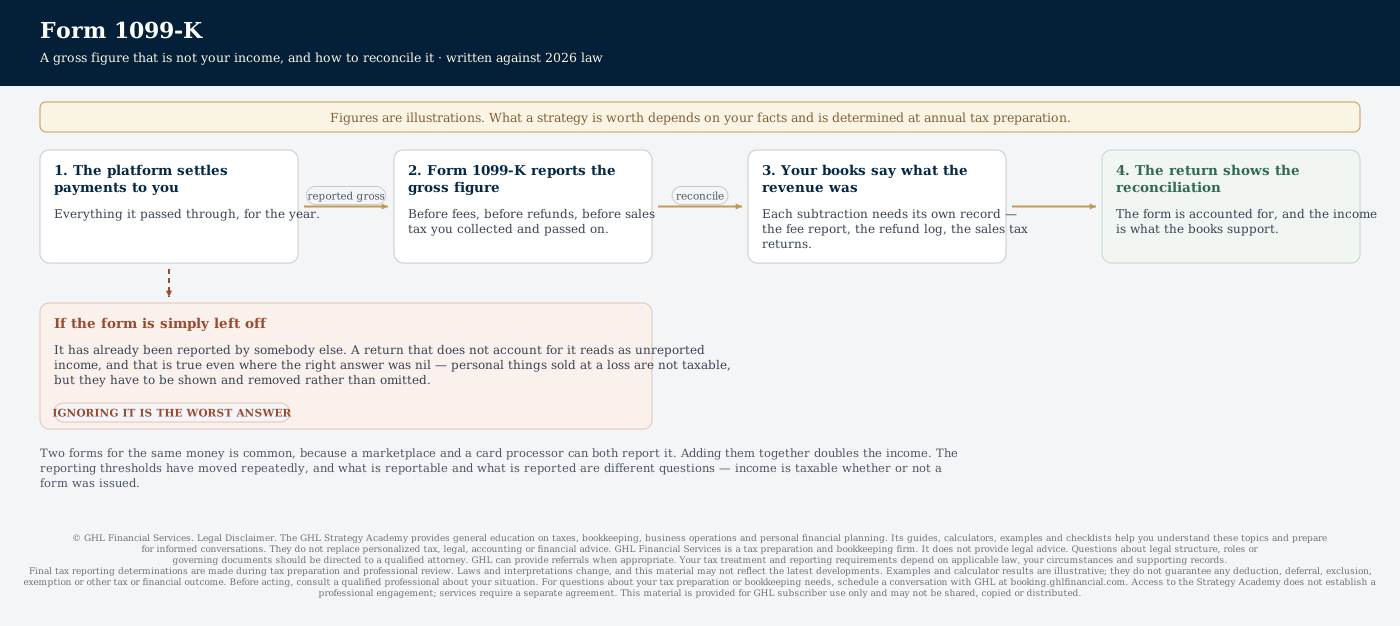
This form causes more unnecessary tax than almost any other, and not because of what it says. It reports the gross amount a platform settled to you, which is a larger number than your income by design — fees have not been taken out, refunds have not been netted, and any sales tax you collected and passed on is inside it.
The income is what the books say. The form is what a third party settled. Reconciling one to the other is a normal part of preparing a return, and it needs records kept during the year rather than a figure argued about afterwards.
Selling personal things at a loss is not income at all. That is not a deduction or a strategy — it was never taxable. But because it has been reported, it has to be shown and removed explicitly, and a return that simply omits it looks like unreported income.
| Reported on the form, gross | $48,000 |
|---|---|
| Platform and processing fees inside it | $3,400 |
| Refunds and chargebacks inside it | $1,900 |
| Sales tax collected and passed on | $2,700 |
| Revenue the books actually show | $40,000 |
Illustrative amounts for one seller. Every one of the subtractions needs its own record — the platform's fee report, the refund log, the sales tax returns. The figures are not in dispute; what they are made of is what has to be shown.
How it works
A payment settlement entity reports the gross amount it settled to you for the year, month by month, under §6050W. Gross means before anything is taken out.
Your income is your revenue less what it cost to earn, which is what the books are for. The form is a starting point for a reconciliation and not a figure to be entered.
Where the same money passes through two reporters — a marketplace and a card processor — two forms can arrive for it. Each has to be traced rather than added.
Personal items sold for less than they cost are not taxable and the loss is not deductible either. The gross is reported on the return and the same amount is removed, so the net effect is nothing and the form is accounted for.
Personal items sold for MORE than they cost are taxable, as a capital gain. It is rare, and it happens with collectibles.
Where the business is real, the answer is an ordinary business return with revenue and expenses, and the form reconciles to the revenue line rather than replacing it.
The reporting thresholds have changed repeatedly. What is reportable and what is reported are different questions, and income is taxable whether or not a form was issued.
What you would do
- Use one account for business and a different one for personal. Almost every hard case here starts with one account doing both.
- Download the platform's fee and refund reports monthly, not at year end. Some only keep a rolling window.
- Keep proof of what personal items cost, where you can, so a sale at a loss can be shown as one.
- Reconcile the form to your books when it arrives, and keep the working.
- Send GHL every form you receive, including ones you think are wrong or duplicated.
Usually a week or two — mostly things you can start yourself.
What GHL needs from you
- Every Form 1099-K received, from every platform.
- The platform's fee, refund and chargeback reports for the year.
- Your own revenue records, to reconcile against.
- Sales tax collected and remitted, if any.
- For personal items, whatever shows what they originally cost.
What usually goes wrong
- It reports GROSS payments. Platform fees, refunds, chargebacks and sales tax collected are all inside the figure and none of them are your income.
- Ignoring it because the figure is wrong is the worst response. It has been reported, and a return that does not account for it invites the letter.
- Selling personal belongings at a loss is not taxable — but it still has to appear on the return and be backed out, not simply left off.
- Personal transfers between friends should never be on one. Where a payment app has been used for both business and splitting dinner, untangling it afterwards is the whole job.
- Two forms for the same money is common — a platform and a processor can both report it. Adding them together doubles the income.
- The reporting threshold has moved several times and is still moving, so the absence of a form in a past year says nothing about whether the income was reportable.
Common questions
The figure is far higher than I earned. Is it wrong?
Usually not wrong, just gross. What it needs is a reconciliation rather than a correction.
Friends repay me through an app. Will that be on the form?
It should not be — personal transfers are outside it if they are tagged as such. Where they have been mixed with business receipts, separating them is the work, and a separate account is the fix going forward.
Read next
Keeping it alive
A position is not finished when it is set up. This is what it needs each year to still be there when it matters.
- Confirm it still applies — circumstances change more often than the law does.
- Put the date in the calendar. This one closes at the year end and cannot be added at tax preparation.
- Ask GHL what changed for 2027. Figures move every year and rules move most years.