
When it matters: Basis and at-risk are measured at the year end, so anything that would fix them has to happen before December 31. The passive test is about the whole year's participation and cannot be arranged in the last week.
Does this fit you?
- Your K-1 shows a loss that did not reduce your tax.
- You are about to fund the business and want to know whether it releases anything.
- You own a rental and have been told your losses are suspended without being told why.
What it could be worth
Nothing is created here. What changes is WHEN a loss you have already suffered becomes usable, and that can be the difference between this year and several years away.
The value is in knowing which limit stopped it, because the fixes do not overlap. Capital releases a basis-blocked loss and does nothing at all for a passive one; more hours release a passive loss and do nothing for a basis one.
The largest single release is usually a disposal: selling a passive activity outright frees its accumulated suspended losses, which is worth modeling before the sale rather than discovering after it.
| Your share of the loss | $50,000 |
|---|---|
| Gate 1 — basis | basis is $30,000, so $20,000 suspends here |
| Released by | more basis: contribute capital, or lend to the company yourself |
| Gate 2 — at-risk | of the $30,000, only what you are personally on the hook for passes |
| Released by | converting borrowing you are not at risk on, or putting in your own money |
| Gate 3 — passive | if you do not materially participate, what is left waits for passive income |
| Released by | passive income, enough participation, or disposing of the activity entirely |
The three limits are applied in this order and each is computed separately. A loss suspended at one gate never reaches the next. Basis and at-risk are measured at the year end; material participation is tested across the whole year. In an S corporation, entity-level borrowing creates no shareholder basis; in a partnership, a share of partnership liabilities generally does.
How it works
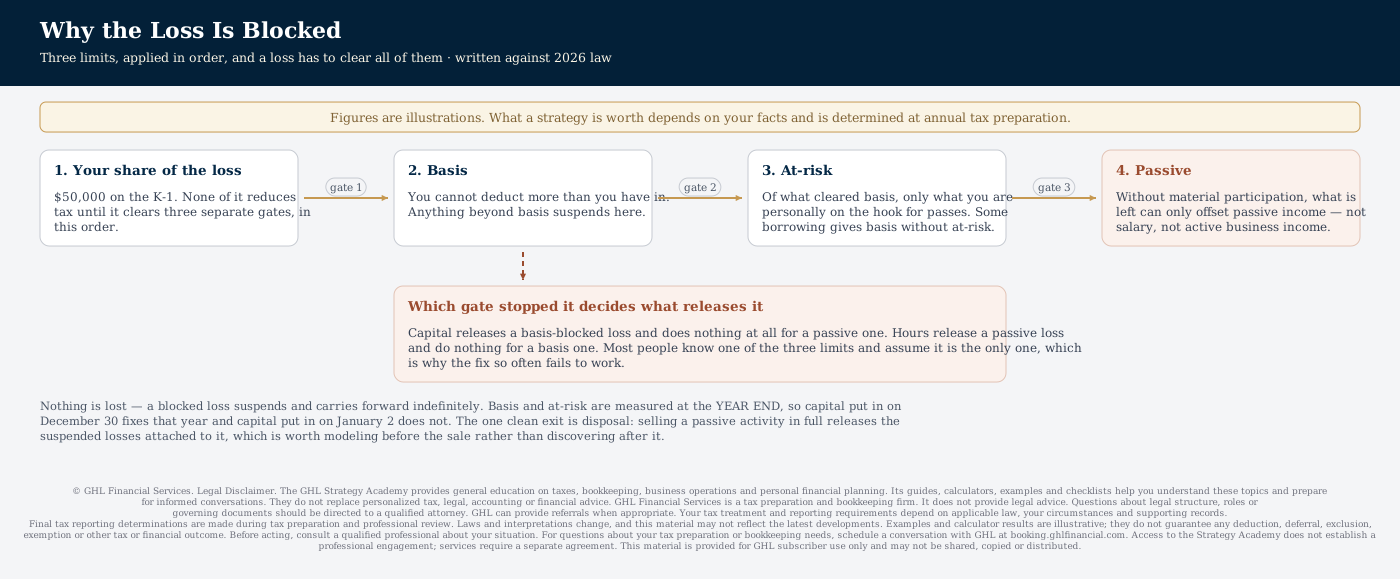
Your share of a loss arrives on a K-1. Before any of it reduces your tax it has to pass three tests, in order.
First, basis. You cannot deduct more than you have in the activity. A loss beyond basis suspends and waits for basis to appear.
Second, at-risk. Of what cleared basis, only the part you are genuinely on the hook for is deductible. Some borrowing gives basis without putting you at risk, and that gap is where losses stop.
Third, the passive rules. If you do not materially participate, the remaining loss can only offset passive income — not salary, not business income you work in, not investment income.
A loss stopped at any gate is suspended and carried forward indefinitely. Nothing is lost; it is deferred.
What releases it depends entirely on which gate stopped it, and the three answers have nothing in common.
Disposing of a passive activity in full releases the suspended losses attached to it, which is why a sale can be worth considerably more than the price suggests.
What you would do
- Ask GHL which gate stopped the loss. Without that, any attempt to fix it is a guess.
- If it is basis, decide before the year end whether to contribute or lend. Capital put in during January does nothing for the year just closed.
- If you are lending to the business, document it as a loan with a note. A transfer with no paperwork may create no basis at all.
- If it is passive, log participation hours from January 1. Nobody has ever reconstructed a participation year convincingly in March.
- Before selling a passive activity, ask what suspended losses it is carrying. That figure belongs in the decision.
- Keep the basis schedule current. It is the record that answers all of this and it cannot be rebuilt quickly.
Allow three to six months. It needs documents, and usually somebody else to draw them.
Worksheets to use
- Owner basis schedule (XLSX). Opening basis, income, contributions, distributions, losses used and losses suspended, year by year, with stock and loan basis kept apart. This is the record that answers gate one and gate two. It is a running balance, so a missing year has to be rebuilt before the current one can be computed.
- Participation hours log (XLSX). Hours by date and task, which is what decides material participation and therefore gate three. Log as you go. Participation is tested across the whole year and a log written afterwards is the weakest evidence there is.
What GHL needs from you
- The K-1, in full, with all attached statements.
- Your basis schedule, or what is needed to rebuild it.
- Loans you have personally made to the entity, and the documents.
- Whether the borrowing in the entity is recourse or not.
- Hours you spent in the activity, and in what.
What usually goes wrong
- Three separate limits, applied in that order, and a loss must clear all three. Most people know one of them and assume it is the only one.
- A loss stopped by any of them is SUSPENDED, not lost. It waits. Which limit stopped it decides what releases it, and the answers are completely different.
- Basis is fixed by what you put in and what has happened since. More basis releases a basis-blocked loss — and in an S corporation, money the company borrows gives you none of it.
- At-risk is narrower than basis. Money you are not personally on the hook for — certain non-recourse borrowing — can give basis without giving at-risk, so a loss can clear the first test and fail the second.
- Passive is about participation, not money. No amount of capital releases a passive loss; only passive income, more participation, or disposing of the activity entirely does.
- Disposing of a passive activity completely releases its suspended losses. That is the one clean exit and it is frequently the reason a sale is worth more than it looks.
- Putting capital in on December 30 fixes a basis problem for that year. Putting it in on January 2 does not.
Common questions
I put $100,000 into the business. Why is my loss still blocked?
Because capital answers gate one and possibly gate two, and does nothing for gate three.
Is the loss gone?
No. The question is only when it becomes usable, which is why knowing which gate stopped it matters more than the amount.
The company borrowed the money. Does that give me basis?
In an S corporation, no — not even where you stood behind it personally; only a direct shareholder loan does. The at-risk test then asks a further question: whether you are genuinely on the hook for it.
Read next
Keeping it alive
A position is not finished when it is set up. This is what it needs each year to still be there when it matters.
- Confirm it still applies — circumstances change more often than the law does.
- Keep the record current. Filled in as the year happens it is evidence; assembled in March it is a reconstruction.
- Put the date in the calendar. This one closes at the year end and cannot be added at tax preparation.
- Ask GHL what changed for 2027. Figures move every year and rules move most years.