
When it matters: A plan has to exist before the benefit is provided. Several of these also need the amount on the W-2 by the year end, which cannot be added afterwards.
Does this fit you?
- You wonder what the business can pay for without it being pay.
- You are an S-corporation shareholder over 2%, where the answer is different from what an employee gets.
- You are weighing up entity choice, where this is one of the few places it changes a real number.
- You employ a spouse or a child.
What it could be worth
There are benefits an employer can provide that are deductible to the business and not income to the employee. That is the best treatment available anywhere in tax — better than a deduction, because nothing is taxed on either side.
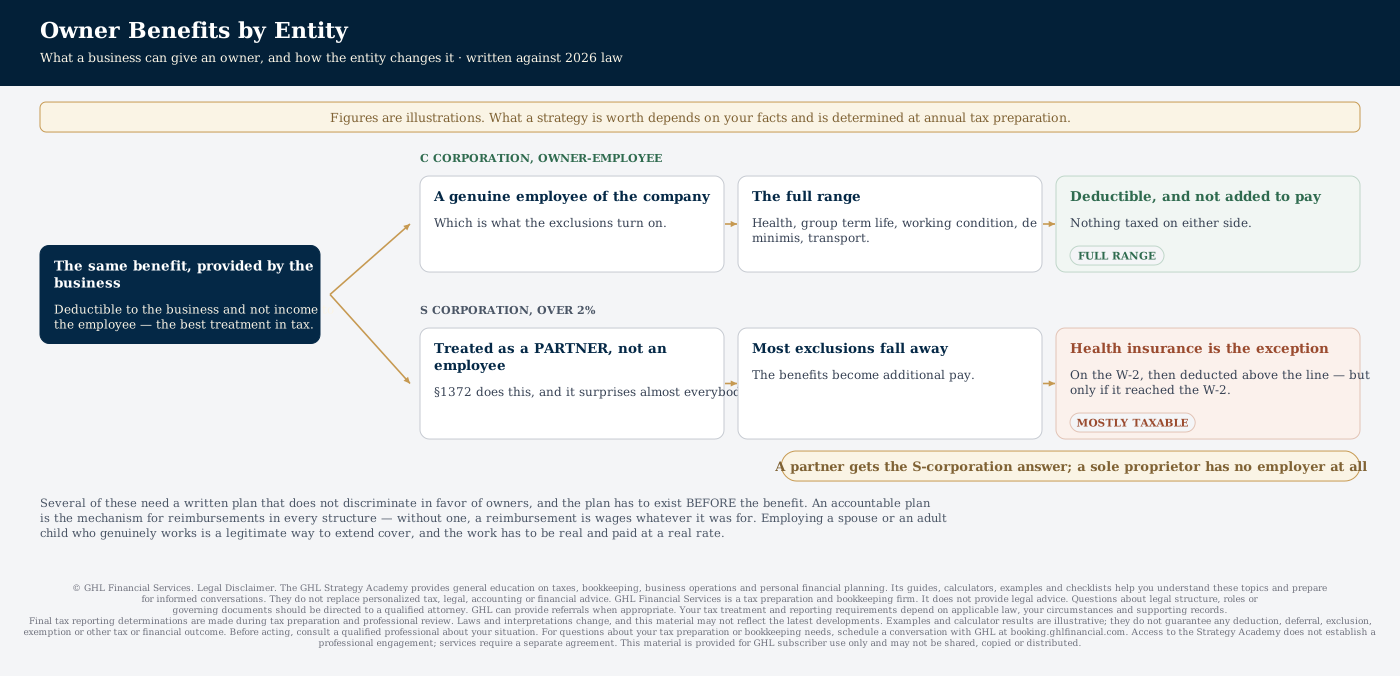
The catch is who counts as an employee. A C corporation's owner who works in it genuinely is one, and gets the full range. A partner is not, and a shareholder owning more than 2% of an S corporation is treated as a partner for this purpose — which removes most of it.
So the same benefit has up to four answers depending on the structure, and this is one of the few places where entity choice changes an ordinary running cost rather than a rate.
| C corporation, owner-employee | the full range — deductible, and not added to pay |
|---|---|
| S corporation, over 2% | treated as a partner — most benefits become taxable pay |
| Partnership, a partner | treated as self-employed — the same limitation |
| Sole proprietor | no employer to provide anything |
| Health insurance, S-corp over 2% | on the W-2, then deducted above the line |
| Ordinary employees, any structure | the full range, untaxed |
The structure of §132, §105 and §1372. Which benefits survive for a 2% shareholder, and the limits on each, are applied by GHL for your year. Several require a written plan that does not favor owners, and that plan has to exist before the benefit.
How it works
A working condition benefit is something that would have been deductible if the employee had paid for it themselves — a subscription, a tool, training for the current role. It is deductible to the business and not income.
De minimis items are too small to be worth accounting for. The exception is narrow and does not stretch to a regular allowance.
Health cover provided by an employer is deductible and not income under §105 and §106 — the largest of these by a distance.
Group term life under §79 is untaxed up to a limit, and the excess is imputed onto the W-2 rather than disallowed.
Educational assistance, dependent care assistance and transport benefits each have their own limit and their own written-plan requirement.
§1372 treats a shareholder owning more than 2% of an S corporation as a partner for fringe benefit purposes. That removes most of the exclusions, and the benefits become additional pay.
Health insurance is the exception worth knowing: for such a shareholder it is included in W-2 wages, and the shareholder then takes the self-employed health deduction above the line. It works out broadly neutral, but only if it reached the W-2.
For a partnership the equivalent is a guaranteed payment, and the same above-the-line deduction follows.
An accountable plan is the mechanism for reimbursing costs in every structure. Without one, a reimbursement is wages.
Employing a spouse or an adult child who genuinely works is a legitimate way to extend benefits, and the work has to be real and paid at a real rate.
What you would do
- Check what the business is actually taxed as before assuming any of this applies.
- If you own more than 2% of an S corporation, make sure health insurance is on the W-2 before the year closes.
- Put a written plan in place for anything that needs one, and do it before the benefit is provided.
- Set up an accountable plan for reimbursements, whatever the structure.
- List what the business currently pays for on your behalf and check each one against the structure.
- Raise this in any entity conversation. It is one of the few places the answer genuinely differs.
Allow one to two months. Some of it depends on other people.
What GHL needs from you
- How the business is taxed, and each owner's percentage.
- A list of what the business pays for on the owners' behalf.
- Plan documents for anything requiring one.
- W-2s for owner-employees, showing what was included.
- The accountable plan, and the reimbursement records under it.
What usually goes wrong
- A shareholder owning more than 2% of an S corporation is treated as a partner for most of these, not as an employee. Almost every benefit that would be untaxed to a normal employee becomes taxable to them.
- Health insurance for such a shareholder has to go on the W-2 to be deductible above the line. Left off, the deduction is lost, and January is too late to add it.
- A sole proprietor has no employer to provide anything. There is nobody on the other side of the arrangement.
- A plan that covers only the owner is not a plan. Several of these require a written plan that does not discriminate in favor of owners.
- Reimbursing a cost without an accountable plan makes the payment wages, whatever it was for.
- Family members working in the business can be covered as employees, and that is genuinely useful — but they have to actually work.
Common questions
My health insurance was paid by the company but not on my W-2.
Then the above-the-line deduction is at risk, because the inclusion is what supports it. It is fixable during the year and much harder after it.
Would a C corporation fix this?
For benefits, largely yes — an owner-employee of a C corporation gets the full range. It also brings a second layer of tax on profit, so it belongs in the whole entity conversation rather than deciding it.
Can I put my spouse on the payroll for the benefits?
If they genuinely work in the business and are paid a real rate for it, yes. If the job exists only to carry the benefit, it does not hold up.
Read next
Keeping it alive
A position is not finished when it is set up. This is what it needs each year to still be there when it matters.
- Confirm it still applies — circumstances change more often than the law does.
- Check the documents still say what they said — an agreement that has drifted from practice is the usual failure.
- Ask GHL what changed for 2027. Figures move every year and rules move most years.