
When it matters: A §83(b) election is thirty days from grant, with no relief. A §754 election is made on a return filed on time for the year the transfer happened.
Does this fit you?
- You are bringing a key person into ownership rather than only into a bonus scheme.
- Your partnership is admitting a new partner who is paying to come in.
- You have been offered a slice of a business you work in.
- Your partnership has had a partner die or be bought out.
What it could be worth
There are two quite different things people mean by giving somebody equity, and the tax follows which one it actually is.
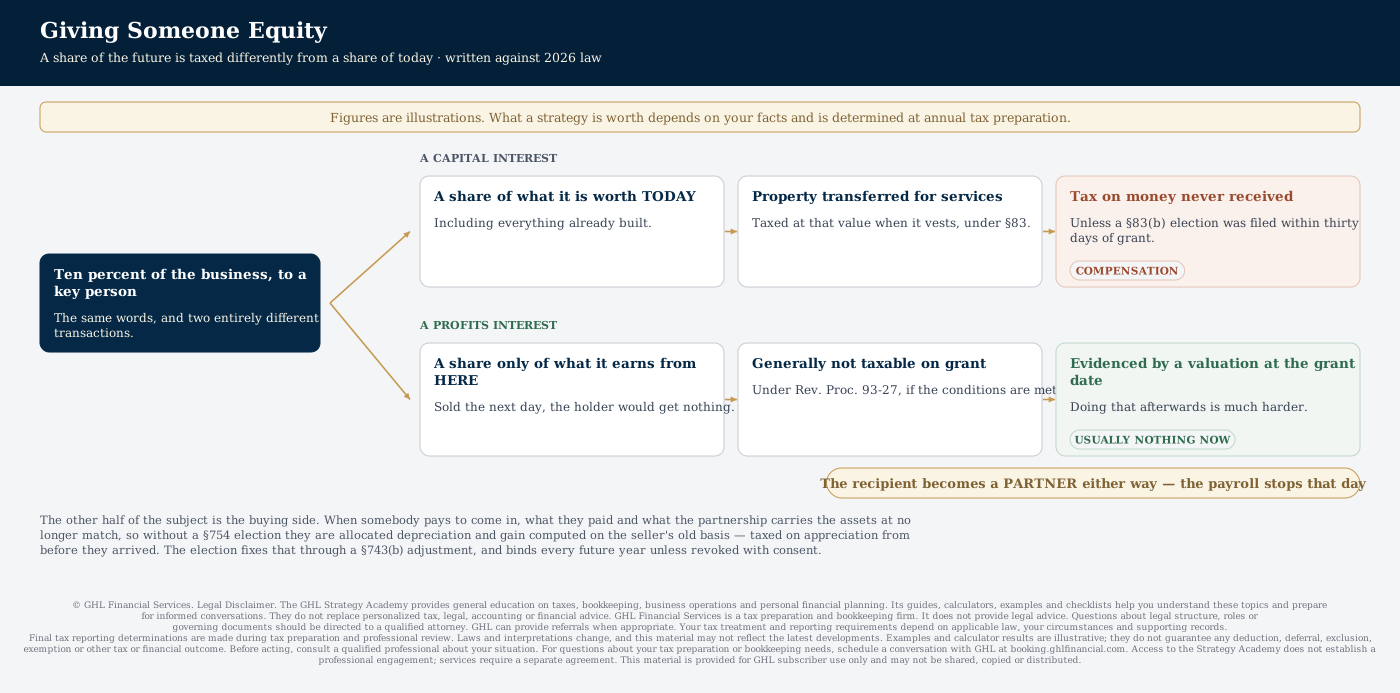
A capital interest is a share of what the business is worth today. Given for services it is compensation, taxed at that value when it vests, and the recipient owes tax on money they have not received. That is the version that goes wrong.
A profits interest is a share only of what the business earns and grows from here. If the business were sold the day after the grant, the holder would get nothing. Because of that, a properly structured profits interest is generally not taxable when it is granted — which is what makes it the usual answer for bringing somebody in.
The other half of the subject is the buyer's side. When somebody buys a partnership interest, what they paid and what the partnership carries the assets at no longer match. A §754 election lets the new partner's share of the inside basis be adjusted to what they actually paid, so the depreciation and the gain they are allocated reflect their own price rather than the seller's history.
| Capital interest, given for services | compensation at current value, taxed on vesting |
|---|---|
| Profits interest, properly structured | generally nothing on grant |
| What makes it a profits interest | no share of liquidation value on the day it is granted |
| What proves it | a valuation at the date of grant |
| Buying in, no §754 election | allocated gain and depreciation on the seller's old basis |
| Buying in, with the election | adjusted to what the buyer actually paid |
The treatment in Rev. Proc. 93-27 for profits interests and §743(b) for the basis adjustment. Each depends on conditions being met and documented at the time. GHL works the actual treatment with counsel on the documents, because the agreement has to create what the tax analysis assumes.
How it works
Property transferred for services is taxed at its value when it vests, under §83. A capital interest in a partnership, or shares in a corporation, is property.
A §83(b) election within thirty days of grant elects to be taxed at the value on the grant date instead of on vesting. For a young business that value is often small, and the election starts the capital holding period immediately. It cannot be undone and it is not refunded if the interest is forfeited.
A profits interest is different in substance: it carries no right to existing value. Under Rev. Proc. 93-27 it is generally not a taxable event on grant, provided it is not a substantially certain income stream, is not disposed of within two years, and is not in a publicly traded partnership.
A valuation at the grant date is what evidences that there was nothing to receive. Where the interest is subject to vesting, a protective §83(b) election is commonly filed as well.
The recipient becomes a partner. They stop being an employee of the partnership, their pay becomes a guaranteed payment or an allocation, and nothing is withheld any more.
On the buying side: a partnership's assets have an inside basis, and a purchaser's interest has an outside basis equal to what they paid. When those diverge, the new partner is allocated depreciation and gain computed on figures that predate them.
A §754 election brings the two together for that partner through a §743(b) adjustment — their share of inside basis is stepped to match their price. It also applies under §734(b) to certain distributions.
Once made, the election applies to every future transfer and distribution until it is revoked with consent. That can be a burden where the adjustments run the other way.
For a corporation none of the §754 machinery exists. A buyer of shares takes basis in the shares and nothing changes inside the company, which is one of the structural differences between the two forms.
What you would do
- Decide which thing you are actually giving before anything is signed. It is a legal question with a tax consequence, not the reverse.
- Get the business valued at the grant date if a profits interest is intended. That document is the evidence.
- File the thirty-day election where one applies, and keep proof it was sent.
- Stop the payroll the day an employee becomes a partner.
- When somebody buys in, raise the §754 election before the return is filed for that year.
- Have counsel draft the agreement. The tax treatment assumes terms that have to actually exist.
Allow three to six months. It needs documents, and usually somebody else to draw them.
What GHL needs from you
- The grant or purchase agreement, and the operating agreement it sits under.
- A valuation at the grant date, for a profits interest.
- Any §83(b) election filed, with proof of sending.
- What the buyer paid and what the partnership carries the assets at.
- Whether a §754 election is already in place from an earlier year.
What usually goes wrong
- Giving a share of the current value of the business to somebody for their work is pay, taxable now at what it is worth, with nothing having been sold to fund it.
- The moment an employee is given a partnership interest they stop being an employee. The payroll has to end and estimated payments have to start, and it is usually discovered in January.
- A profits interest only works if it genuinely has no current liquidation value. The business has to be valued at the date of grant to show it, and doing that afterwards is much harder.
- Without a §754 election, somebody who buys into a partnership is allocated depreciation and gain computed on the old owner's basis — so they are taxed on appreciation that happened before they arrived.
- A §754 election binds every future year unless permission is obtained to revoke it. It is not a one-transaction choice.
- For a corporation, shares given for services are §83 property and are taxed on vesting unless a thirty-day election is made.
- State law and the operating agreement have to actually create what the tax analysis assumes. A profits interest described in an email is not one.
Common questions
I want to give my manager 10% of the company.
Then the first question is ten percent of what — of what it is worth now, or of what it earns from here. The first is pay and is taxed now; the second usually is not.
Does a profits interest mean they get nothing?
It means they get nothing from the value already built. Everything from the grant date onwards is theirs to share in, which for a growing business is most of what they were being offered anyway.
I bought into a partnership and my K-1 shows gain I never had.
That is what the §754 election exists to fix.
Can we make the §754 election now for a purchase two years ago?
Late relief is sometimes available and it is not automatic. It is worth raising as soon as it comes up rather than assuming either way.
Read next
Keeping it alive
A position is not finished when it is set up. This is what it needs each year to still be there when it matters.
- Confirm it still applies — circumstances change more often than the law does.
- Check the documents still say what they said — an agreement that has drifted from practice is the usual failure.
- Ask GHL what changed for 2027. Figures move every year and rules move most years.