
When it matters: The mileage log has to be kept contemporaneously. Estimated at the year end from memory, it is the deduction most often reduced to nothing.
Does this fit you?
- You drive, deliver or rent through a platform, however few hours.
- You are in your first year of it, before the first estimated payment is due.
- You have received a 1099-K far larger than what reached your account.
- You drive for more than one platform.
What it could be worth
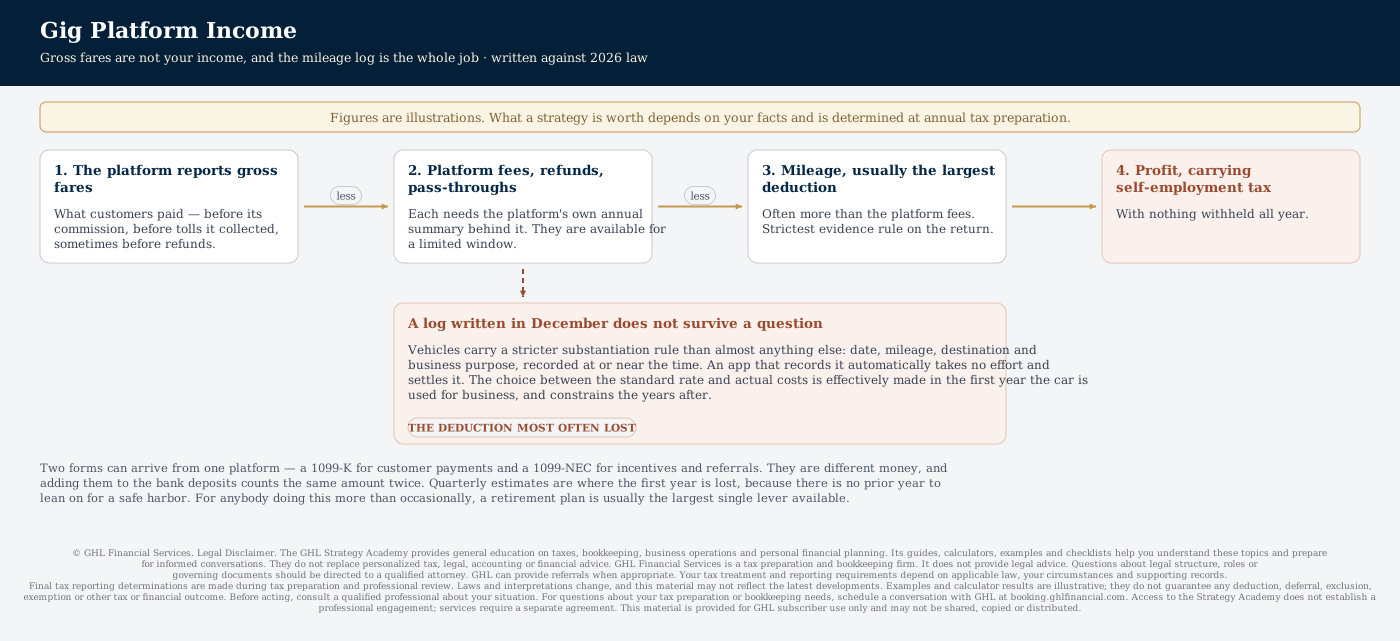
The reconciliation is the work. A platform reports the gross amount passengers or customers paid, before its own commission, before tolls it collected and passed on, and sometimes before refunds. That figure has never matched what arrived in the bank and is not supposed to.
Your income is what the books say: gross as reported, less the platform's fees, less refunds, less anything collected and passed on. Every subtraction needs the platform's own annual summary behind it, and those are usually available for a limited window.
Against that sits mileage, which for most drivers is the largest deduction on the return by a distance — often larger than the platform fees. It is also the one with the strictest evidence rule, and a log written in December from memory is the version that does not survive a question.
| Reported on the 1099-K, gross | $52,000 |
|---|---|
| Platform commission and service fees | $14,000 |
| Tolls collected and passed on | $1,200 |
| Incentives, on a separate 1099-NEC | $2,400 |
| Business miles at the standard rate | the largest single deduction, usually |
| Self-employment tax | on the profit, with nothing withheld through the year |
Illustrative amounts for one driver. The standard mileage rate is set each year and GHL applies the figure for yours. Every subtraction needs the platform's own annual summary behind it, and the mileage needs a contemporaneous log.
How it works
This is self-employment income. It goes on a business schedule with its own expenses, and it carries self-employment tax on the profit as well as income tax.
Nothing is withheld, so the tax is paid through quarterly estimates. The first year is where this bites, because there is no prior year to base a safe harbor on.
Platforms report differently and often twice. Passenger or customer payments processed by the platform come on a 1099-K; incentives, bonuses and referral payments come on a 1099-NEC. They are different money and both are income.
The platform's commission is a business expense. So are tolls, parking, car washes, the phone mount, the insulated bags, and the business share of the phone bill.
Mileage can be claimed at the standard rate per business mile, or by taking the business share of actual running costs including depreciation. The choice is effectively made in the first year and constrains later years.
Miles count from the point the business day begins. Once logged on and available, driving between jobs is business mileage; the personal trip to the shops in the middle of it is not.
The substantiation rule for vehicles is stricter than for most expenses: date, mileage, destination and business purpose, recorded at or near the time. An app that records it automatically is the practical answer.
The qualified business income deduction generally applies to the profit, which is worth having and is computed after everything else.
A retirement plan is available on this income — a solo plan or a simplified one — and is often the largest single lever a full-time driver has.
Health insurance premiums can be deducted above the line against the profit, which matters for anybody buying their own cover.
What you would do
- Download the platform's annual summary for every year and every platform. They are the evidence for every subtraction and they do not stay available forever.
- Use a mileage app from the first day rather than reconstructing later.
- Keep business and personal driving separate in the log, including the personal trips in the middle of a shift.
- Set up quarterly estimates in the first year, before the first deadline rather than after.
- Decide mileage rate against actual costs deliberately in the first year — it is harder to change afterwards.
- If this is more than occasional, ask about a retirement plan. It is usually the biggest thing available.
Usually a week or two — mostly things you can start yourself.
What GHL needs from you
- Every 1099-K and 1099-NEC, from every platform.
- The platform's annual summary showing fees, tolls and refunds.
- The mileage log, total and business miles for the year.
- Vehicle details: when it was placed in business use, and the method chosen.
- Other costs: phone, supplies, parking, tolls not already netted.
What usually goes wrong
- Two forms can arrive from one platform — a 1099-K for passenger payments and a 1099-NEC for incentives and referrals. Adding them to the bank deposits counts the same money twice.
- The 1099-K reports gross fares including the platform's commission. That commission is a deduction, not money you never had, and both sides have to appear.
- Nothing is withheld from any of it. The first year usually ends with a bill and a penalty for not having paid through the year.
- Mileage is normally the largest deduction and the one with the strictest substantiation rule. Without a log kept as you go, it is the first thing disallowed.
- The choice between the standard mileage rate and actual costs is made in the first year the car is used for business and is not freely reversible afterwards.
- Using actual costs means depreciating the car, and depreciation comes back when it is sold or taken out of business use.
- Working for several platforms means several reconciliations, and the totals do not add up to the bank statement on any of them.
Common questions
My 1099-K says $52,000 and I received $36,000.
Both are right. What it needs is a reconciliation rather than a correction.
Can I just estimate my miles?
It is the deduction with the strictest evidence rule, and an estimate made at the year end is the first thing to go. An app recording it as you drive takes no effort and settles it.
Read next
Keeping it alive
A position is not finished when it is set up. This is what it needs each year to still be there when it matters.
- Confirm it still applies — circumstances change more often than the law does.
- Put the date in the calendar. This one closes at the year end and cannot be added at tax preparation.
- Ask GHL what changed for 2027. Figures move every year and rules move most years.