
When it matters: The deduction begins in the month the business actively begins, and the election is made by taking it on a return filed on time for that year.
Does this fit you?
- You have started a business in the last year, or are about to.
- You spent months looking at an opportunity before committing.
- You formed a company and have legal and filing fees to account for.
- You are deciding whether to open now or in January, where the choice is still open.
What it could be worth
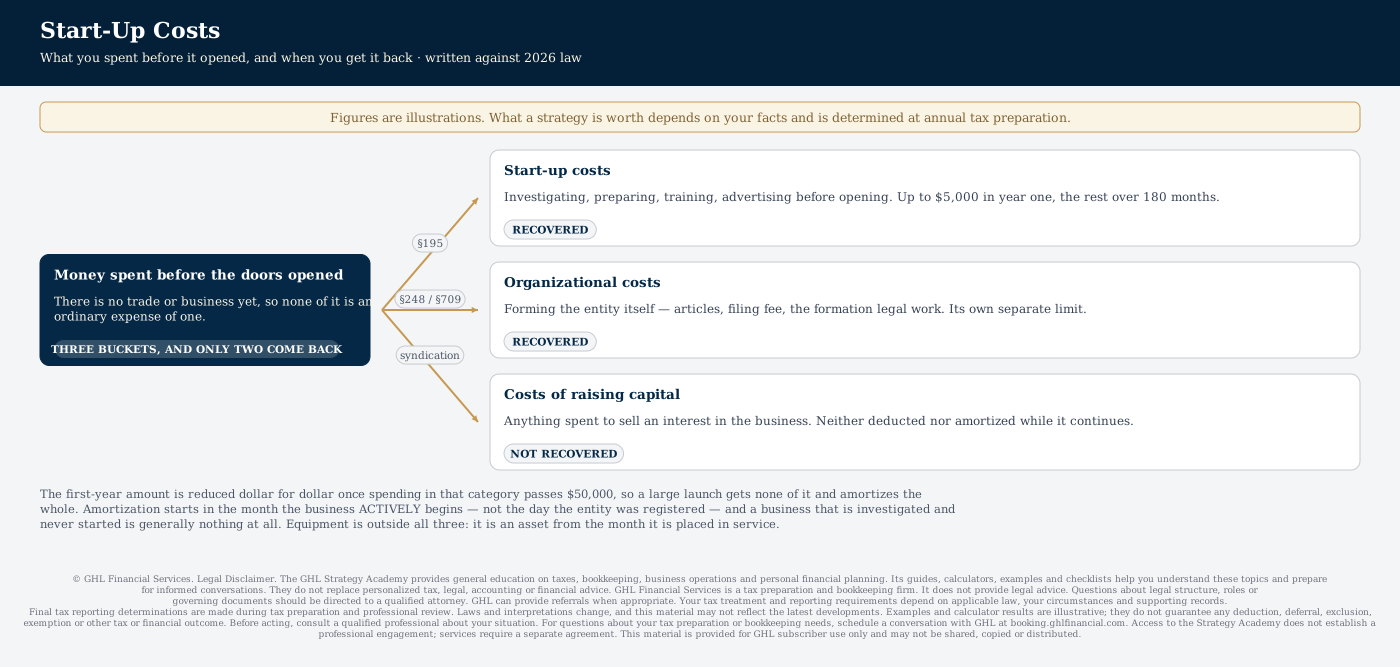
Almost everything spent getting a business ready falls into one of three buckets, and only one of them behaves like an ordinary expense. Getting them apart in the first year is what decides when the money comes back.
Start-up costs are what you spent investigating and preparing before the doors opened: market research, travel to look at sites, consultants, training staff, advertising that ran before opening. Organizational costs are the legal and filing costs of forming the entity itself. Costs of raising money — a private placement, an offering document, commissions to sell an interest — are a third thing and are never recovered.
Up to a set amount of each of the first two can be deducted in the year the business begins. Above a spending threshold that amount reduces dollar for dollar and eventually disappears entirely. Everything not deducted is written off rateably over fifteen years from the month the business actually starts.
| Deductible in the first year, each category | up to $5,000 |
|---|---|
| Reduced dollar for dollar once spending passes | $50,000 |
| So it is gone entirely at | $55,000 |
| Everything not deducted | spread rateably over 180 months |
| Starting from | the month the business actively begins |
| Costs of raising capital | neither deducted nor amortized |
The statutory limits in §195 and §248, which have not moved for many years and are not indexed. The amount available is per category, so start-up and organizational costs are tested separately. GHL confirms the date the business began and the split at preparation.
How it works
The test for an ordinary expense is that the business is already carrying on. Before that point there is no trade or business to have an expense of, which is what §195 exists to deal with.
Start-up costs are the ones that would have been deductible if the business had already been running — investigating, preparing, training, advertising ahead of opening.
Organizational costs are the ones of creating the entity: drafting the articles, the state filing fee, the organizational meeting, the legal fee for the formation itself.
Syndication costs — anything spent to sell an interest in the business — are neither. They stay on the balance sheet and are not recovered while the business continues.
The first-year amount for each category is reduced dollar for dollar by total spending in that category above the threshold, so a business with a large launch gets none of it and amortizes the lot.
The remainder is amortized rateably over 180 months, starting with the month the business actively begins. A business that starts in October gets three months of it in the first year.
The election is deemed made by claiming the deduction on a return filed on time for the year the business began. There is no separate form to remember and no second chance once the position is set.
Where the business is later disposed of or abandoned before the fifteen years are up, what has not been written off can generally be taken then.
Equipment, vehicles and improvements are not in any of this. They are assets, with their own first-year treatment, from the month they are placed in service.
What you would do
- Keep a separate record of everything spent before opening, with dates. The date is what decides the bucket, and it cannot be reconstructed convincingly later.
- Note the day the business actually began — first sale, doors open, first client served — and what evidence supports it.
- Separate the formation legal fees from the rest of the legal spend. They are different categories with separate limits.
- Keep anything spent raising money entirely apart from both.
- If you are close to opening and near the year end, ask whether the month it begins changes the answer. Sometimes it does.
- Open a business bank account before spending anything, so the record exists without being untangled later.
Allow one to two months. Some of it depends on other people.
What GHL needs from you
- A dated schedule of pre-opening spending, by category.
- Formation documents and the invoices for them.
- Evidence of the date the business began operating.
- Anything spent raising capital, listed separately.
- Invoices for equipment or improvements, with the date each was placed in service.
What usually goes wrong
- Costs before the business begins are not ordinary expenses of it. Deducting them as though they were is the common error and it is visible on the face of the return.
- The first-year allowance disappears as total start-up spending rises — it is reduced dollar for dollar above a threshold, so a large launch gets none of it.
- What is left is spread over fifteen years, which is a long time to recover money spent in a single year.
- 'Begins' means the business is open and able to do what it was set up to do — not the day the company was registered and not the day the idea started.
- Costs of raising capital are never deductible and never amortized. They are not organizational costs however they are described in the accounts.
- A business that is investigated and never started is usually nothing at all. The costs do not become a deduction just because the money was genuinely spent.
- Equipment bought before opening is not a start-up cost. It is an asset, and its own rules apply from the month it is placed in service.
Common questions
I spent two years looking before I bought anything. Is that deductible?
If a business did begin, those investigation costs are start-up costs and go through this treatment. If none ever began, they are generally not deductible at all, which is the harder answer and the reason the decision point matters.
When does a business 'begin'?
When it is open and able to do what it was set up to do. Not the registration date, and not the first profitable month. It is a facts question and worth documenting at the time.
I formed an LLC last year and started trading this year. Which year?
The deduction starts in the year the business began operating, not the year the entity was formed. The formation costs wait for it too.
Can I choose to amortize all of it instead of taking the first amount?
Yes, and occasionally it is better — in a first year with no income the deduction can be worth more spread forward. It is a decision to make with GHL before the first return goes out, because it sets the treatment.
Read next
Keeping it alive
A position is not finished when it is set up. This is what it needs each year to still be there when it matters.
- Confirm it still applies — circumstances change more often than the law does.
- Check the documents still say what they said — an agreement that has drifted from practice is the usual failure.
- Ask GHL what changed for 2027. Figures move every year and rules move most years.